Why Your Customer Type Changes Everything

Sam McKinney
Founder & Lead Strategist • January 3, 2026
Overview
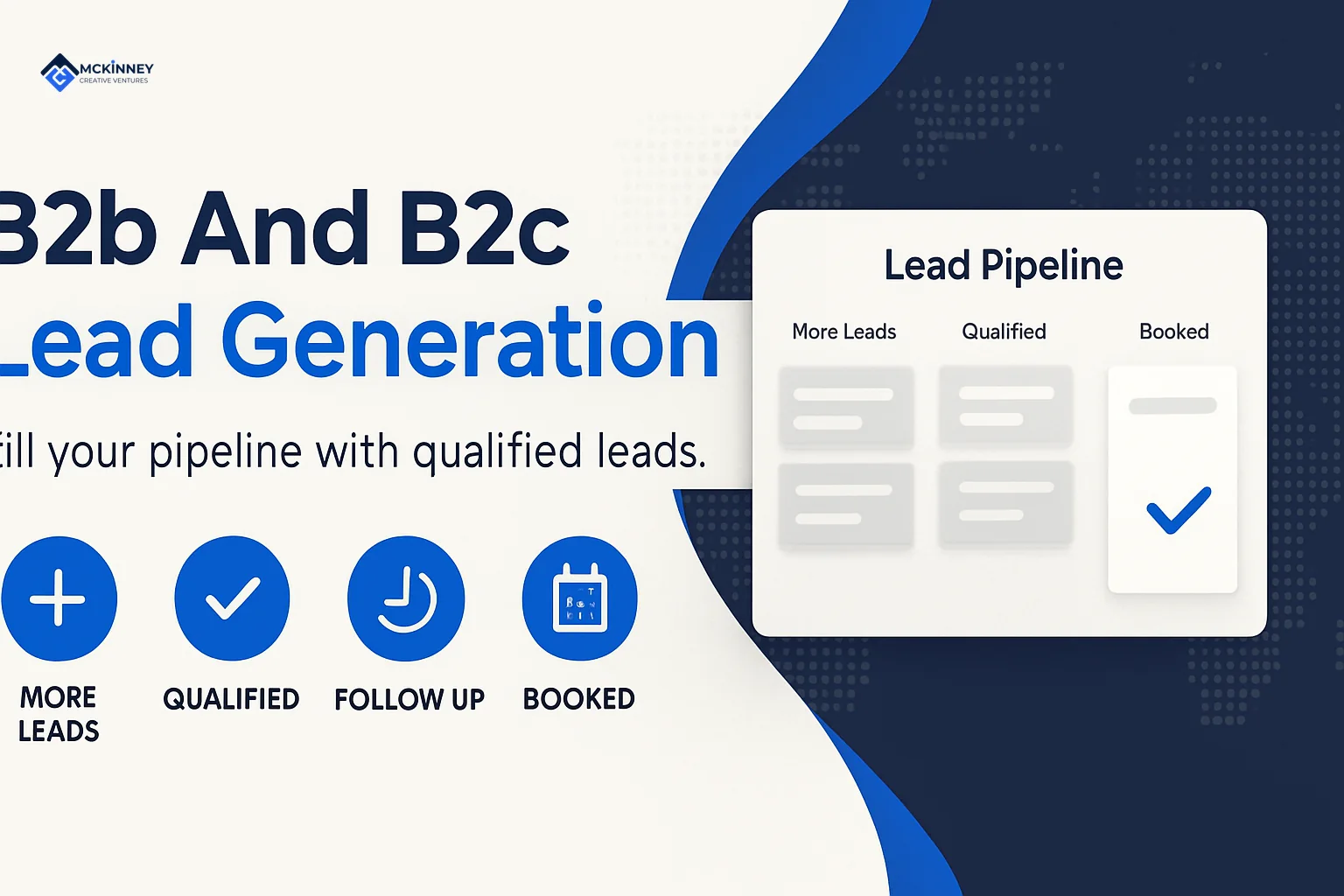
B2B and B2C lead generation are fundamentally different approaches to attracting and converting customers. Here's what you need to know:
B2B and B2C lead generation are fundamentally different approaches to attracting and converting customers. Here's what you need to know:
Key Differences at a Glance:
- B2B (Business-to-Business): Targets companies and decision-makers, involves longer sales cycles (often months), focuses on logic and ROI, requires relationship building, and typically engages multiple stakeholders
- B2C (Business-to-Consumer): Targets individual consumers, features shorter sales cycles (often days or hours), emphasizes emotion and immediate value, relies on brand perception, and involves single decision-makers
Primary Strategic Differences:
| Aspect | B2B Lead Generation | B2C Lead Generation |
|---|---|---|
| Content | White papers, case studies, webinars | Social media posts, videos, contests |
| Channels | LinkedIn, email, industry events | Facebook, Instagram, TikTok |
| Focus | Long-term value and ROI | Price and immediate benefits |
| Sales Cycle | Weeks to months | Minutes to days |
The reality is stark: 91% of marketers say lead generation is their most important goal, yet many businesses struggle because they apply the wrong approach to their customer type.
If you sell to other businesses, you're navigating a world where buyers form committees of 6 to 10 people before making a purchase decision. If you sell to individual consumers, you're competing for attention in a market where emotion and timing matter more than logic.
Getting this wrong wastes budget and frustrates your team. Getting it right creates a predictable system for growth.
I'm Sam McKinney, founder of McKinney Creative Ventures, and I've spent over 15 years helping businesses build smarter marketing systems across both B2B and B2C lead generation environments. My background includes international business development and marketing automation, which taught me that the fundamentals of lead generation change dramatically based on who you're trying to reach.
The Core Differences: Audience, Motive, and Timeline
This section explains the fundamental distinctions that shape your entire approach. Understanding who you are talking to, why they buy, and how long it takes them to decide is the first step in building a successful lead generation system.
When we talk about B2B and B2C lead generation, the most fundamental difference lies in who we are trying to reach. This isn't just a minor detail; it's the bedrock upon which all your marketing strategies should be built. Our approach to identifying, attracting, and converting leads must adapt to the unique characteristics of our target audience, their motivations, and the typical timeline for their purchasing decisions.
For a small business in the East Metro or St. Croix Valley, whether you're selling professional services to other local businesses or products directly to individual consumers, this distinction is critical. It determines everything from the language you use in your marketing to the platforms you choose for advertising.
The B2B Buyer: A Calculated, Committee-Based Decision
Imagine a business in Woodbury, MN, looking to invest in new software for their operations. This isn't a spur-of-the-moment decision. It’s a calculated, logic-driven purchase that directly impacts their bottom line and operational efficiency. The B2B buyer is focused on return on investment (ROI), long-term value, and how your product or service can solve their specific business problems. They're not buying for personal gratification; they're buying for strategic advantage.
One of the most significant aspects of B2B purchasing is the involvement of multiple stakeholders. It's rarely a single person making the call. Research shows that B2B buyers are likely to discuss offers with a buying committee of up to 6 to 10 members before sealing a deal. This means your B2B lead generation efforts must appeal to a diverse group of individuals within an organization, each with their own priorities and concerns. We need to provide robust, precise information that addresses the needs of IT, finance, operations, and leadership.
The sales cycle in B2B is considerably longer, often spanning weeks or even months. This is because the stakes are higher, the investment is larger, and internal approvals are required. It takes an average of 12 points of contact to turn a prospect into a sales-qualified lead (SQL). This extended timeline necessitates a focus on relationship building and trust. We need to nurture these leads, providing value and demonstrating expertise consistently, rather than pushing for a quick sale. Our strategies must be designed to guide these committees through their decision-making process, often before sales even gets involved, as more than 70% of the buyer’s journey happens digitally.
The B2C Buyer: An Emotional, Individual Choice
Now, consider a consumer in Stillwater, MN, looking for a new product for their home. This purchase is often driven by immediate need, desire, or emotion. It could be influenced by trends, personal preferences, or even a sudden impulse. The B2C buyer typically makes decisions individually, or with a much smaller circle of influence, and often seeks instant gratification.
For a B2C business, brand perception and social proof play a massive role. Consumers want to know that others have had positive experiences. They are often more price-sensitive and responsive to promotions, discounts, and attractive advertising. Their purchasing decisions are less about long-term ROI and more about how a product or service makes them feel, or how it addresses an immediate personal want or need.
The sales cycle for B2C is much shorter, usually taking minutes to days. Think about someone browsing online and making a purchase within a few clicks. This means our B2C lead generation strategies need to capture attention quickly, create desire, and facilitate an easy, seamless path to purchase. We're looking for quick conversions and building brand loyalty through positive experiences and strong brand identity.
Key Strategic Differences in B2B and B2C Lead Generation
Once you understand the core differences, you can build a strategy that aligns with your specific customer. This is about choosing the right tools and messages to connect with your audience effectively, rather than just casting a wide net and hoping for the best.
Knowing who you're talking to is only half the battle. The other half is knowing how to talk to them and where to find them. For businesses in the Greater Twin Cities Metro and Western Wisconsin, this means we tailor our strategies to match the distinct behaviors and expectations of our B2B and B2C audiences. A cookie-cutter approach simply won't yield the results you need.
Tailoring Content for B2B and B2C Lead Generation
Content is king, but the crown looks very different depending on whether you're serving a business or a consumer.
For B2B lead generation, our content needs to be highly informative, authoritative, and focused on solving complex problems. Think of it as providing educational resources that help decision-makers understand their challenges and how your solution offers superior value. We focus on demonstrating our expertise and building credibility.
| B2B Content Examples | B2C Content Examples |
|---|---|
| White papers | Blog posts |
| Case studies | Social media updates |
| Webinars | Contests |
| In-depth guides | User-generated content |
| Industry reports | Influencer marketing |
| Product demonstrations | Short videos |
On the other hand, B2C lead generation thrives on engaging, entertaining, and visually appealing content that evokes emotion and creates desire. We're aiming for content that resonates personally, makes an immediate connection, and often inspires a quicker purchase decision. This is where creativity often takes center stage.
For a B2B service provider in Minneapolis, we might develop a detailed white paper on optimizing local supply chains, or host a webinar demonstrating the ROI of a new software solution. These pieces are designed to educate a buying committee and build trust over time. In contrast, a B2C retail business in Hudson, WI, might use vibrant Instagram posts showcasing new products, run a social media contest, or partner with a local influencer to generate excitement and drive immediate sales. The goals are different, and so is the content.
Choosing Channels for B2B and B2C Lead Generation
The platforms where your audience spends their time dictate your channel strategy. We wouldn't try to sell complex enterprise software on TikTok, just as we wouldn't exclusively promote impulse fashion buys on LinkedIn.
For B2B lead generation, LinkedIn is undeniably the powerhouse. It's where professionals connect, share industry insights, and conduct business. LinkedIn is the most popular channel for B2B marketing, and 40% of visitors engage with a page organically each week. It's an ideal platform for sharing high-quality, informative content that positions your brand as an industry authority. We can leverage LinkedIn for organic posts, paid ads, and even direct outreach to decision-makers. Given that most B2B buyers use corporate email, which isn't associated with their Facebook or Instagram, LinkedIn provides a more direct line to professional contacts.
For B2C lead generation, social media platforms like Facebook, Instagram, and TikTok are vital. Facebook alone has almost 3 billion monthly users and offers robust data-capturing and analysis tools that can make lead generation seamless. These platforms are perfect for broad reach, visual storytelling, and direct engagement with individual consumers. We also use email marketing for both, but the messaging and frequency will differ, with B2B emails often being more formal and information-rich, and B2C emails more promotional and visually driven.
SEO and local search are crucial for both, but with different nuances. For a B2B service, SEO might focus on technical keywords and thought leadership, while for a B2C business like a local restaurant in Roseville, MN, local SEO is paramount. We ensure businesses are optimized for local keywords, with strong Google My Business profiles and accurate listings across directories, to attract customers searching for services "near me."
Pricing, Value, and the Path to Purchase
How pricing and perceived value influence purchasing decisions varies significantly between B2B and B2C markets, and our B2B and B2C lead generation strategies must reflect this.
In B2B lead generation, the focus is squarely on return on investment (ROI) and long-term value. Businesses aren't just looking at the price tag; they're evaluating how your solution will save them money, increase efficiency, or drive revenue. Our strategies emphasize demonstrating the tangible benefits, the cost savings, and the strategic advantages your offering provides. We might use case studies, ROI calculators, or detailed proposals to communicate this value. The buying process often involves extensive research and justification, with multiple stakeholders needing to be convinced of the value proposition.
Conversely, in B2C lead generation, consumers are often more price-sensitive and driven by immediate gratification. While quality and brand reputation matter, a competitive price or an attractive promotion can be a powerful motivator for a quick purchase. Our strategies here might include clear pricing, special offers, limited-time discounts, and transparent comparisons. The value proposition for a B2C customer in Eagan, MN, might be convenience, enjoyment, or solving an immediate personal problem, often with less emphasis on a complex financial justification.
The sales process itself is also different. B2B often involves a complex sales funnel with multiple touchpoints and a consultative approach, whereas B2C typically aims for a more direct and streamlined path to purchase.
Shared Foundations: What Works for Both
Despite the differences, some principles of good marketing apply to everyone. Building a strong foundation with these shared strategies ensures you are creating a sustainable system for growth, no matter who your customer is.
While the tactics and channels may diverge, the underlying principles of effective B2B and B2C lead generation share common ground. At McKinney Creative Ventures, we believe in building robust, sustainable systems that serve businesses in the East Metro and St. Croix Valley, regardless of their target market. These foundational elements are crucial for long-term success and provide the consistent support our clients value.
The Power of Organic Strategy and SEO
Organic lead generation is a game-changer for both B2B and B2C businesses. It focuses on attracting potential customers without relying on paid advertising, building a sustainable, long-term presence. This requires patience and consistent effort, but it yields higher-quality leads and better customer loyalty.
Content marketing is at the heart of organic strategy. For a B2B firm in St. Paul, MN, publishing timely, relevant blog content, offering online courses, and detailed e-books builds authority and attracts decision-makers. For a B2C service in River Falls, WI, engaging blog posts about local events or tips relevant to their offering can draw in individual consumers. By consistently sharing valuable information, we position your brand as an industry expert.
Search Engine Optimization (SEO) is the engine that drives organic traffic. We optimize websites for search engines, ensuring your business appears prominently when potential customers are searching for your products or services. This includes technical SEO, on-page optimization, and building quality backlinks. For local businesses, Local SEO is paramount. We optimize Google My Business profiles and other local directories, ensuring that when someone in Woodbury, MN, searches for a "marketing agency," McKinney Creative Ventures is easily found. This helps drive organic traffic from nearby customers, which is incredibly valuable for service-based businesses.
Measuring What Matters: Data and Analytics
If we're going to put in the effort, we need to know if it's working. Data and analytics are indispensable for both B2B and B2C lead generation. They allow us to measure the success of our efforts, understand what's performing well, and identify areas for improvement.
We focus on Key Performance Indicators (KPIs) such as conversion rates, lead volume, lead quality, and Cost Per Lead (CPL). Tools like Google Analytics provide invaluable data on website traffic, user behavior, and conversion funnels. For B2B, we might track how many white paper downloads convert to sales-qualified leads. For B2C, we'd look at how many social media clicks result in e-commerce purchases.
The goal is to use this data to refine our strategy continuously. By analyzing what's working and what isn't, we can allocate resources more effectively, optimize our campaigns, and improve our overall ROI. This data-driven approach is how we ensure your marketing budget in the East Metro and St. Croix Valley is spent wisely, pushing budget towards whatever is generating the conversions and leads most efficiently.
Nurturing Leads from Interest to Action
Generating a lead is just the first step. The journey from initial interest to a paying customer often requires careful cultivation, especially in the B2B space. Lead nurturing is the process of building relationships with prospects, providing them with valuable information, and guiding them through their buyer's journey.
Marketing automation platforms are essential tools for effective lead nurturing. They allow us to send out personalized email sequences, deliver targeted content, and engage with leads at the right time. For B2B, this might involve a series of emails offering case studies or invitations to webinars, slowly building trust and demonstrating expertise. For B2C, it could be automated emails with product recommendations or exclusive discounts.
The research clearly shows the power of this approach: Companies that successfully leverage lead nurturing generate 50% more sales-ready leads. This means that instead of pushing for a sale too soon and alienating potential clients, we focus on providing as much value as possible. This builds trust and credibility before the sale, which is crucial for both B2B (where relationships are paramount) and B2C (where brand loyalty can be a significant differentiator). Our fractional marketing team can help implement these systems, ensuring your leads in Cottage Grove, MN, or New Richmond, WI, are nurtured effectively.
Extended Recap & Conclusion
Whether you serve businesses or individual consumers, a thoughtful B2B and B2C lead generation strategy is essential for sustainable growth. It is not about chasing every possible lead, but about building a predictable system that attracts the right customers. By understanding these key differences and shared principles, you can create a marketing engine that works for your specific business goals.
The world of lead generation is complex, but by understanding the core differences between B2B and B2C, and by implementing robust, data-driven strategies, we can create a powerful marketing engine for your business. It's about being strategic, patient, and consistent.
At McKinney Creative Ventures, we act as your fractional marketing team, bringing strategic planning, systems, and automation to your business in the East Metro and St. Croix Valley. We help you navigate these complexities, ensuring your B2B and B2C lead generation efforts are not just busywork, but a predictable path to sustainable growth. We're here to build those systems with you, providing the expertise and consistent support you need without the overhead of internal staff.
Contact us to build your marketing strategy: Contact us to build your marketing strategy
If you want a connected marketing system that brings this together for your business, we can help. Book a free strategy call and we will map out a plan built around your goals. No pitch, just a clear next step.
Written by
Sam McKinney
Founder & Lead Strategist, McKinney Creative Ventures
Sam McKinney helps local service businesses across the Twin Cities East Metro and St. Croix Valley grow through connected marketing systems. Websites, SEO, CRM, and AI automation built to work together instead of in isolation.
More about MCVRelated Articles
Storytelling, Skate Shops, and the Business of Video: Henry Schneider of Open Window Productions
Henry Schneider builds video for East Metro businesses at Open Window Productions and co-owns a North St. Paul skate shop. On mistakes as tuition, why story beats gear, and when authentic beats polished.
Getting Your Stillwater Business Found in Local Search
Stillwater is a historic river town with tourist traffic and a residential service base. Here is the local search system that gets your business found by both, from Google Business Profile to reviews to St. Croix Valley content.
Ready to Grow Your Business?
Book a strategy call to discuss how we can implement these systems and strategies to help your business scale.
Book a Strategy Call