Why Content and SEO Work Better Together

Sam McKinney
Founder & Lead Strategist • January 14, 2026
Overview
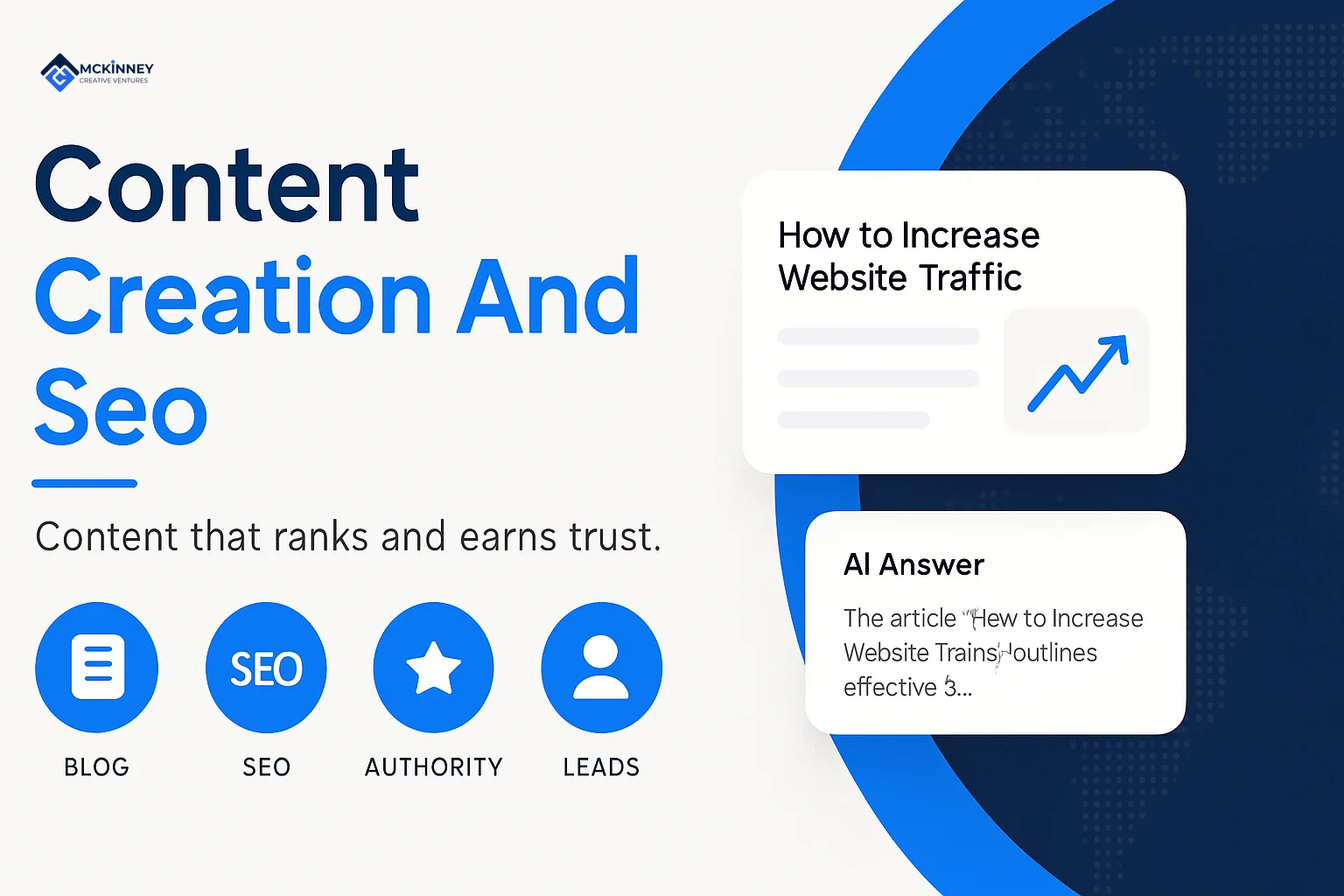
Content creation and SEO are often treated as separate tasks, but they work best as a unified system. Here's how they connect:
Content creation and SEO are often treated as separate tasks, but they work best as a unified system. Here's how they connect:
- Content without SEO sits unseen, no matter how good it is
- SEO without content has nothing to optimize or rank
- Together, they attract the right visitors and turn them into customers
- The goal is sustainable growth through visibility and trust
This guide shows you how to combine content creation and SEO into one practical strategy that drives real business results.
Most small business owners know they need a website. Many know they need content. Some understand SEO matters. But few realize these pieces only work when they fit together.
Content creation means producing information that helps your audience. SEO means making that information findable in search engines like Google. When you separate them, you waste time and money. When you combine them, you build a system that attracts customers while you focus on running your business.
The research backs this up. Content marketing generates 3x more leads than traditional marketing and costs 62% less. Companies that blog consistently get 67% more leads than those that don't. But these results only happen when content is created with SEO in mind from the start.
I'm Sam McKinney, and over 15 years I've helped businesses build marketing systems that connect content creation and SEO into one efficient process. My work focuses on turning scattered digital efforts into reliable lead generation engines for service-based businesses.
The Foundation: What is SEO Content and Why It Matters
At its core, SEO content is any information we create with the explicit goal of attracting search engine traffic. "SEO" refers to search engine optimization, which is the process of optimizing a website so people can easily find it via search engines like Google. "Content" is any information that lives on the web and can be consumed, from text to videos to images. When we put these two concepts together, we are talking about creating content that is strategically designed to be found by your ideal customers in places like the East Metro Twin Cities, MN, or the St. Croix Valley, WI.
Why is this so important? Because even the most compelling design and the most interactive experience are meaningless if your audience cannot find them. SEO efforts with good content can lead to a 10x increase in organic traffic. This isn't just about getting eyes on your site; it's about building trust and establishing your authority as an expert in your field. Google and other search engines are constantly reading your website, and the words you use directly determine whether your site will rank.
Understanding Search Intent
One of the most crucial aspects of effective SEO content is understanding "search intent." This refers to the underlying reason a user types a query into a search engine. There are four main types of search intent:
- Informational Intent: The user is looking for an answer to a question or general information (e.g., "how to unclog a sink," "best hiking trails near Stillwater, MN").
- Commercial Intent: The user is researching a product or service with the intent to buy in the near future (e.g., "best personal injury lawyer Minneapolis," "reviews for roofing companies Woodbury, MN").
- Transactional Intent: The user is ready to make a purchase (e.g., "buy new furnace Maplewood MN," "schedule dog grooming Hudson WI").
- Navigational Intent: The user is trying to find a specific website or page (e.g., "McKinney Creative Ventures website," "Google Search Central blog").
When we create content, we must match it to the appropriate search intent. If someone is searching for "how to fix a leaky faucet," they likely want an informational guide, not a sales page for new plumbing services. If we create content that directly addresses their intent, we increase the likelihood of ranking, providing value, and ultimately satisfying the user. This user satisfaction is key, as search engines prioritize content that people find helpful and engaging.
The Business Case for Quality Content
The numbers don't lie: prioritizing quality content with a strong SEO foundation drives tangible business benefits.
Content marketing costs 62% less than traditional marketing and generates about three times as many leads. This means a more efficient use of your marketing budget, a critical factor for small businesses in our local area. Businesses that prioritize blogging efforts are 13 times more likely to see positive ROI. For local businesses in areas like Cottage Grove, MN, or River Falls, WI, this translates to more leads, more customers, and ultimately, more growth. SEO is a key component of content marketing, with 70% of marketers saying SEO is their most effective strategy for lead generation. It's about attracting the right people who are actively looking for the products or services you offer.
Building Your Integrated Content Creation and SEO Strategy
"Separating content marketing from SEO is like trying to sail a boat without wind," says Sam Yadegar, co-founder and CEO of HawkSEM. This sentiment perfectly captures our approach. We believe in building marketing systems that integrate content creation and SEO from the ground up. This isn't about one-off tactics; it's about a long-term, sustainable strategy that yields consistent results. For our clients in the Greater Twin Cities Metro and St. Croix Valley, this means a reliable flow of potential customers finding their business.
Step 1: Master Keyword Research for Content Ideas
Keyword research is the bedrock of any successful SEO content strategy. If you want to generate traffic through search, it’s best to do keyword research before you start writing. This ensures we focus on topics people are already searching for.
Our process for keyword research involves several steps:
- Start with your business mission: What problems do you solve? What services do you offer in places like Roseville, MN, or New Richmond, WI?
- Brainstorm a broad list of terms: Think about how your customers describe their needs. Often, clients use internal jargon while customers use entirely different terms. We need to speak their language.
- Differentiate between head and long-tail keywords:
- Head keywords are short, broad terms (e.g., "plumber Minneapolis"). They have high search volume but are very competitive.
- Long-tail keywords are longer, more specific phrases (e.g., "emergency plumber for leaky pipes St. Paul MN"). They have lower search volume but often indicate stronger intent and are easier to rank for. Using long-tail keywords naturally helps us capture highly qualified leads.
- Analyze search volume and keyword difficulty: Tools help us understand how many people search for a term and how hard it will be to rank for it.
- Understand search intent: As discussed, this is critical. A keyword isn't necessarily a topic; we need to come up with an original idea for a blog post or service page that fulfills that intent.
Here are some free starting points for your keyword research:
- Google Autocomplete: As you type into Google, it suggests popular searches.
- "People also ask" section: Found in search results, this reveals related questions users have.
- Related searches: At the bottom of Google's results, you'll find other relevant queries.
- Competitor analysis: See what keywords your competitors are ranking for.
Step 2: Plan Your Site Structure and Content
A well-structured site is like a well-organized store; customers can easily find what they need, and search engines can understand what's most important. A well-structured site with quality content is more likely to appear in Google's search results.
- Pyramid structure: We envision your website like a pyramid. Your homepage is at the top, followed by main service categories, then individual service pages or blog posts. This hierarchy helps Google understand your site's content and its relative importance.
- Cornerstone content: These are the most important pieces of content on your site, the ones you are most proud of and that best fit your business's mission. For a business in Maple Grove, MN, this might be a comprehensive guide to local home improvement services. We want these pages to rank highest, so we give them extra attention and internal links.
- Topic clusters: Instead of creating many separate articles on similar topics, we create a central "pillar page" that broadly covers a topic (e.g., "Residential HVAC Services Stillwater, MN") and then link to more detailed "cluster content" pieces (e.g., "Furnace Repair Costs Stillwater, MN," "AC Maintenance Tips Stillwater, MN"). This helps prevent content cannibalization, where your own pages compete against each other.
- Internal linking: This is crucial. We link from less important pages to our cornerstone content, spreading "link juice" and indicating to search engines which pages are most authoritative. It also helps users navigate your site easily.
Step 3: Write for People, Then Optimize for Google
This is where the art of copywriting meets the science of SEO. We always write for people first. Our goal is to create content that is genuinely helpful, engaging, and easy to understand for your customers in places like Landfall, MN, or Prescott, WI.
- Copywriting for readers: Only 16 percent of people read web copy word-for-word, so we need to capture attention quickly. We focus on benefits over features, using storytelling to create an emotional connection. We want to answer "why should I care?" for your readers.
- Readability: We prioritize clear, concise, and plain language. Most people prefer reading plain English, even experts. This means:
- Short paragraphs: Ideally, no more than three sentences per paragraph.
- Using subheadings: These break up text, guide readers, and help them scan for information.
- Bullet points and spacing: These make content scannable and easier to digest.
- On-page SEO: Once the content is compelling for humans, we optimize it for search engines.
- Title tags and meta descriptions: These are critical. The title tag is the clickable headline in search results, and the meta description is the short summary below it. We ensure they are unique, descriptive, and include our target keywords to entice clicks. Meta descriptions briefly sketch out the content and quality of a web page.
- Header tags (H1, H2, H3): Your H1 should contain your primary keyword. H2s and H3s structure your content and can include secondary or long-tail keywords. This helps Google understand the topic hierarchy.
- Alt text: Images need descriptive alt text. This helps search engines understand what the image is about and improves accessibility for visually impaired users. We might use "HVAC technician repairing furnace in Maplewood MN" as alt text for a relevant image.
- Avoiding keyword stuffing: This is a common pitfall. We never "stuff" keywords into content in an unnatural way. Google's algorithms are sophisticated and can detect this, which is against Google’s guidelines and will hurt your rankings. We focus on natural language, using synonyms and related terms.
Putting Your Content to Work: Types, Promotion, and Measurement
Your content is a valuable asset, and we work to make sure it earns its keep. This means not just creating it, but strategically distributing it and carefully analyzing its performance.
Choosing the Right Content Formats
Different goals call for different types of content. Here's a look at some common formats and when to use them:
- Blog posts: One of the easiest ways to create a regular stream of effective SEO content. Blogs are excellent for informational intent, answering common questions, and building authority. For a local landscaping business, blog posts on "Best drought-resistant plants for Twin Cities gardens" or "Fall cleanup tips for Lakeland, MN homeowners" can attract significant traffic.
- Product pages: These are the bread and butter for any retail or e-commerce business. A good product page can serve as both SEO content and a PPC landing page, providing detailed information and encouraging transactions.
- Guides/How-to articles: Comprehensive, in-depth pieces that address complex topics. These are fantastic for establishing expertise and can be structured as multi-page resources or long-form articles. For a financial advisor, a "Guide to Retirement Planning in St. Croix Valley" would be highly valuable.
- Case studies: Powerful for demonstrating your expertise and showcasing results. These are particularly effective for service-based businesses in areas like Afton, MN, or Bayport, MN, looking to build trust.
- Videos: Can be easier to rank for competitive keywords. Videos are excellent for "how-to" content, product demonstrations, or testimonials. A plumber demonstrating "how to clear a clogged drain" will often outperform an article for that search query. Remember to include text transcripts for SEO.
We carefully select the format that best suits the search intent and your business goals.
Ensuring Your Content is Findable
Creating great content is only half the battle; it needs to be findable. Our approach includes both direct promotion and ensuring search engines can effectively crawl and index your pages.
- Content promotion: We leverage various channels to get your content in front of the right audience. This includes:
- Social media: Sharing new blog posts, videos, or guides on platforms where your audience spends their time.
- Email newsletters: Distributing valuable content directly to your subscribers, nurturing leads and driving repeat traffic.
- Community engagement: Participating in local online forums or groups (where appropriate) to share helpful resources. Word of mouth is one of the most effective and lasting ways to promote a site.
- Making sure Google can find your content:
- Submitting sitemaps: An XML sitemap lists all the important pages on your site, helping Google find them.
- Technical SEO checks: We ensure Google can access the same resources (like CSS and JavaScript) as a user's browser. If important components are hidden, Google might not fully understand your page.
- Using the URL Inspection Tool in Search Console: This tool lets us check how Google sees your page and troubleshoot any indexing issues.
Measuring the Success of Your Content Creation and SEO
We don't just create and promote; we measure, analyze, and refine. Measuring the success of your SEO content efforts is crucial for understanding what works and for guiding future strategy.
Key metrics we track include:
- Organic traffic: The number of visitors coming to your site from search engines.
- Keyword rankings: Where your pages appear in search results for target keywords. You can use Semrush or Ahrefs to build custom rank trackers and see where content ranks for particular keywords.
- Engagement rates: Metrics like bounce rate, time on page, and pages per session tell us how users interact with your content.
- Backlinks: Links from other reputable websites to yours. High-quality content naturally attracts backlinks, which are a strong signal of authority to search engines. Longer content tends to attract more backlinks than short posts.
- Conversion rates: How many visitors complete a desired action (e.g., fill out a form, make a purchase) after engaging with your content.
We rely heavily on tools like Google Analytics and Google Search Console. These platforms show traffic breakdowns, help us understand where visitors come from, and allow us to measure conversions from content.
Long-Term Growth: Adapting and Avoiding Pitfalls
SEO is not a one-time project; it's a marathon. For businesses in the East Metro Twin Cities and St. Croix Valley, sustainable growth comes from continuous improvement and adaptation.
Common Pitfalls in Content Creation and SEO
We've seen businesses stumble, and often it's due to these common mistakes:
- Thin content: Publishing content that lacks depth, originality, or value. Google may penalize sites that promote "thin," low-value content, leading to high bounce rates and low conversion rates.
- Ignoring user intent: Creating content that doesn't match what users are actually looking for. If you're selling a service, but your content is purely informational when users are ready to buy, you're missing the mark.
- Inconsistent publishing: Erratic content schedules can make it difficult to build audience loyalty and establish authority.
- Neglecting promotion: Building it doesn't mean they will come. Content needs a push to gain initial traction.
- Focusing only on rankings: While rankings are important, the ultimate goal is business results. Content should drive leads, sales, and customer engagement, not just top spots in search results.
Adapting Your Strategy Over Time
The digital landscape is constantly evolving, with small Google algorithm updates rolled out daily. Our strategy isn't static; it's designed to adapt.
- Content audits: We regularly analyze your existing content to see what's performing well, what needs updating, and what can be repurposed. This helps us avoid keyword cannibalization and maximize existing resources.
- Refreshing old content: Evergreen content, in particular, benefits from periodic review and updates (every 6-12 months). This ensures accuracy, keeps it relevant, and can significantly boost its performance.
- Repurposing content: A successful blog post can become a video, an infographic, or a series of social media posts, extending its reach and value.
- Monitoring algorithm changes: We stay informed about major shifts in search engine algorithms by following resources like the Google Search Central blog. This allows us to proactively adjust our strategies.
Leveraging Tools to Streamline Your Process
Effective content creation and SEO require the right tools. We use a suite of platforms to streamline our efforts and gain valuable insights:
- Keyword research tools: Tools like Semrush and Ahrefs help us identify relevant keywords, analyze search volume and difficulty, and uncover competitor strategies.
- Analytics platforms: Google Analytics and Google Search Console are indispensable for tracking traffic, rankings, user behavior, and identifying technical issues.
- SEO crawlers: Tools like Screaming Frog review your site structure and page content to pinpoint issues that impact performance and website rankings, such as broken links or indexing problems.
- Content optimization software: These tools can help ensure content is comprehensive, relevant, and optimized for target keywords without resorting to keyword stuffing.
- Task management systems: We use these internally to manage the entire content workflow, from ideation and writing to optimization and promotion.
Extended Recap & Conclusion
The synergy between content creation and SEO is undeniable. It's not about choosing one over the other; it's about integrating them into a cohesive, powerful strategy. When done right, this integrated approach builds online visibility, establishes authority, attracts qualified leads, and ultimately drives sustainable growth for your business.
We understand that for small businesses in our local communities, from Woodbury, MN, to River Falls, WI, managing these complex marketing systems can be a challenge. That's where we come in. As a fractional marketing team, McKinney Creative Ventures helps businesses build and manage these systems, providing the expertise and consistent support you need without the overhead of an in-house marketing department. We are your partner in building a strong, long-term marketing foundation.
Learn more about our approach
If you want a connected marketing system that brings this together for your business, we can help. Book a free strategy call and we will map out a plan built around your goals. No pitch, just a clear next step.
Written by
Sam McKinney
Founder & Lead Strategist, McKinney Creative Ventures
Sam McKinney helps local service businesses across the Twin Cities East Metro and St. Croix Valley grow through connected marketing systems. Websites, SEO, CRM, and AI automation built to work together instead of in isolation.
More about MCVRelated Articles
Storytelling, Skate Shops, and the Business of Video: Henry Schneider of Open Window Productions
Henry Schneider builds video for East Metro businesses at Open Window Productions and co-owns a North St. Paul skate shop. On mistakes as tuition, why story beats gear, and when authentic beats polished.
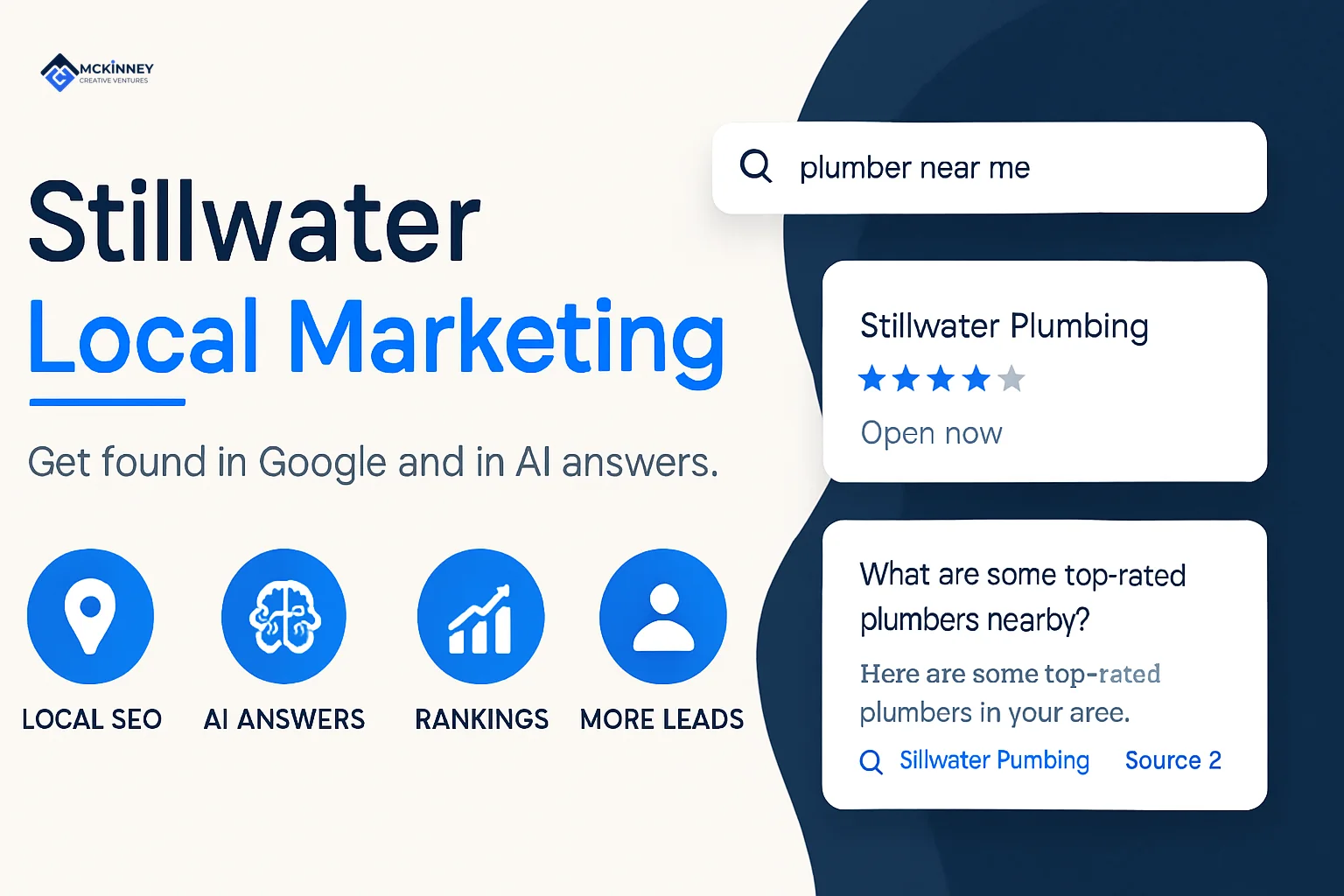
Getting Your Stillwater Business Found in Local Search
Stillwater is a historic river town with tourist traffic and a residential service base. Here is the local search system that gets your business found by both, from Google Business Profile to reviews to St. Croix Valley content.
Ready to Grow Your Business?
Book a strategy call to discuss how we can implement these systems and strategies to help your business scale.
Book a Strategy Call