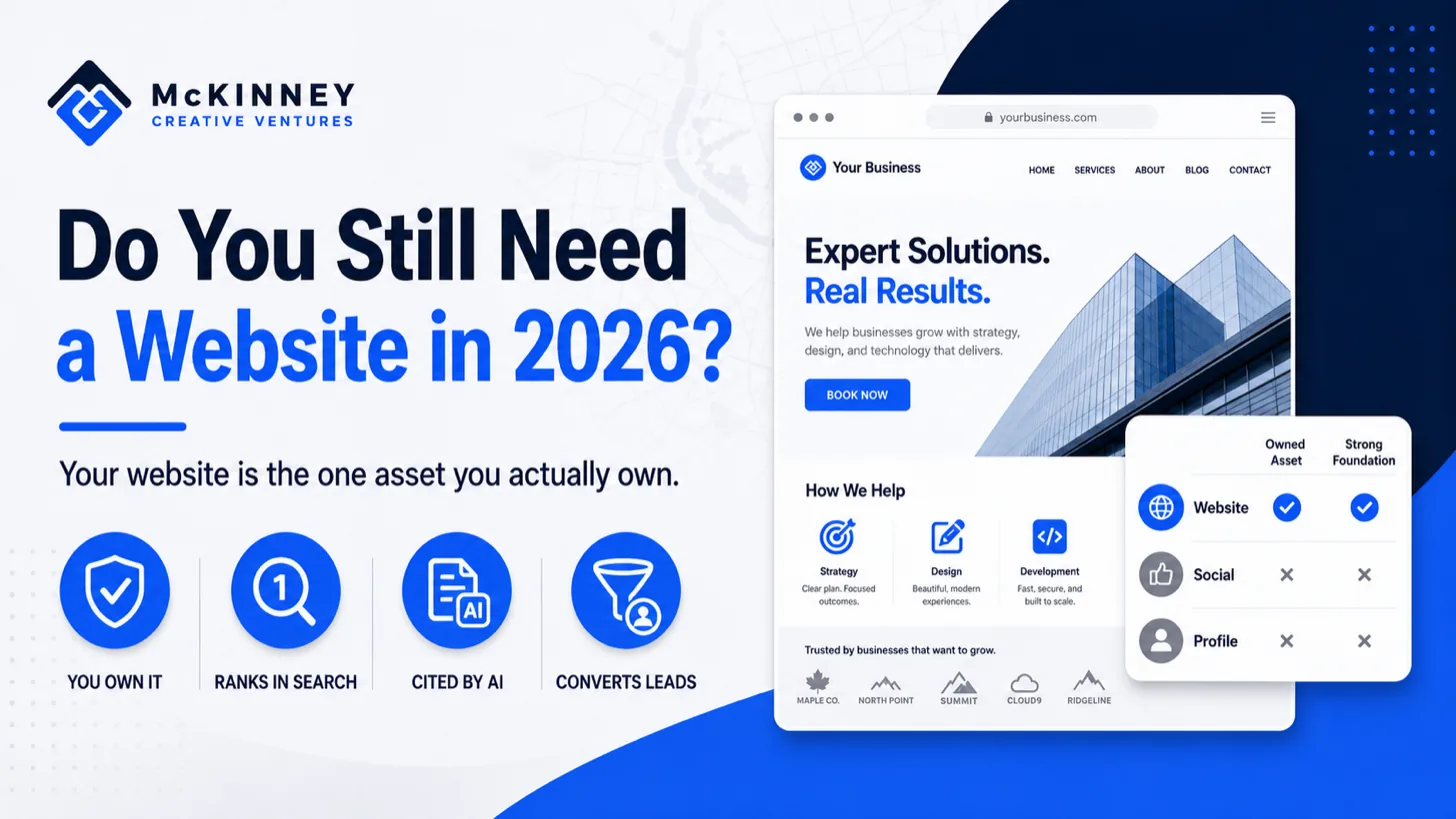
Do Local Service Businesses Still Need a Website in 2026?

Sam McKinney
Founder & Lead Strategist • June 6, 2026
Overview
Google Business Profile and AI search do more than ever, which makes the question fair. Here is the honest answer on whether a local service business still needs a website in 2026, and what it really needs to do.
Short answer: yes, and arguably more than ever. The longer answer is the one worth reading.
It is a fair question in 2026. Your Google Business Profile already shows your hours, photos, and reviews without anyone clicking through to a website. AI Overviews in Google, along with assistants like ChatGPT and Perplexity, now answer questions directly, often without sending a click anywhere at all. So if customers can find you, read your reviews, and even get an answer about your business without visiting your site, why keep one?
Because every one of those surfaces is visibility you are renting on someone else's terms, and none of them do the single job that actually grows a local service business: turning interest into a booked job, on infrastructure you own and control. Here is the honest breakdown for a Twin Cities service business.
The case for skipping the website
The argument is not unreasonable, and it is worth taking seriously before we take it apart.
- Google Business Profile is free and prominent. A complete profile can appear in the Google map pack above the regular results, with your phone number, directions, hours, photos, and a button to call or book.
- AI now answers for you. Ask an assistant who a good plumber in Woodbury is, and it will often name businesses and summarize them directly in the response.
- Social pages feel like enough. A Facebook or Instagram page gives you a presence, posts, and messaging without the cost of building and maintaining a site.
If all you need is to exist online, those three things technically cover it. The problem is that existing online and growing a business online are not the same goal.
What Google Business Profile and AI search actually do, and what they do not
Google Business Profile is genuinely powerful, and every local service business should have a complete, active one. It is free, it is often the first thing a searcher sees, and it is non-negotiable. Claim it and keep it current (Google Business Profile).
But a profile is exactly that: a listing on Google's platform. Google decides the layout, which features you get, which competitors appear next to you, and what the rules are this quarter. You are a tenant, not the owner. The moment Google changes a feature or reorders the local pack, your visibility changes with it, and there is nothing you can do about it.
AI Overviews and assistants work by synthesizing answers from content published across the web. They do not invent businesses, they summarize what credible sources already say. If your business has little or no substantive web presence of its own, you have given those systems less to read, less to trust, and less to cite. A thin online footprint does not make you more AI proof. It makes you easier to leave out of the answer.
Reviews reinforce the point. According to BrightLocal's 2024 Local Consumer Review Survey, 75 percent of consumers always or regularly read online reviews, and Google is the most-used place to read them (BrightLocal, 2024). That is a strong argument for a great Google Business Profile and a steady stream of reviews. It is not an argument against a website. They are different parts of the same system.
What only your website controls
Here is where the question answers itself. Some jobs cannot be done by a profile, a social page, or an AI answer, because they happen on infrastructure you do not own.
Conversion
A profile can send someone to a phone number. Your website is where you control the entire path from interested visitor to booked appointment: the offer, the proof, the call to action, the booking flow, and the fast follow-up that comes after. That path is the difference between traffic and revenue, and it is yours to design and improve.
Measurement and ownership of your data
You cannot put your own analytics, ad conversion tracking, or retargeting on a Google or Facebook profile. On your website you can see exactly where leads come from, prove which marketing is working, and feed every inquiry straight into your CRM. Without a site of your own, you are flying blind on the numbers that decide where your budget goes.
Depth, trust, and your actual story
A profile holds a few lines and some photos. A website holds your service detail, your team, your credentials, your service area, and the proof that you are the right choice. That depth is what turns a curious click into confidence, and it is what AI systems and search engines read when they decide whether to surface and cite you.
Ownership
You own your domain and your content. Platforms can change their rules, suspend accounts, or quietly deprioritize you. A business built entirely on rented land has no foundation of its own. Your website is the one asset in your marketing that you fully control.
| Capability | Your website | Google Business Profile | Social media |
|---|---|---|---|
| You own the asset | Yes | No, Google owns it | No, the platform owns it |
| You control design and message | Fully | Limited | Minimal |
| Ranks in classic search | Yes | Local pack only | Rarely |
| Can be cited by AI answer engines | Yes | Partially | Rarely |
| Converts on your terms | Yes | Limited | Limited |
The real question is not whether, it is how
The honest version of the 2026 question is not whether you need a website. It is what your website actually needs to do now. A static brochure site from 2015 that just sits there is a fair thing to question. A modern site engineered to convert visitors and to be readable by both search engines and AI is not optional. It is the hub everything else points to.
That is how we build at McKinney Creative Ventures. Your website sits at the center of a connected system: your Google Business Profile, reviews, paid ads, and SEO, GEO, and AEO all drive attention toward a site that converts, and every lead is captured into a CRM with fast follow-up. The profile and the AI answer get you noticed. The website is what turns that attention into a booked job, and the data to prove it.
Extended Recap & Conclusion
Yes, local service businesses still need a website in 2026, and the rise of AI search makes a credible one more important, not less. Google Business Profile, reviews, and AI answers are essential ways to get noticed, but they are surfaces you rent and cannot fully control or measure. Your website is the one piece you own. It controls conversion, it captures and tracks your leads, it holds the depth that builds trust, and it gives search and AI systems credible material to read and cite. The goal is not a website instead of those things. It is a modern website at the center of them, doing the job none of them can.
Frequently Asked Questions
Isn't a complete Google Business Profile enough for a local service business?
A complete, active Google Business Profile is essential, but it is a listing on Google's platform, not a conversion engine you control. It can get you found and send a call, yet it cannot run your full booking path, track where your leads come from, hold your proof and story, or feed your CRM. Treat it as a critical front door, not the whole house.
Will AI search make my website obsolete?
The opposite is more likely. AI assistants and Google's AI Overviews build answers from content published across the web. A credible, well-structured website gives them more to read, trust, and cite, while a thin or missing one makes you easier to leave out of the answer.
What makes a website AI friendly in 2026?
Clear, entity-first content that answers real questions directly, accurate and consistent business information, structured data, genuine expertise and authorship, and fast, well-organized pages. These are the same foundations that help you rank in traditional search, which is why we build both into every site.
I have an old website that gets no leads. Should I fix it or scrap it?
Neither extreme. The problem usually is not that you have a website, it is that the site was never built to convert or to be found. The fix is to rebuild it as a conversion-focused hub connected to your reviews, ads, and CRM, rather than abandoning the one asset you own.
How does a website work alongside my Google Business Profile and reviews?
They reinforce each other. Your profile and reviews build trust and get you discovered in local and AI search, then point people to a website that converts them and captures the lead. Strong reviews lift the profile, a strong site lifts conversion, and a connected CRM makes sure no inquiry slips through.
If you are weighing whether your website is pulling its weight in an AI-first search world, that is exactly the kind of thing we work through on a discovery call. Book a free 30-minute strategy call and we will look at your current setup and map a connected system that actually books jobs. No pitch, just a plan.
Written by
Sam McKinney
Founder & Lead Strategist, McKinney Creative Ventures
Sam McKinney helps local service businesses across the Twin Cities East Metro and St. Croix Valley grow through connected marketing systems. Websites, SEO, CRM, and AI automation built to work together instead of in isolation.
More about MCVRelated Articles
Local Landing Page Best Practices: Pages That Turn Searchers Into Calls
City and service pages fail when they are the same page wearing different name tags. Here is the architecture, the trust signals, and the technical layer that turn a local landing page into booked work.

Hudson, WI Service Businesses: Marketing Across the Border
A Hudson service business that works both sides of the St. Croix is running one brand across two states, two licensing regimes, and two separate local search markets. Here is how to set that up so neither side gets treated as an afterthought.
Ready to Grow Your Business?
Book a strategy call to discuss how we can implement these systems and strategies to help your business scale.
Book a Strategy Call