Why Lead Generation for Service Business Is the Key to Sustainable Growth

Sam McKinney
Founder & Lead Strategist • January 3, 2026
Overview
Lead generation for service business is the process of attracting potential customers and converting them into qualified prospects. It involves attracting customers,.
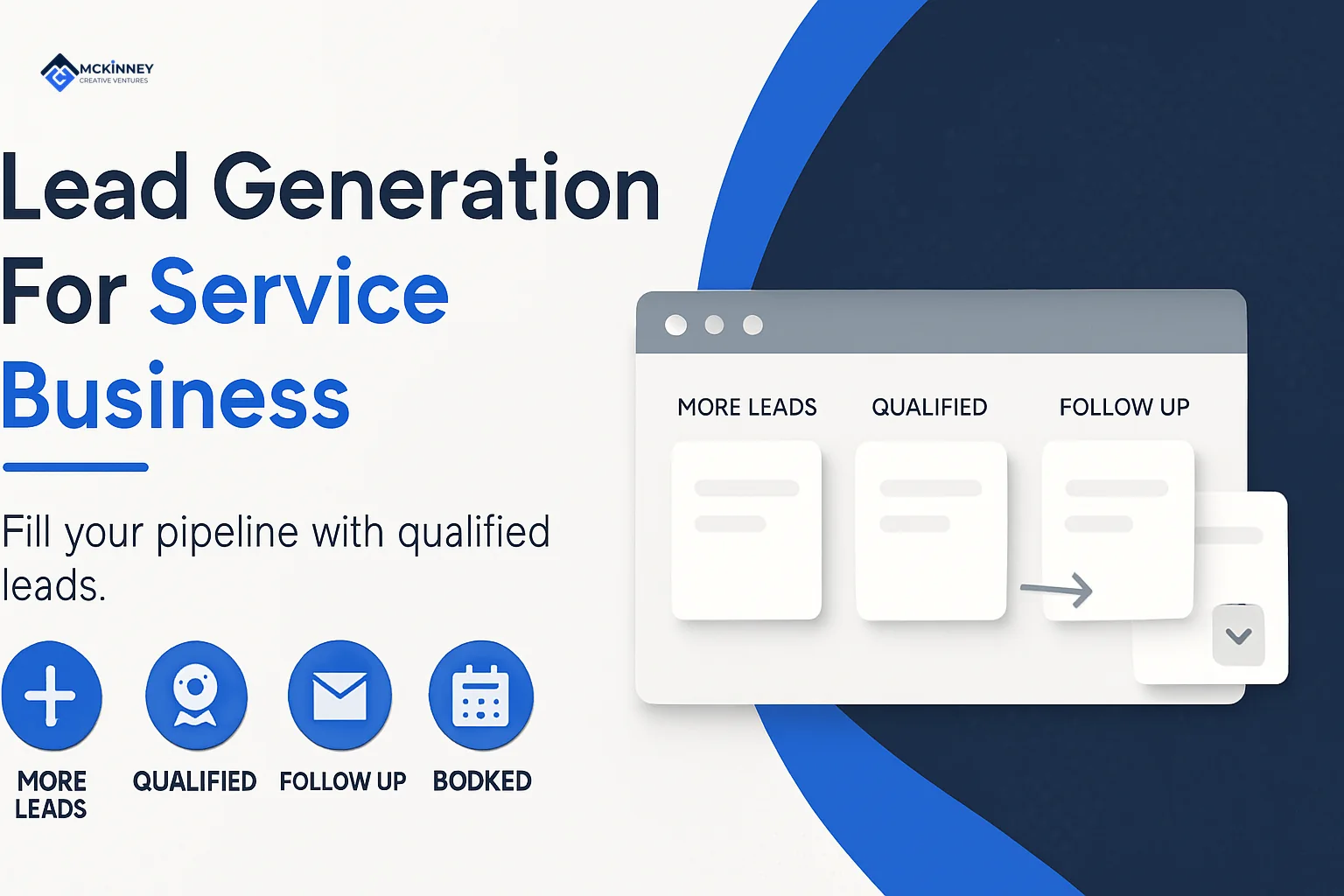
Lead generation for service business is the process of attracting potential customers and converting them into qualified prospects. It involves attracting customers, capturing their information, qualifying them as a good fit, nurturing the relationship, and converting them into paying customers.
You've probably felt the feast-or-famine cycle. Three months where the phone won't stop ringing, followed by weeks of silence. You're either drowning in work or scrambling for the next client.
That cycle exists because most service businesses lack a system for generating leads. They rely on word of mouth or expensive advertising that works until it doesn't. If you want consistent revenue, you need consistent leads. And consistent leads come from systems, not luck.
Industry research shows that 61% of marketers find generating traffic and leads to be their biggest challenge. You are not alone in this struggle. The good news is that lead generation doesn't require a massive budget. It requires a smart strategy applied consistently over time.
I'm Sam McKinney, founder of McKinney Creative Ventures. I've spent over 15 years helping service businesses build marketing systems that generate consistent leads. Throughout this guide, I'll walk you through a proven framework for service business owners who want to grow without the guesswork.
Building Your Foundation: Strategy Before Tactics
Before diving into tactics, we need a solid foundation. Without a clear strategy, your lead generation efforts will be scattered and ineffective. Our strategy centers on understanding your ideal customer and mapping their journey from awareness to becoming a loyal customer. This journey is often visualized as a lead generation funnel.
The buyer's journey has distinct stages:
- Awareness (Top of Funnel - TOFU): Potential customers are experiencing a problem and looking for information. They might not know a solution like yours exists.
- Consideration (Middle of Funnel - MOFU): They've defined their problem and are researching various solutions, including your type of service.
- Decision (Bottom of Funnel - BOFU): They're ready to purchase and are comparing providers, looking for reasons to choose one over another.
Understanding these stages is crucial for both B2B and B2C services. The sales cycle for B2B is typically longer, while B2C might be quicker, but both require a thoughtful approach.
You can learn more about how this journey unfolds for customers here.
Defining Your Ideal Customer for a Service Business
Who is your best customer? The one who values your service most, is a pleasure to work with, and refers others? Identifying your Ideal Customer Profile (ICP) is the most important step in effective lead generation for service business. It focuses your marketing efforts where they'll have the biggest impact.
To define your ICP, we look at several factors:
- Demographics: Age, income, family status (for B2C).
- Firmographics: For B2B, this includes company size, industry, and location. This is key for targeting local businesses in the East Metro Twin Cities or St. Croix Valley.
- Pain Points: What problems does your service solve?
- Goals: What are they trying to achieve, and how does your service help?
We start by analyzing your current best customers to find commonalities. Creating a simple ICP document based on these insights helps us speak directly to their needs and attract more clients just like them.
Mapping Content to Your Funnel
Once we know who we're talking to, we map content to each stage of their journey. Content is the vehicle that moves potential customers through your lead generation funnel.
- TOFU Content (Awareness): Attract a wide audience with helpful, informative content. Think blog posts like "5 Signs Your Furnace Needs Repair" for an HVAC company in Woodbury, MN, or a "Spring Cleaning Checklist" for a cleaning service in Hudson, WI.
- MOFU Content (Consideration): Convert visitors into leads with valuable "gated content" like case studies or webinars. In exchange for their contact information, they get a resource that helps them evaluate solutions. Email newsletters are also powerful for nurturing leads at this stage.
- BOFU Content (Decision): Help prospects make their final decision. Offer free consultations, detailed proposals, client testimonials, or a comparison of your service packages to show why you are the best choice.
Choosing Your Channels: Effective Lead Generation for Your Service Business
With your strategy in place, it's time to choose the right channels to reach your ideal customers. We categorize lead generation into two main approaches: inbound and outbound.
| Feature | Inbound Lead Generation | Outbound Lead Generation |
|---|---|---|
| Approach | Attracts customers by providing value (they come to you) | Proactively reaches out to potential customers (you go to them) |
| Methods | SEO, content marketing, social media, webinars, referrals | Cold calling, direct mail, traditional ads, email outreach |
| Cost per Lead | Generally lower over time | Can be higher, but immediate results possible |
| Lead Quality | Often higher (self-qualified, already interested) | Varies, requires more qualification |
| Sales Cycle | Nurturing often takes longer, relationship-focused | Can be shorter if prospect is ready to buy |
| Effectiveness | Builds trust, authority, and long-term relationships | Good for quickly filling pipelines or new market entry |
Inbound lead generation is often preferred for its effectiveness and lower long-term cost-per-lead. It builds trust and brings warm leads to your door. Outbound can still play a role for quickly filling gaps, but it must be strategic. Our approach blends the two, prioritizing inbound while using smart outbound tactics to supplement. Channel selection depends on your ICP, and we continuously test to find what works best for your business.
Attracting Leads with Your Website and SEO
Your website should be a powerful lead generation engine, not just an online brochure.
For businesses in the East Metro and St. Croix Valley, local SEO is paramount. Since 97% of people search online for local businesses, we want to ensure they find you. Here's how we leverage your website and SEO:
- Google Business Profile (GBP): This free listing is critical. We optimize your GBP with accurate info, quality photos, and consistent hours to improve your visibility in Google Maps and local search results, driving calls and website visits.
- Keyword Research: We identify the terms people in our area use to find your services, from broad terms like "plumber St. Paul MN" to specific ones like "emergency water heater repair Woodbury MN."
- Helpful, Location-Based Content: We create blog posts and service pages that answer common questions and include local keywords, like a post on "Preparing Your HVAC for Winter in the Twin Cities."
- On-Page SEO: We optimize every page with clear headings, good descriptions, and fast load times so search engines understand what you offer.
Engaging Prospects with Content and Email
Content and email work together to build trust and nurture leads into sales-ready opportunities.
- Blogging for Expertise: Regular blog posts position you as an authority. A landscaper in Lake Elmo, MN, can attract homeowners by sharing tips on low-maintenance yard design.
- Gated Content: Offer valuable resources like guides or checklists behind a simple form to capture lead information.
- Email Newsletters: Send practical, useful newsletters, not just sales pitches. Since 60% of consumers make purchases from marketing emails, this is a powerful tool.
- Nurture Sequences: Automated email sequences deliver relevant content based on a lead's actions, keeping your business top-of-mind and guiding them toward a decision.
Using Social Media Strategically
Social media is for building community and driving leads. Your customers are there, and they use it to research services.
- LinkedIn for B2B Services: For businesses targeting other businesses (like commercial cleaning), LinkedIn is invaluable for connecting with decision-makers.
- Facebook for B2C Services: For most local B2C services, Facebook and Instagram are powerful. We showcase your work, share reviews, and run targeted ads to reach customers in specific neighborhoods.
- Showcasing Work and Reviews: High-quality photos and videos of your completed projects are highly engaging, as are positive customer reviews.
- Social Media Ads: Platforms like Facebook offer powerful targeting. We can create ads that reach specific homeowners or business owners in your service area, often with lead forms built directly into the ad.
Exploring Direct Response and Paid Channels
While inbound builds long-term value, paid channels offer immediate visibility.
- Pay-Per-Click (PPC) Advertising: These ads appear at the top of Google search results. We manage PPC campaigns to target specific keywords and locations, ensuring your ad spend is efficient.
- Google Local Services Ads (LSAs): A game-changer for many service businesses, these ads appear at the very top of Google. You only pay when a customer calls you through the ad, making them highly cost-effective.
- Pay Per Call Model: In this performance-based model, you pay only for qualified phone call leads. Callers are often high-intent leads, leading to higher conversion rates and a strong return on investment.
- Co-Marketing and Local Partnerships: Collaborate with non-competing local businesses that serve a similar customer base, like a painter partnering with a real estate agent.
- Referral Programs: Your happy customers are your best advocates. A formal referral program incentivizes them to spread the word.
The Art of the Follow-Up: Qualifying and Nurturing Your Leads
Capturing leads is only half the battle. The real work is qualifying and nurturing them so your sales team focuses on prospects most likely to convert. Since 67% of lost sales result from poor lead qualification, this step is crucial.
We categorize leads to understand their readiness:
- Marketing Qualified Lead (MQL): Someone who has shown interest (e.g., downloaded a guide) but isn't ready for a sales conversation. They are still researching.
- Sales Qualified Lead (SQL): This lead has been vetted and shows clear intent to purchase, such as requesting a quote or consultation. They are ready for direct sales engagement.
The goal is a smooth handoff from marketing to sales, ensuring sales teams receive genuinely interested leads.
How to Qualify Leads Without Wasting Time
To assess a lead's potential quickly, we use frameworks like BANT:
- Budget: Does the lead have the financial resources for your service?
- Authority: Is this person the decision-maker or an influencer?
- Need: Do their needs align with what your service offers?
- Timing: Are they looking to buy now, or just gathering information for the future?
By asking simple qualification questions, we can quickly determine if a lead is worth pursuing, preventing your team from chasing prospects who aren't a good fit.
Implementing Basic Lead Scoring and Grading
To further refine qualification, we use lead scoring and grading to prioritize.
- Lead Scoring: We assign points to leads based on their actions. Downloading a pricing guide might earn 20 points, while visiting the homepage gets 5. A higher score indicates a more engaged, "hotter" lead.
- Lead Grading: We assign grades (A, B, C, D) based on how well a lead matches your Ideal Customer Profile. An "A" grade might be a perfect-fit commercial client, while a "C" is a small, one-off residential job.
Combining scoring and grading helps your team focus on the most promising opportunities. A high-score, high-grade lead is a top priority, while a low-score, low-grade lead can be nurtured with automated content.
Measuring What Matters: Tools, ROI, and Continuous Improvement
Effective lead generation requires tracking, analyzing, and adapting to get the right leads and continuously improve. We focus on Key Performance Indicators (KPIs) to measure success:
- Cost Per Lead (CPL): The cost to acquire one lead from a specific channel.
- Customer Acquisition Cost (CAC): The total cost to convert a lead into a paying customer.
- Conversion Rates: The percentage of visitors who become leads, and leads who become customers.
We use essential lead generation tools to streamline your marketing:
- CRM Software (Customer Relationship Management): Tools like HubSpot or Salesforce organize leads, track interactions, and manage the sales pipeline.
- Email Marketing Platforms: These automate nurture sequences, send newsletters, and track engagement.
- Analytics Tools: Google Analytics and platform-specific tools help us understand traffic, user behavior, and campaign effectiveness. Website visitor identification solutions can even help identify anonymous visitors and turn them into leads.
Measuring the ROI of lead generation for a service business
The ultimate measure of success is Return on Investment (ROI). Your marketing dollars must generate more revenue than they cost.
We track leads from their source to a closed sale, connecting marketing efforts to actual revenue. A robust CRM system makes it easy to attribute sales to specific campaigns. For example, if a $500 Google Ads campaign generates $5,000 in revenue, that's a clear 10x ROI.
This data-driven approach allows us to make informed decisions, see which channels perform best, and adjust our strategy to maximize your growth.
Extended Recap & Conclusion
We've covered a lot of ground, from defining your ideal customer to choosing the right channels and measuring your success. The core takeaway is this: consistent, sustainable growth for your service business comes from having a strategic, systematic approach to lead generation for service business, not from random acts of marketing.
By focusing on strategy first, understanding your customer's journey, and implementing proven tactics, you can transform your business from one caught in the feast-or-famine cycle to one with a predictable pipeline of qualified leads. This isn't just about getting more clients; it's about gaining control, reducing stress, and building a more resilient business.
At McKinney Creative Ventures, we partner with local service businesses in the East Metro Twin Cities and St. Croix Valley to build and execute these exact systems. We become your outsourced marketing team, providing the expertise and consistent follow-through you need without the overhead of an in-house department.
Let's work together to open up your business's full potential. Start building your lead generation system today.
If you want a connected marketing system that brings this together for your business, we can help. Book a free strategy call and we will map out a plan built around your goals. No pitch, just a clear next step.
Frequently Asked Questions
What are the biggest lead generation challenges for service businesses?
Many service businesses face similar problems. One of the biggest is generating high-quality leads consistently. It's not just about getting more calls; it's about getting calls from people who are truly a good fit for your services. Another challenge is often a lack of time and resources. As a busy service business owner, you're focused on delivering great service, not necessarily becoming a marketing expert. Measuring effectiveness can also be tricky; it's easy to spend money on advertising without knowing if it's actually working.
We overcome these challenges by implementing systematic, data-driven strategies. By defining your ICP, mapping the buyer's journey, and tracking results, we ensure your efforts are focused on attracting high-quality leads and demonstrating clear ROI.
How should a service business budget for lead generation?
Budgeting for lead generation can be approached in a few ways. Many businesses allocate a percentage of their revenue (often 5-10% for growth-focused businesses). Common pricing models for lead generation services include:
- Pay-per-lead: You pay a set amount for each qualified lead. This is common with services like Google Local Services Ads or Pay Per Call models, where you only pay for actual customer inquiries.
- Retainers: You pay a fixed monthly fee for ongoing marketing services, which includes lead generation efforts. This is often the case when partnering with a fractional marketing team like ours.
It's important to consider what you're paying for versus what you're getting. Sometimes, a higher-cost lead that converts reliably is more valuable than a low-cost lead that rarely turns into a customer. Think about the lifetime value of a customer for your business.
What should I ask before hiring a lead generation company?
Choosing the right partner is crucial. Here are some questions we recommend asking:
- Experience in my industry: Do they understand the nuances of my specific service business? Have they worked with similar businesses in the East Metro or St. Croix Valley?
- Lead qualification process: How do they ensure the leads they deliver are high-quality and a good fit for my business? What criteria do they use?
- Reporting and transparency: How will they measure success, and what kind of reports will I receive? Can I see where my marketing dollars are going and what results they're generating?
- Contract terms: What are the contract lengths, and what's included? Are there any hidden fees?
- Communication style: How often will we communicate, and what's the best way to reach them? Do they feel like a true partner?
Written by
Sam McKinney
Founder & Lead Strategist, McKinney Creative Ventures
Sam McKinney helps local service businesses across the Twin Cities East Metro and St. Croix Valley grow through connected marketing systems. Websites, SEO, CRM, and AI automation built to work together instead of in isolation.
More about MCVRelated Articles
Storytelling, Skate Shops, and the Business of Video: Henry Schneider of Open Window Productions
Henry Schneider builds video for East Metro businesses at Open Window Productions and co-owns a North St. Paul skate shop. On mistakes as tuition, why story beats gear, and when authentic beats polished.
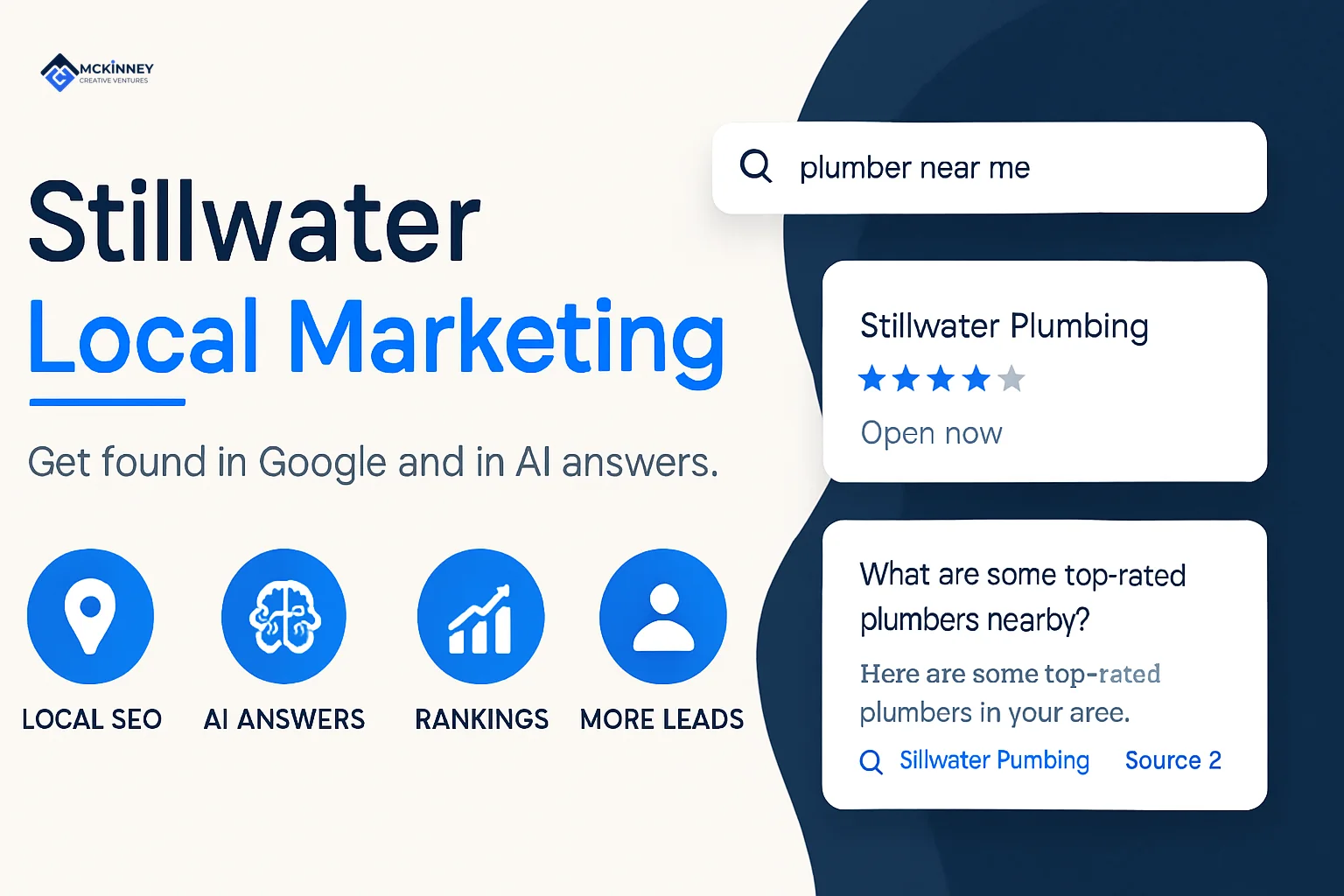
Getting Your Stillwater Business Found in Local Search
Stillwater is a historic river town with tourist traffic and a residential service base. Here is the local search system that gets your business found by both, from Google Business Profile to reviews to St. Croix Valley content.
Ready to Grow Your Business?
Book a strategy call to discuss how we can implement these systems and strategies to help your business scale.
Book a Strategy Call