How Local Service Businesses Rank in Google AI Overviews

Sam McKinney
Founder & Lead Strategist • June 16, 2026
Overview
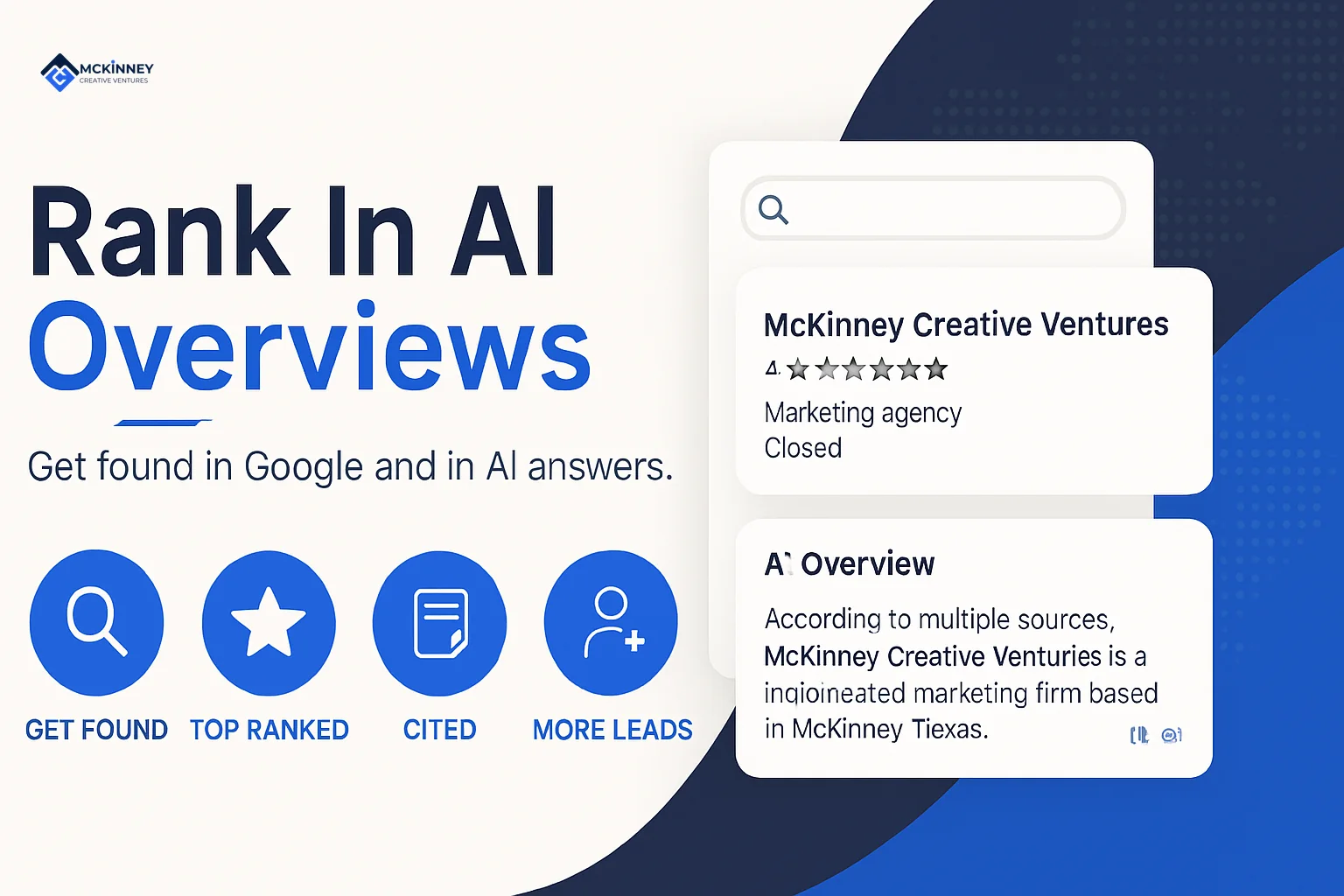
AI Overviews now sit above the map pack on a growing share of searches. Here is how a local service business earns its way into that answer, using the same signals Google has always rewarded.
To rank in Google AI Overviews, a local service business needs three things working together: content that clearly and directly answers the questions customers actually ask, strong local authority built on a complete Google Business Profile and real reviews, and a technically sound, fast website that Google can read. There is no separate AI ranking system and no special markup that buys your way in. Google has said plainly that the same foundational SEO best practices that earn strong organic rankings are what make your content eligible for AI Overviews and AI Mode (Google Search Central, AI features documentation).
If you run a service business in the Twin Cities East Metro, the St. Croix Valley, or western Wisconsin, you have probably noticed the change already. Search for something like "why is my water pressure low" or "do I need a permit to replace a furnace" and Google often answers the question itself, in a box at the top of the page, citing a handful of websites. That box is an AI Overview, and the businesses cited in it are pulling attention before a searcher ever reaches the traditional results or the map pack.
This guide explains how AI Overviews actually choose their sources, what that means for a local service business, and the connected system that earns inclusion. It is built on Google's own documentation, not guesswork, because the tactics being sold as AI Overview shortcuts mostly are not real.
What Google AI Overviews are and how they pick sources
An AI Overview is a generated summary that appears at the top of some Google searches, pulling together information from multiple web pages and linking out to them. The important thing to understand is where that information comes from. According to Google, AI features draw on the same core systems and index that power regular Search, which means there is no separate "AI index" you need to get into and no distinct algorithm to game (Google Search Central).
Behind the scenes, Google breaks a complex question into several related searches, gathers candidate pages for each, and assembles an answer from the most relevant and reliable ones. The practical takeaway is simple: pages that already rank well, answer the question directly, and come from a source Google trusts are the ones most likely to be cited. You are not optimizing for a new machine. You are giving the existing machine cleaner, clearer material to work with.
How common are these overviews? In a study tracking more than 10 million keywords across 2025, Semrush found AI Overview presence rising from roughly 6.5 percent of tracked searches in January to a peak near 24.6 percent in July, before settling around 15.7 percent by November (Semrush AI Overviews Study, 2025). The exact percentage varies by industry and by how a study defines its keyword set, but the direction is not in dispute. Informational and how-to queries, the kind your future customers type before they are ready to call, increasingly trigger an AI answer.
The three signals that get a local business cited
To rank in Google AI Overviews, focus on the signals Google actually rewards rather than the shortcuts it does not. They fall into three groups, and the businesses that win are strong in all three at once.
1. Content that answers the question directly
AI Overviews are built to answer a specific question. Pages that lead with a clear, direct answer, then back it up with detail, give the system something clean to lift. That means structuring a page around a real question, putting the answer in the first sentence or two, and supporting it with specifics: the steps involved, what it costs in general terms, how long it takes, and what a homeowner should watch for.
This is the heart of answer engine optimization, and it overlaps heavily with how you would write for a human in a hurry. Google's own guidance is to create helpful, reliable, people-first content and to make sure your important information is available in plain text rather than locked inside images or scripts (Google Search Central). We cover the writing patterns in depth in our guide to answer engine optimization for local service businesses.
2. Local authority and trust signals
For anything with local intent, Google leans on the signals it has always used to rank local results: relevance, distance, and prominence, the three factors it names in its own Business Profile documentation (Google Business Profile Help). A complete, accurate Google Business Profile and a steady stream of genuine reviews build the prominence and trust that make a business worth citing as a local answer.
Reviews do double duty here. They lift your local ranking, and they reassure the next customer. The behavior is measurable: in BrightLocal's 2024 Local Consumer Review Survey, 88 percent of consumers said they would use a business that replies to all of its reviews, compared with 47 percent for a business that does not respond at all (BrightLocal, 2024). Our Google Business Profile optimization guide walks through the profile side of this in detail.
3. A technically clean, fast website
None of the above matters if Google cannot read your site easily. A fast, mobile-first website with clear page structure, descriptive headings, and content in real text is far easier for Google to parse and quote. Structured data helps Google understand what a page is about and can make it eligible for rich results, but be clear-eyed about its role. Google states directly that there is no special schema you need to add to appear in AI Overviews, and that you do not need to create new AI-specific files or markup (Google Search Central). Use structured data because it sharpens Google's understanding of your content, not because someone promised it as a ticket into the AI box.
A readiness checklist: what to do and why it matters
Here is how the signals above translate into concrete moves, mapped to the reason each one earns AI Overview inclusion.
| What to do | Why it helps you rank in AI Overviews |
|---|---|
| Build a page around each real customer question, with the answer in the first two sentences | Gives the system a clean, direct answer it can lift and cite |
| Keep important information in plain text, not buried in images | Google can only quote content it can read in text form |
| Complete every field on your Google Business Profile and keep it active | Builds the relevance and prominence Google uses for local answers |
| Run a steady review engine and reply to every review | Strengthens trust signals and local ranking prominence |
| Show real experience: named author, license, service area, photos of real work | Reinforces the experience and trustworthiness Google rewards |
| Keep the site fast, mobile-first, and well structured with clear headings | Makes your content easy for Google to parse, rank, and quote |
| Add relevant structured data for understanding, not as a shortcut | Sharpens Google's grasp of your content, though it is not a citation trigger |
What does not work, and why
A lot of advice circulating about AI Overviews is wishful thinking. It is worth naming the dead ends so you do not waste budget on them.
- There is no special AI markup. Adding FAQ schema or a new file will not "get you into" AI Overviews. Google has said so directly. Schema can help Google understand a page, but it does not force a citation.
- There is no separate AI ranking algorithm to game. Because AI features pull from the same index as regular Search, the work that improves your organic and local rankings is the same work that improves AI visibility. There is no shortcut around earning relevance and trust.
- Thin, generic content does not get cited. An AI Overview exists to answer a question well. A page that restates the obvious without specifics, local detail, or real expertise gives the system nothing distinctive to pull.
The honest version is less exciting and more durable: the businesses that earn AI Overview citations are the ones doing local SEO and content well in the first place. If you want the broader picture of how classic search, generative engines, and answer engines fit together, our guide to generative engine optimization lays out the full landscape.
How the pieces connect into one system
The reason this works as a system, and not a checklist of isolated tasks, is that each piece strengthens the others. Clear, question-led content gives Google something to cite. A strong Google Business Profile and real reviews tell Google you are a trustworthy local source. A fast, readable website ensures all of that is visible to the systems doing the ranking. Weaken one and the others lose leverage. This is exactly the connected approach we build inside our SEO, GEO, and AEO service, and it pairs with the website foundation and review and follow-up systems that keep the whole thing running.
Extended Recap & Conclusion
Ranking in Google AI Overviews is not a separate game from ranking in Google overall. Google has been explicit that AI features run on the same index and the same best practices, with no special markup or AI-only requirements. For a local service business, that means the path to AI visibility is the path you should already be on: content that directly answers the questions your customers ask, a complete and active Google Business Profile backed by genuine reviews, and a fast, technically clean website that Google can read and trust.
The shortcuts being sold, special schema, AI files, and algorithm hacks, do not exist in the way they are pitched. What does exist is durable: be the clearest, most trustworthy local answer to the questions in your market, and you become the source Google reaches for when it builds an answer. That work compounds, and it serves your human customers just as well as the AI.
Frequently Asked Questions
How do I get my business to show up in Google AI Overviews?
Focus on three things Google actually rewards: content that answers customer questions clearly and directly, a complete Google Business Profile with steady real reviews, and a fast, well-structured website Google can read. AI Overviews draw from the same index as regular Search, so the work that improves your organic and local rankings is what makes you eligible to be cited.
Does adding schema or FAQ markup get me into AI Overviews?
No. Google states directly that there is no special schema and no new files or markup required to appear in AI Overviews or AI Mode. Structured data is still useful because it helps Google understand your content and can earn rich results, but it does not trigger an AI citation on its own.
How often do AI Overviews actually appear?
It varies by query type and industry. A Semrush study of more than 10 million keywords across 2025 found AI Overview presence ranging from roughly 6.5 percent of tracked searches early in the year to a peak near 24.6 percent in summer. Informational and how-to searches, the kind people run before they hire, are especially likely to trigger one.
Will AI Overviews hurt my website traffic?
They change it. Some informational searches now get answered on the results page, which can reduce clicks for purely informational content. But AI features still link out to sources, and high-intent local searches still send people to profiles, websites, and phone calls. The response is to be one of the cited sources and to make sure your site converts the visits you do get.
Is ranking in AI Overviews different from regular local SEO?
Not fundamentally. Because AI features use Google's existing index and ranking systems, strong local SEO is the foundation. The added emphasis is on answering specific questions directly and demonstrating real local experience and trust, which makes your content a clean, credible source for an AI-generated answer.
If your business is getting found for some searches but losing ground as AI answers take over the top of the page, that is exactly what we map out on a strategy call. Book a free 30-minute strategy call and we will show you where your AI search visibility stands and the connected system to improve it. No pitch, just a plan.
Written by
Sam McKinney
Founder & Lead Strategist, McKinney Creative Ventures
Sam McKinney helps local service businesses across the Twin Cities East Metro and St. Croix Valley grow through connected marketing systems. Websites, SEO, CRM, and AI automation built to work together instead of in isolation.
More about MCVRelated Articles
Cottage Grove MN Marketing: How Local Service Businesses Get Found
Cottage Grove is growing, but growth does not automatically send the right customers to your door. Build a local marketing system that connects search visibility, useful city content, reviews, and fast follow-up.
Med Spa Marketing in the Twin Cities: Keeping the Calendar Booked
Aesthetics practices lose money in the gaps between local search, reviews, and follow up. Here is the full med spa marketing system for the East Metro and St. Croix Valley, plus the federal rules that now govern it.
Ready to Grow Your Business?
Book a strategy call to discuss how we can implement these systems and strategies to help your business scale.
Book a Strategy Call