Why your Twin Cities business is losing search traffic (and how to actually win in the age of AI search)

Samuel McKinney
Founder & Lead Strategist • May 25, 2026
Overview
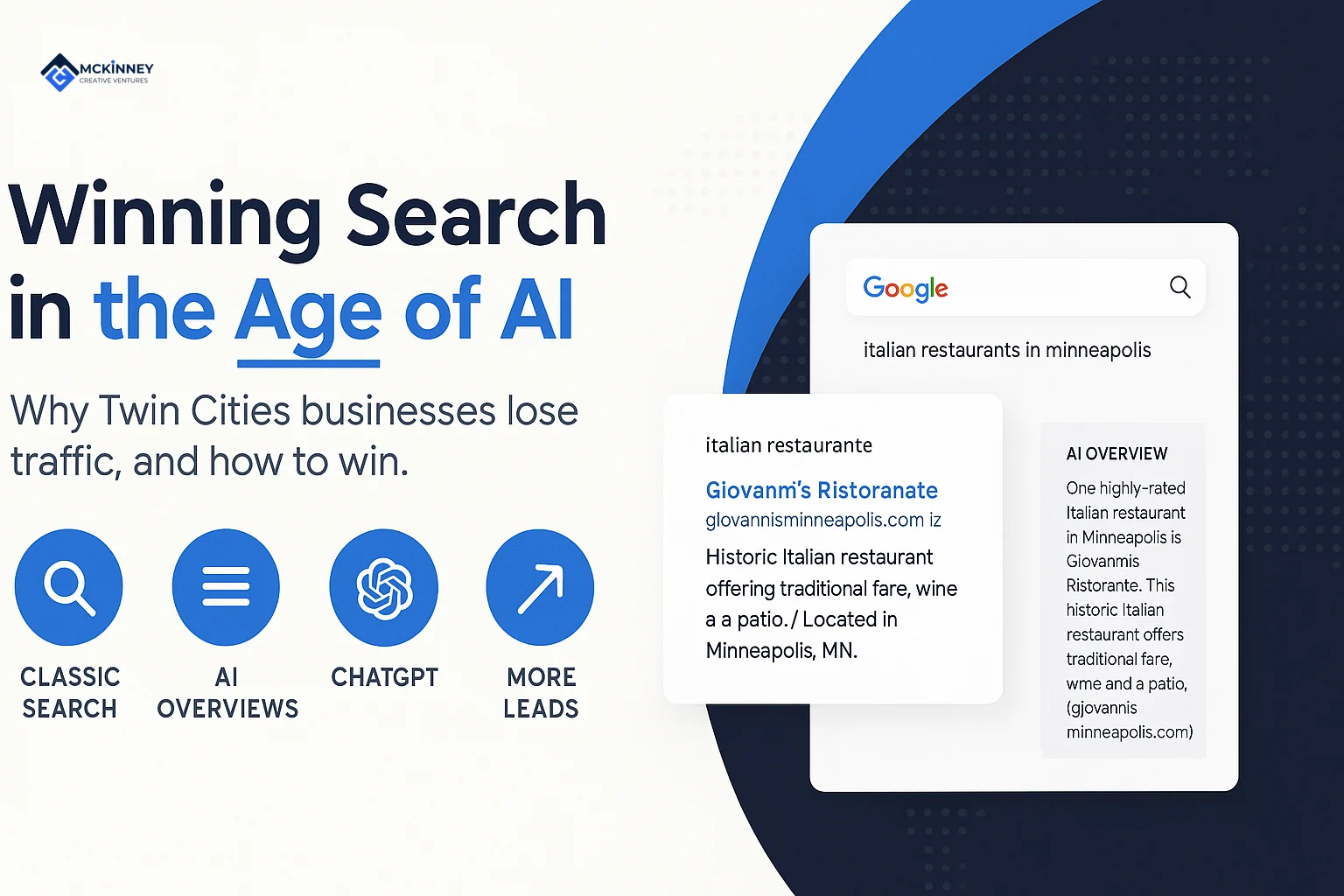
AI Overviews and ChatGPT are reshaping how Twin Cities customers find local businesses. Here's what changed and what to do about it.
If you own a small business in the Twin Cities and your website traffic has been quietly dropping over the last year, you are not imagining it. You are not being penalized. Your SEO agency did not break something. The rules of search have changed underneath everyone, and most small businesses in the East Metro and St. Croix Valley are still operating like it is 2022.
This is the honest explanation, from a local agency that builds search systems for Twin Cities businesses every week.
What is actually happening to search right now
Google is no longer the search engine you remember. When someone searches for a local plumber, a Spanish immersion preschool in Woodbury, or the best brunch in St. Paul, Google now answers the question directly at the top of the page using an AI-generated summary called an AI Overview. The traditional blue links still appear underneath, but most users get their answer before they ever reach them.
At the same time, search behavior is leaking out of Google entirely. Customers are asking ChatGPT, Perplexity, Claude, Gemini, and Microsoft Copilot the same questions they used to type into Google. These AI engines do not return a list of ten links. They return one synthesized answer, citing a handful of sources they decided to trust.
Two new disciplines have emerged to address this shift. Generative Engine Optimization (GEO) is the practice of structuring your business and its content so AI engines surface and cite you inside their answers. Answer Engine Optimization (AEO) is the related practice of making your content the direct answer to specific questions, whether that answer appears in a Google AI Overview, a featured snippet, a voice assistant response, or an AI chat reply.
Traditional SEO still matters. But on its own, it is no longer enough.
How much traffic are local businesses actually losing
The numbers from the last twelve months are not subtle.
An Ahrefs study published in early 2026 analyzed 300,000 keywords and found that when an AI Overview appears on a search result page, the top-ranking organic listing loses about 58 percent of the clicks it used to get. That decline nearly doubled from a 34.5 percent drop measured just nine months earlier. Position one click-through rates for AI Overview keywords dropped from roughly 7.3 percent in late 2023 to 1.6 percent by the end of 2025.
A separate randomized field study conducted in early 2026 tested actual user behavior with and without AI Overviews enabled. The result: AI Overviews appeared on 42 percent of queries, reduced outbound clicks by 38 percent on those queries, and pushed zero-click searches from 54 percent up to 72 percent. Nearly three out of four searches now end without anyone visiting a website at all.
The data from Seer Interactive shows one nuance worth knowing. Click-through rates on AI Overview results bottomed at 1.3 percent in December 2025 and recovered to 2.4 percent by February 2026, an 85 percent jump. Pages that get cited inside the AI Overview earn more clicks than pages that do not. The lesson is direct. Being cited inside the AI answer is the new objective. Ranking number one and getting ignored is not a win.
Why Google made this change on purpose
This shift is not a glitch. It is Google's defensive response to losing search market share to AI-native competitors. Google is keeping users on the search results page by answering their questions directly so they do not leave for ChatGPT or Perplexity. The trade-off is fewer clicks to websites, including yours.
Whether you agree with the change is irrelevant. It is the environment your business is operating in. Adapting to it is no longer optional.
Why this matters more for small Twin Cities businesses than for anyone else
Big national brands have entire teams adapting to this shift in real time. A small Stillwater contractor, a White Bear Lake dental practice, or a family-owned restaurant in St. Paul does not have that luxury. And here is the part that gets overlooked: small local businesses are disproportionately exposed to this change.
Most of the searches that drive revenue for a local business are exactly the kind of searches AI Overviews now handle aggressively. "Best window cleaner near Stillwater." "Spanish immersion preschool Woodbury." "Emergency plumber White Bear Lake." "Roofing contractor East Metro." These are short, specific, intent-rich queries. AI Overviews love them. Google's old organic results, where local businesses used to compete on roughly equal footing with anyone willing to do the work, are getting pushed further down the page.
Two things follow from this. First, if your business is not visible inside the AI answer, you are increasingly invisible to the customers who would have hired you. Second, the businesses that figure this out first in their market will pull noticeably ahead of competitors who did not. There is a window right now, and it will not stay open forever.
What AI engines actually look for when deciding who to cite
Google, ChatGPT, Perplexity, Claude, and Gemini are not random. They are looking for specific signals when they decide which businesses to surface and cite. Understanding those signals is the entire game.
Real reputation, not paid reputation
Reviews are foundational. Volume, recency, average rating, and how you respond to reviews all factor in. A business with 180 Google reviews averaging 4.8 stars, with consistent recent reviews and thoughtful owner responses, signals trust to both Google and AI engines. A business with 12 reviews from three years ago signals the opposite. Yelp, Facebook, BBB, and industry-specific platforms (Houzz for contractors, Healthgrades for medical, Avvo for legal) all contribute to the broader reputation picture.
Named, credentialed humans behind the work
AI engines look for evidence that real, qualified people stand behind the content and the business. That means real owner and practitioner bios with photos, credentials, and links to their LinkedIn profiles. It means blog posts attributed to a named author rather than published anonymously. It means showing the people who actually do the work, not stock photos.
This connects to Google's E-E-A-T framework: Experience, Expertise, Authoritativeness, and Trustworthiness. AI engines have effectively adopted the same lens. They are trying to figure out whether your business is genuinely worth recommending.
Content written for humans, structured for machines
AI engines pull short passages from web pages and stitch them into answers. That means your content has to be readable in pieces. Each section of every page should answer one specific question fully in its first two or three sentences, then expand with detail. Headings should be phrased the way real customers would ask the question. The first paragraph of every meaningful page should be lift-ready, a direct answer to what the page is about.
Pages stuffed with keywords, written for an algorithm rather than a reader, get filtered out. AI engines have gotten very good at detecting that pattern.
Local proof and geographic specificity
For Twin Cities businesses, local signal is the unfair advantage. AI engines and Google's local search both reward businesses that demonstrate genuine roots in their service area. That means real photos of your physical location, content that references specific neighborhoods and suburbs you serve, customer stories from named local customers, mentions in local press (Twin Cities Business, Pioneer Press, Sun Sailor, community papers), and involvement in local organizations like the Minneapolis Regional Chamber, BNI groups, and AGC pods.
National brands cannot fake this. A locally-rooted business that documents its local presence well has an advantage that scales with consistency over time.
Technical foundations that AI crawlers can actually read
The technical layer does not win the game on its own, but a broken technical foundation makes everything else invisible. AI engines need to be able to crawl your site, parse your content, and understand your business entity. That means clean schema markup (structured data in JSON-LD format) telling search and AI engines exactly who you are, where you operate, what you do, and what other people say about you. It means fast mobile performance, a clean URL structure, and a properly configured llms.txt file at the root of your site so AI crawlers know where the important content lives.
Most Twin Cities small businesses have none of this in place. The ones who do show up in AI answers their competitors never see.
What this actually looks like in the Twin Cities right now
A practical example. A customer in Woodbury opens ChatGPT and asks, "What's a good Spanish immersion preschool in the East Metro?" ChatGPT does not return a list of ten links. It returns one or two recommendations with a short explanation of why. The preschool it cites might not be the largest in the area, the cheapest, or the one with the slickest website. It is the one with the strongest combination of reviews, named educators with credentials, content that clearly explains the program in plain language, schema markup confirming the details, and outside mentions in local parenting blogs, community publications, and school directories.
Another example. A homeowner in Stillwater asks Google, "Roofing contractor near me for storm damage," and an AI Overview answers with three named contractors. The contractors named are not random. They have invested in review generation, named owner profiles, geographically specific service area content, schema markup, and a presence across local directories. The contractor with 8 reviews and a basic website is not in that answer, and increasingly is not getting the call.
This is happening across every local service category in the metro right now. Most business owners do not see it because they search for their own business by name and find it just fine. The customers who do not know your name yet are the ones the AI is filtering out.
What McKinney Creative Ventures recommends for Twin Cities small businesses
This is the practical playbook. Whether you implement it yourself, hire MCV, or hire another local agency, these are the moves that matter most right now.
Build real reputation through consistent review generation
Set up an automated system that requests a Google review from every satisfied customer immediately after the transaction or service. The best time to ask is when the customer is happiest. Aim for one new review per week as a baseline. Respond to every review, positive and negative, in a professional voice. Volume and recency both matter to Google and to AI engines.
Put named humans in front of the brand
Make sure your About page features the owner with a real photo, real bio, and real credentials. Link to LinkedIn. Add bios for key staff. Attribute blog content to named authors. Show the people who do the work.
Publish content that answers actual customer questions
Pull blog topics from the questions you get on sales calls, in customer service emails, and in Facebook groups in your industry. Write each post to fully answer one question in the first paragraph, then expand. Avoid keyword stuffing. Avoid generic "ultimate guide" content that says nothing the reader cannot find on twenty other sites. One genuinely useful post per week beats thirty thin posts in a month.
Invest in the technical foundation once, properly
Get your schema markup right (LocalBusiness, Organization, Person, FAQPage, Service, Review schemas in JSON-LD format). Make sure your site loads fast on mobile. Add an llms.txt file at the root of your domain. Submit your site to Google Search Console and Bing Webmaster Tools. Claim and fully complete your Google Business Profile and Bing Places listings. Most of this is one-time work that pays off for years.
Document your local roots
Show up at community events. Document the involvement on your site. Get mentioned in local press and community publications. Join the Minneapolis Regional Chamber, your industry association, or a local BNI group. Sponsor youth sports or school events. These activities build the kind of local trust signal that AI engines cannot fake and competitors cannot easily copy.
Treat search as an ongoing system, not a one-time project
SEO and GEO results compound. A business that publishes one solid piece of content every two weeks, requests reviews consistently, refreshes its cornerstone pages every quarter, and keeps its technical foundation maintained will pull ahead of a competitor that did a big SEO push two years ago and then stopped. There is no finish line. The businesses winning local search in 2026 are the ones who built a sustainable rhythm and held to it.
Extended Recap & Conclusion
In summary, the rise of AI Overviews and chat-based search requires a fundamental shift in local SEO. By focusing on factual density, structured data, and authentic local reputation, your Twin Cities business can thrive in the new era of Answer Engine Optimization. See the SEJ field study for more data.
- AI Overviews are significantly reducing traditional organic clicks.
- GEO and AEO are essential for getting cited by AI models.
- Real reputation and verifiable credentials matter more than ever.
- Invest in structured data and an llms.txt file to guide AI crawlers.
Frequently Asked Questions
Will AI search completely replace Google?
No, but it is changing how Google displays results. AI Overviews act as a synthesis layer on top of traditional search.
Is it too late to start optimizing for GEO?
Not at all. The shift is happening now, and early adopters in local markets have a significant advantage.
Written by
Samuel McKinney
Founder & Lead Strategist, McKinney Creative Ventures
Sam McKinney helps local service businesses across the Twin Cities East Metro and St. Croix Valley grow through connected marketing systems. Websites, SEO, CRM, and AI automation built to work together instead of in isolation.
More about MCVRelated Articles
Med Spa Marketing in the Twin Cities: Keeping the Calendar Booked
Aesthetics practices lose money in the gaps between local search, reviews, and follow up. Here is the full med spa marketing system for the East Metro and St. Croix Valley, plus the federal rules that now govern it.
How to Get Cited by ChatGPT and Perplexity as a Local Business
AI assistants cite sources they can reach, trust, and quote quickly. Here is how retrieval actually works inside ChatGPT and Perplexity, and the sequence a local service business should work through to become one of those sources.
Ready to Grow Your Business?
Book a strategy call to discuss how we can implement these systems and strategies to help your business scale.
Book a Strategy Call