Why Web Content Creation Matters for Your Business

Sam McKinney
Founder & Lead Strategist • January 23, 2026
Overview
Web content creation is the process of planning, writing, and publishing the words, images, and videos that appear on your website and other digital platforms. It's how you.
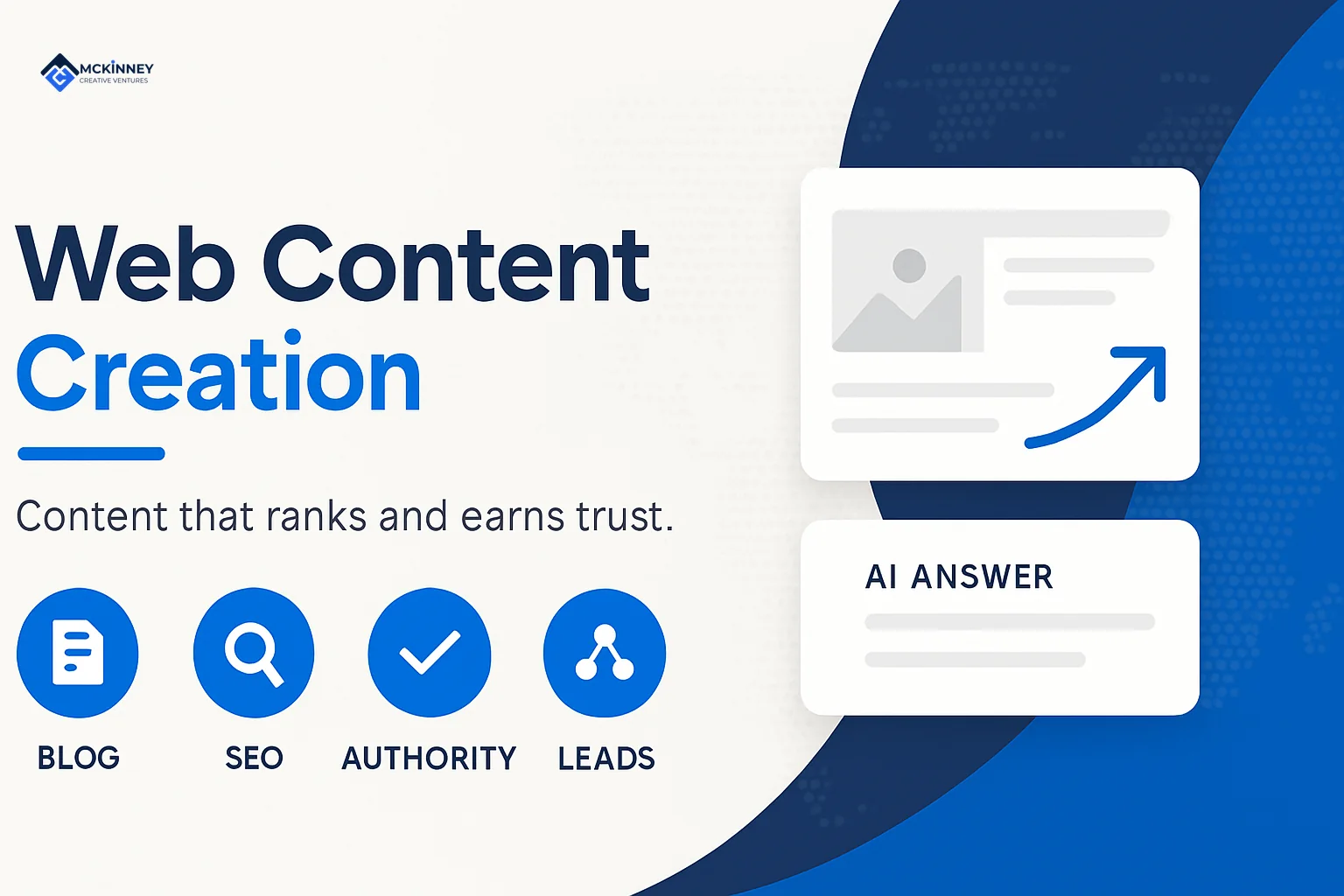
Web content creation is the process of planning, writing, and publishing the words, images, and videos that appear on your website and other digital platforms. It's how you tell your story, answer questions, and guide potential customers toward doing business with you.
The Web Content Creation Process:
- Understand your audience - identify who you're writing for and what they need
- Develop your brand voice - establish how you sound and what you stand for
- Generate content ideas - use keyword research, customer questions, and market gaps
- Plan your content - create an editorial calendar and organize topics into clusters
- Choose your format - select blog posts, service pages, videos, or other formats
- Write and format - create scannable, clear copy with headers and lists
- Add visuals - include images, graphics, and videos to improve understanding
- Optimize for search and mobile - ensure content works on all devices and ranks well
- Publish, promote, and measure - share your content and track what works
Creating content for the web is different than creating content for print. Nearly 80% of website visitors scan rather than read word-for-word. That means your content needs to be structured for quick comprehension, with clear headers, short paragraphs, and strategic use of visuals.
For small businesses, web content creation is not a one-time project. It's an ongoing system that builds visibility, establishes trust, and generates leads over time. Quality educational content makes customers 131% more likely to buy from your business. But most business owners struggle with where to start, what to write about, and how to stay consistent.
I'm Sam McKinney, founder of McKinney Creative Ventures, and I've spent over 15 years helping service-based businesses build marketing systems that work. My approach to web content creation focuses on strategy first, consistency through automation, and long-term growth that doesn't rely on constant manual effort.
Laying the Foundation: Strategy Before You Write
Before we write a single word, we first need a clear strategy. Think of it like building a house. You wouldn't start hammering nails before you have blueprints. The same goes for your online presence. For us, at McKinney Creative Ventures, this strategy-first mindset is paramount. It's how we help local businesses in the East Metro, St. Croix Valley, and surrounding areas achieve sustainable growth. We build systems and processes that work for the long term, rather than chasing quick, unsustainable wins. A solid content strategy will guide the "what," "where," and "when" of your web content creation, ensuring every piece serves a purpose. You can explore more about building an effective content strategy by reviewing this guide on content strategy best practices.
Part of this foundation involves clearly defining your Unique Selling Proposition (USP). What makes your service-based business in Woodbury, Cottage Grove, or Hudson truly stand out? Articulating this unique value is crucial because it becomes the core message woven into all your web content. Your USP isn't just about what you do, but how you do it differently and why that matters to your ideal client.
Understanding Your Audience for Effective Web Content Creation
Who are you trying to reach? This isn't a trick question, but it's one many businesses skip over. Effective web content creation begins with a deep understanding of your audience. We encourage our clients, whether they're in Stillwater, Lake Elmo, or River Falls, to create detailed buyer personas. These are semi-fictional representations of your ideal customers, built from market research and real data about your existing clients. What are their demographics? What are their interests, their daily routines, and their online behaviors?
More importantly, what are their challenges and their goals? Your content should speak directly to these. If you run a landscaping business in Afton, your customers might be struggling with lawn maintenance or looking for ways to improve their property value. Your content should offer solutions and insights to these specific problems.
Another key aspect is understanding user intent. When someone types a query into a search engine, what are they hoping to find?
- Informational intent: They're looking for answers to questions (e.g., "how to choose a reliable plumber in Minneapolis"). Your content should educate and demonstrate thought leadership.
- Navigational intent: They're looking for a specific website or page (e.g., "McKinney Creative Ventures website"). Your brand visibility helps here.
- Transactional intent: They're ready to take action (e.g., "book a marketing consultation St. Paul"). Your content should facilitate that decision, with clear calls to action.
By aligning your content with user intent, you not only improve search engine rankings but also create a better experience for your audience. Our goal is always to write for people first.
Developing Your Brand Voice
Imagine walking into a room and instantly recognizing someone by their way of speaking. That's your brand voice online. It's your business's personality and how you communicate with your audience. For local businesses, a consistent brand voice builds a recognizable and relatable identity, fostering trust with your community in places like Maplewood, Oakdale, or New Richmond.
Developing a comprehensive style guide is a practical step here. This document outlines your preferred tone of voice (e.g., friendly, authoritative, empathetic), typography, formatting rules, image guidelines, and even grammar preferences. It ensures that whether we're writing a blog post, a service page, or an email, the message always sounds unmistakably like your business. This consistency is crucial for establishing credibility and making your brand memorable. Almost 90% of consumers trust word-of-mouth recommendations, and a consistent, trustworthy voice contributes to that sense of reliability.
The Core of Web Content Creation: From Idea to Published Page
Once we have our strategy and audience defined, we move into the actual creation process. This is where a systematic approach truly shines. We often visualize this as a well-oiled machine, where ideas flow through a structured workflow, leading to published content that serves a clear purpose.
A critical component of this systematic approach, especially for SEO, is organizing your content into topic clusters and pillar pages. Instead of creating isolated blog posts, we build a comprehensive framework. A pillar page is a broad, in-depth guide on a core topic (e.g., "Complete Guide to Small Business Marketing"). Topic clusters are groups of related, more specific articles that link back to that pillar page (e.g., "Local SEO Strategies for Landscapers," "Social Media Tips for Restaurants," "Email Marketing for Salons"). This structure signals to search engines that you are an authority on the broader topic, improving your overall visibility. In fact, 98% of SEOs consider content clusters an important part of their content strategy.
Finding Your Content Ideas
The blank page can be intimidating, but generating ideas doesn't have to be. We have several reliable sources for uncovering content gold:
- Keyword research: This is our primary method for finding what your audience is actively searching for. By understanding the language they use and the questions they ask, we uncover valuable opportunities for content. Tools like Google search (autocomplete, "People Also Ask" sections, related searches) can offer insights. We look for keywords with a good balance of low difficulty and high search volume, especially for local queries relevant to our East Metro and St. Croix Valley clients.
- Customer feedback: Your existing customers are a treasure trove of ideas. What questions do they frequently ask your sales or customer support teams? What problems did your service solve for them? Testimonials and case studies are powerful here.
- Competitor analysis: What are your competitors in places like Roseville or River Falls writing about? What topics are they missing? This helps us identify gaps and differentiate your brand.
- Brainstorming sessions: Sometimes, the best ideas come from simply putting our heads together. We often involve different departments (sales, customer service) within a client's business to tap into their unique insights about customer needs and industry trends.
- Answering questions: Focus your content on answering your customers' most pressing questions. If they're asking, others are searching.
Choosing the Right Content Format
Once you have an idea, the next step is deciding how to present it. The "best" format depends on the topic, your audience's preferences, and your goals.
- Blog posts: Excellent for in-depth articles, guides, and thought leadership. They establish your expertise and provide valuable information.
- Service pages: Detail your specific offerings, highlighting benefits over features, and include clear calls to action. These are essential for businesses in places like Maple Grove or Hudson.
- Case studies: Showcase how your product or service solved a specific problem for a client, building trust and credibility.
- Infographics: Visually represent complex data or processes, making information easy to digest. Images, infographics, and videos can increase views by 94% over text-only content.
- Videos: Engage your audience with demonstrations, tutorials, or behind-the-scenes glimpses of your business.
When choosing a format, consider how your customers prefer to consume content. Do they respond well to visual explanations, or do they prefer detailed written guides? Tailoring the format to their needs improves engagement.
Planning with an Editorial Calendar
Consistency is key to any successful web content creation strategy. An editorial calendar is our roadmap, helping us stay organized and ensure a steady flow of valuable content. For our clients, this calendar typically outlines:
- Content titles: What each piece will be about.
- Content types: Whether it's a blog post, video, or social media update.
- Publish dates: When each piece is scheduled to go live.
- Statuses: Tracking progress (e.g., ideation, drafting, editing, published).
We typically plan content quarterly, or even an entire year in advance for larger projects. This proactive approach helps us mix evergreen content (always relevant) with timely pieces. It also provides a cushion, allowing us to stay at least a month ahead of publishing dates. This streamlines production, allows for thorough review, and prevents the dreaded "content creator apathy", where low-effort content is produced just to fill a spot. A well-planned calendar ensures that every piece of content is thoughtful and aligned with your business goals, whether you're serving clients in Baldwin, WI, or White Bear Lake, MN.
Writing for the Web: Best Practices for Readability and Engagement
Now we get to the core of crafting the words themselves. Creating content for the web is fundamentally different from creating content for print. When someone reads a magazine or book, they typically engage with it linearly. Online, user behavior is different. We know that nearly 80% of visitors scan website content. They're looking for quick answers and digestible information, not dense prose. This means our approach to web content creation must prioritize clarity, conciseness, and scannability above all else.
Formatting for Scannability
To capture and hold a visitor's attention, your web content needs to be easy to skim. We achieve this through strategic formatting:
- Descriptive headers: Use H1, H2, H3 tags to break up your content into logical sections. These act as signposts for readers, allowing them to quickly find the information they need. Make them descriptive and benefit-oriented.
- Short paragraphs: Aim for paragraphs of 2-4 sentences. Long blocks of text are overwhelming online. Divide your content into one topic per paragraph for better comprehension.
- Bulleted lists and numbered lists: These are fantastic for breaking down complex information, highlighting key points, or presenting steps in a process. They dramatically improve readability.
- White space: Don't be afraid of empty space on the page. It makes your content feel less dense and easier on the eyes.
By employing these formatting techniques, we ensure that even if a user only scans your page, they can still grasp the main points and value you offer.
Writing Clear and Compelling Copy
Beyond formatting, the language itself needs to be precise and engaging.
- Active voice: Use active voice whenever possible. It makes your sentences more direct, concise, and easier to understand. For example, instead of "The service was provided by our team," write "Our team provided the service."
- Avoiding jargon: Speak your audience's language. Avoid industry-specific jargon or technical terms unless you're writing for a highly specialized audience. If you must use them, explain them clearly. This is especially important for local businesses wanting to connect with their community in places like Landfall or Grant.
- Simple language: Use short sentences and simple words. Our goal is to communicate clearly, not to impress with complex vocabulary. If you can break a long sentence into two, do it.
- First and second-person perspective: Using "we" (your business) and "you" (the customer) makes your content more approachable and personal. It creates a direct connection, as if you're speaking one-on-one with the reader.
- Prioritizing key information: Web users have limited attention spans. Place the most crucial information at the top of your page or section. This "inverted pyramid" style ensures that even if a reader doesn't scroll to the end, they still get the essential message.
Using Links and Calls to Action
Links and calls to action (CTAs) are the signposts that guide your users through your website and encourage them to take the next step.
- Effective internal linking: Link to other relevant pages on your website. This helps users explore more of your content, improves your site's SEO by distributing "link juice," and establishes your authority on related topics.
- Guiding users: Links should always add value and help the user. Avoid the infamous "click here." Instead, use descriptive link text that tells the user exactly where they're going (e.g., "learn more about our web design services").
- Action-oriented CTAs: A compelling call to action is short, actionable, and descriptive. It should start with a verb and include keywords where appropriate. Good examples include "Request a Free Quote," "Download Our Guide," or "Schedule Your Consultation." These clear instructions reduce friction and encourage engagement.
- Accessible CTAs: Make sure your CTAs are easy to find and understand. They should stand out visually and clearly communicate the benefit of clicking.
Beyond the Words: Enhancing Content with Visuals and Mobile-Friendliness
In today's digital landscape, words alone are often not enough. To truly engage your audience and ensure your message is received, visuals and mobile optimization are non-negotiable aspects of effective web content creation.
Consider this: including images, infographics, and videos in your content can increase views by 94% over text-only content. Our brains process visuals much faster than text, making them incredibly powerful tools for communication. Furthermore, the way people access your content has shifted dramatically. Mobile devices now receive nearly 70% of all web traffic. This is a significant change, and Google's shift to mobile-first indexing means that how your content performs on mobile directly impacts your search rankings. If your content isn't mobile-friendly, you're missing out on a huge portion of your potential audience in places like Bloomington, Eagan, or Prescott, WI.
Using Visuals to Improve Your Message
Visuals aren't just decorative; they're integral to enhancing your message:
- Relevant images: High-quality, relevant images break up text, grab attention, and help convey emotions or concepts more effectively. Make sure they align with your brand and message.
- Brand-aligned graphics: Custom graphics, illustrations, or charts can reinforce your brand identity and simplify complex ideas.
- Explainer videos: Short videos are excellent for demonstrating products, explaining services, or telling your brand story in a dynamic way.
- Infographics: These are perfect for presenting data, statistics, or step-by-step processes in an easy-to-understand visual format.
When used strategically, visuals make your content more engaging, memorable, and shareable. They help tell your story faster and more effectively.
Optimizing for Accessibility and Performance
While visuals are powerful, they must also be optimized for both accessibility and performance.
- Image compression: Large image files can significantly slow down your website, leading to a poor user experience and hurting your search rankings. We always optimize images by resizing and compressing them to the minimum possible size without sacrificing quality.
- Fast load times: Beyond images, overall page speed is critical. Users expect pages to load quickly, and search engines penalize slow sites.
- Alt text for images: This is a small but mighty detail. "Alt text" (alternative text) describes an image for visually impaired users who rely on screen readers. It's also crucial for SEO, as search engines use alt text to understand the content of your images. Always provide descriptive alt text for every image, including relevant keywords where appropriate.
- Web Content Accessibility Guidelines (WCAG): Ensuring your content is accessible to everyone is not just good practice, it's often a legal requirement. We recommend reviewing the U.S. Department of Health and Human Services article on Web Content Accessibility Guidelines for further information on creating inclusive content.
After You Hit 'Publish': Measuring, Refining, and Promoting Your Content
Hitting "publish" isn't the end of the web content creation journey; it's merely the beginning of the next phase. Think of your content as a long-term asset, much like a physical storefront in Stillwater or Minneapolis. It requires ongoing care, promotion, and measurement to ensure it continues to attract and serve customers. Our approach emphasizes continuous improvement and ethical promotion, ensuring your efforts build a visible, reputable online presence. We also refer to the FTC’s guide on Advertising and Marketing for further insight into building trust through ethical and transparent content.
Promoting and Monitoring Your Content
Even the best content won't work hard for you if no one sees it. Promotion is crucial:
- Content promotion channels: Share your new content across all relevant platforms. This includes your social media channels (Facebook, LinkedIn, etc.), email newsletters, and even through local community groups or partnerships in places like Lakeland or St. Paul.
- Monitoring performance: Once your content is live and promoted, we need to track how it's performing. Tools like Google Analytics are invaluable here. We look at metrics such as page views, time on page, bounce rate, and conversion rates. Which pages are getting the most views? Are visitors engaging with your thought leadership articles? Are they clicking through to case studies or service pages? This data provides critical insights into what resonates with your audience.
The Importance of Content Audits
Content is not static; it ages. Even solid, thought-provoking content can become outdated or less effective over time. This is why regular content audits are so important. We recommend conducting a thorough content audit at least twice a year, or even quarterly for active sites.
- Improving existing content: An audit helps us identify underperforming content that can be updated, expanded, or optimized. Perhaps a blog post from two years ago needs fresh statistics or a new perspective. Updating older content can significantly boost its search performance.
- Identifying gaps: Audits also reveal topics you haven't covered yet, or areas where your competitors are outperforming you. This feeds directly back into our content ideation process.
- Content refresh strategy: Sometimes, a piece of content just needs a refresh, like updating a series of blogs and republishing them as an eBook. This can breathe new life into valuable assets.
- Measuring ROI: By consistently monitoring and auditing your content, we can establish clear Key Performance Indicators (KPIs) and measure the return on investment (ROI) of your web content creation efforts. This helps prove the value of your marketing activities and informs future strategy.
Extended Recap & Conclusion
Effective web content creation is more than just writing words for your website. It's a strategic, systematic process that empowers your business to tell its story, connect with customers, and achieve sustainable growth online. From understanding your audience and defining your brand voice to planning, creating, and optimizing your content for search and mobile, every step builds towards a more effective digital presence.
Consistency, driven by a well-structured editorial calendar and continuous improvement through audits and performance monitoring, is what transforms content from a task into a powerful asset. By embracing this approach, local businesses in the East Metro, St. Croix Valley, and surrounding areas can build trust, establish authority, and truly engage with their community.
At McKinney Creative Ventures, we believe in building marketing systems that work for you, allowing you to focus on what you do best: serving your clients. If you're ready to craft compelling web content that truly reflects your business and drives results, we're here to help. Find how a fractional marketing team can provide the expertise and consistent support you need to lift your online story and grow your business.
Learn how a fractional marketing team can help you grow
If you want a connected marketing system that brings this together for your business, we can help. Book a free strategy call and we will map out a plan built around your goals. No pitch, just a clear next step.
Written by
Sam McKinney
Founder & Lead Strategist, McKinney Creative Ventures
Sam McKinney helps local service businesses across the Twin Cities East Metro and St. Croix Valley grow through connected marketing systems. Websites, SEO, CRM, and AI automation built to work together instead of in isolation.
More about MCVRelated Articles
Storytelling, Skate Shops, and the Business of Video: Henry Schneider of Open Window Productions
Henry Schneider builds video for East Metro businesses at Open Window Productions and co-owns a North St. Paul skate shop. On mistakes as tuition, why story beats gear, and when authentic beats polished.
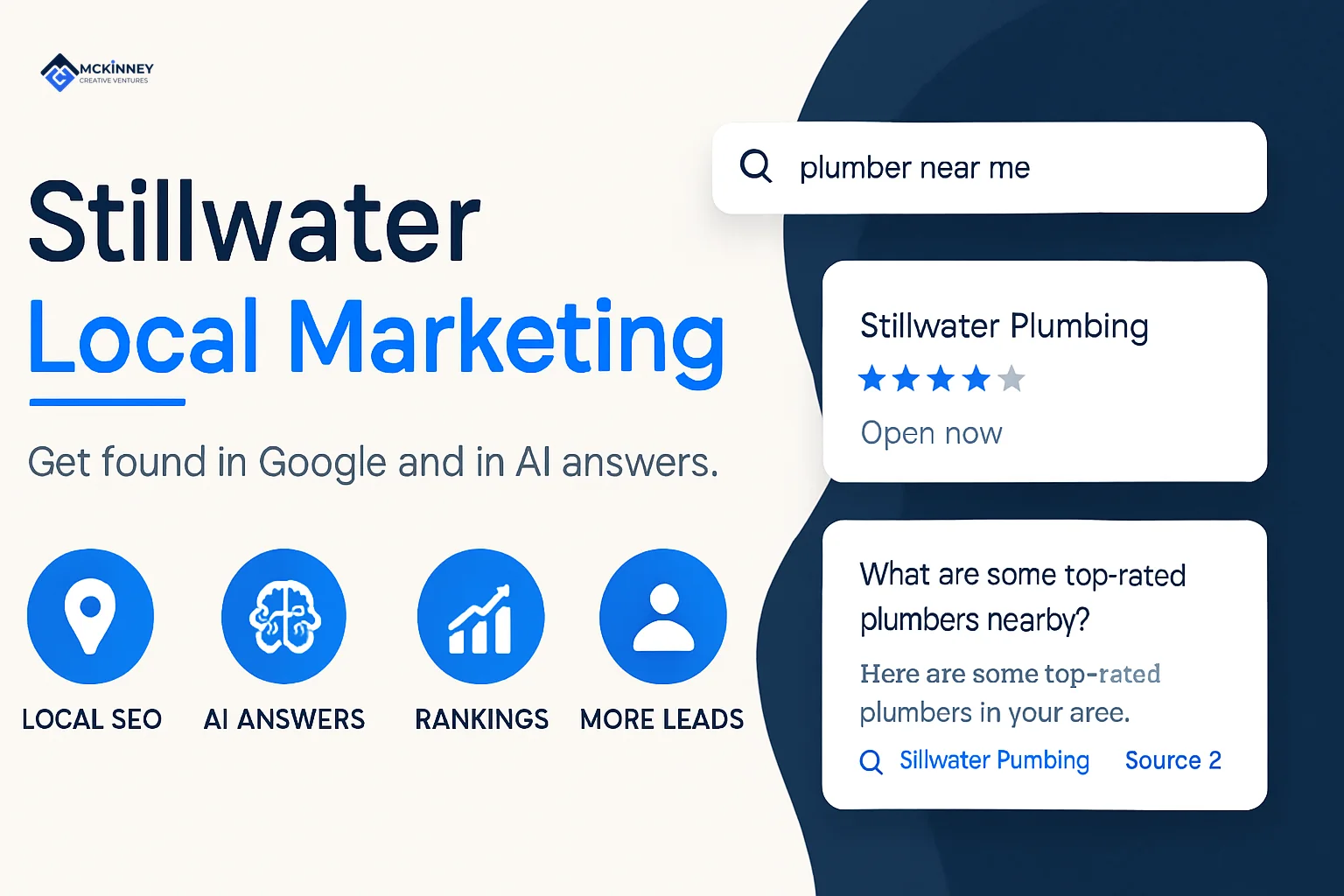
Getting Your Stillwater Business Found in Local Search
Stillwater is a historic river town with tourist traffic and a residential service base. Here is the local search system that gets your business found by both, from Google Business Profile to reviews to St. Croix Valley content.
Ready to Grow Your Business?
Book a strategy call to discuss how we can implement these systems and strategies to help your business scale.
Book a Strategy Call