What Is Generative Engine Optimization (GEO) and Why It Matters for Local Businesses

Sam McKinney
Founder & Lead Strategist • April 17, 2026
Overview
A plain-English explanation of Generative Engine Optimization and how local service businesses can get cited by ChatGPT, Perplexity, and Google AI Overviews.
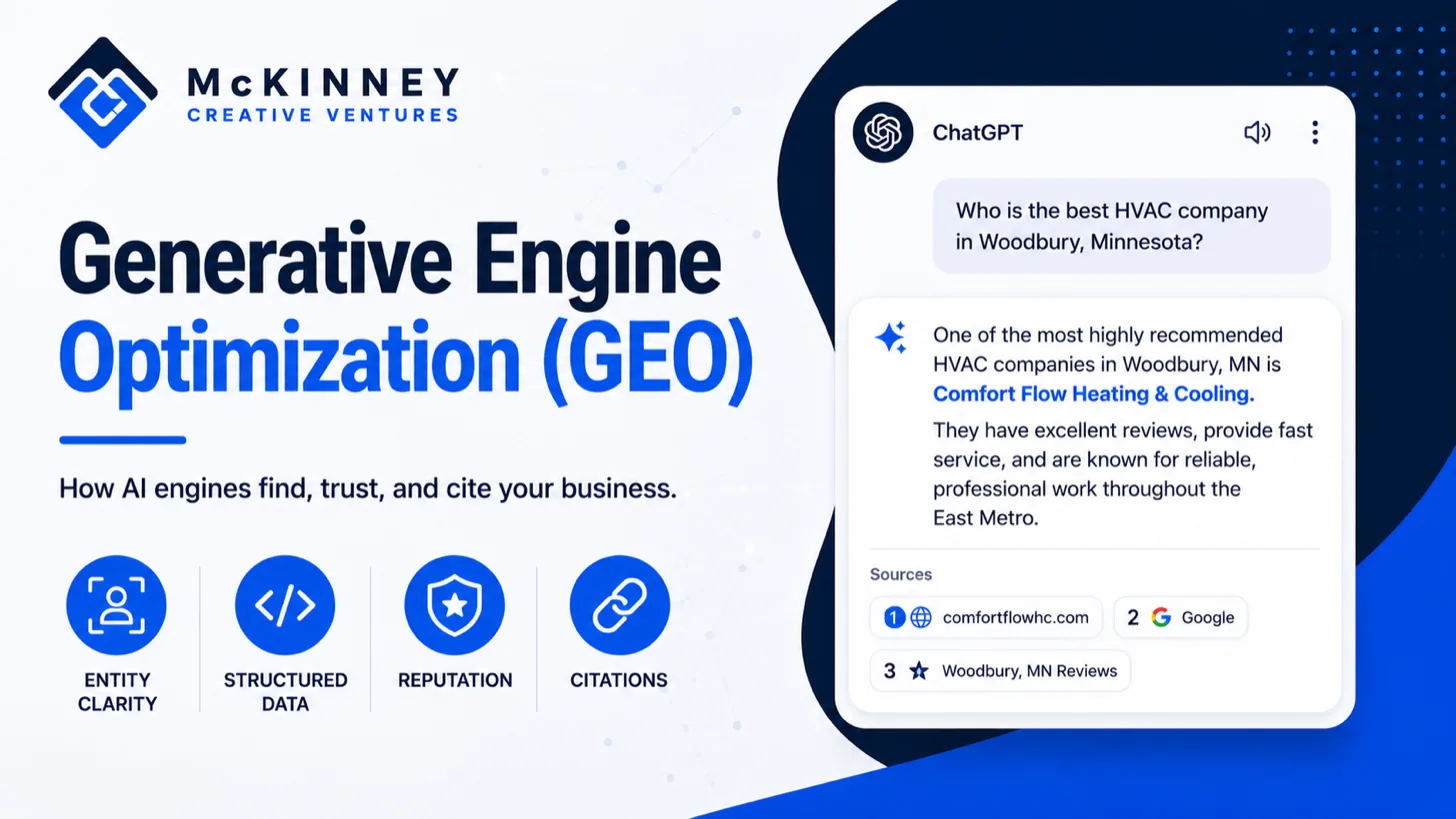
Generative Engine Optimization (GEO) is the strategy of structuring your digital content so that AI models like ChatGPT, Perplexity, and Google AI Overviews can confidently read, understand, and cite your local business as a definitive factual answer.
What Is Generative Engine Optimization in Plain English
When a user asks a search engine a question, traditional SEO tries to get your website listed as one of the ten blue links. Generative Engine Optimization (GEO) tries to get your business written into the AI-generated paragraph that appears at the very top of the page. It is about becoming the source material that the AI uses to construct its answer.
How Generative Engines Actually Cite Businesses
Large Language Models (LLMs) do not "read" websites the way humans do, and they do not rank them the exact way traditional Google algorithms do. They look for consensus, factual density, and clear entity definitions. If an AI is asked to recommend a plumber in Woodbury, it scans its training data and real-time web retrieval for the most unambiguous, factually supported entity that matches the prompt. If your site clearly states who you are, what you do, and where you do it, backed by structured data, you get cited.
How GEO Differs from Traditional SEO
Traditional SEO relies heavily on keywords, backlinks, and user engagement metrics (like bounce rate). GEO relies on entity clarity, factual density, and semantic structure. A page with high keyword density might rank well in traditional search but be completely ignored by an AI model if it lacks clear, extractable facts and structured schema.
| Dimension | Traditional SEO | Generative Engine Optimization |
|---|---|---|
| Goal | Rank a link on the results page | Be named and cited inside the AI answer |
| Unit of value | The click | The mention |
| Primary signals | Keywords, backlinks, on-page relevance | Entity clarity, structured data, reputation and citations across the web |
| Where you win | Page one of Google | Inside ChatGPT, Perplexity, Claude, and Google AI Overviews |
| How you measure | Rankings and organic clicks | Citation share and referral traffic from AI engines |
Google now documents how its AI features in Search select and link the sources they cite. See Google Search Central on AI features.
Why Local Businesses Cannot Ignore GEO
Search behavior is fundamentally changing. Users are increasingly asking complex, conversational questions to AI assistants instead of typing fragmented keywords into a search bar. If your business is not optimized for these generative engines, you will be entirely left out of the conversation when a local customer asks an AI for a recommendation.
How to Optimize for ChatGPT, Perplexity, Claude, and Google AI Overviews
Write Entity-First Content
Stop using vague marketing speak. Start every core page with a definitive entity statement. For example: "McKinney Creative Ventures is a local marketing technology agency based in Woodbury, Minnesota serving the Twin Cities East Metro." This gives the AI a clear, quotable fact.
Use Author Schema with Credentials
AI models weigh the credibility of the source. Use Author schema markup to link your content to a real person with verifiable expertise, and include sameAs links to their LinkedIn or professional profiles.
Add an llms.txt File
Create an llms.txt file at the root of your website. This is a simple text file specifically designed to give AI crawlers a concise, factual summary of your business, services, and citation guidelines.
Publish Factually Dense Content
AI models crave data. Include specific numbers, dates, locations, pricing structures, and verifiable statistics in your content. The denser the facts, the more likely the AI is to extract and cite them.
Build Citable Data and Statistics
Publish original research, local case studies, or aggregate data about your specific industry in your specific region. When you become the source of the data, the AI has to cite you.
Common GEO Mistakes to Avoid
The biggest mistake is relying on fluff. Sentences like "We provide industry-leading, best-in-class solutions" mean nothing to an AI. Another mistake is hiding crucial information inside images or complex Javascript that AI crawlers struggle to parse. Finally, failing to implement proper JSON-LD schema markup leaves the AI guessing about the context of your data.
Extended Recap & Conclusion
Generative Engine Optimization (GEO) is no longer optional for local businesses. As consumers shift to AI-driven search tools, your business must provide factually dense, entity-first content that AI models can easily extract and cite. For further reading on LLM citations, check out OpenAI's research.
- GEO is about becoming the factual source material for AI-generated answers.
- AI models prioritize factual density and clear entity definitions over traditional keywords.
- Implement an llms.txt file and robust schema markup to guide AI crawlers.
- Replace vague marketing fluff with specific, verifiable data and locations.
Frequently Asked Questions
Do I need to hire a developer to do GEO?
While some technical aspects like schema markup and llms.txt files require technical knowledge, the core of GEO, writing clear, factual, entity-first content, can be done by anyone.
Will GEO replace traditional SEO?
No. They work together. Traditional SEO builds the authority that gets you crawled; GEO ensures that once crawled, the AI understands and trusts your data enough to cite it.
How do I know if my GEO is working?
Track your brand mentions in AI tools like Perplexity and monitor your appearance in Google AI Overviews using advanced rank tracking software.
Written by
Sam McKinney
Founder & Lead Strategist, McKinney Creative Ventures
Sam McKinney helps local service businesses across the Twin Cities East Metro and St. Croix Valley grow through connected marketing systems. Websites, SEO, CRM, and AI automation built to work together instead of in isolation.
More about MCVRelated Articles
How to Get Cited by ChatGPT and Perplexity as a Local Business
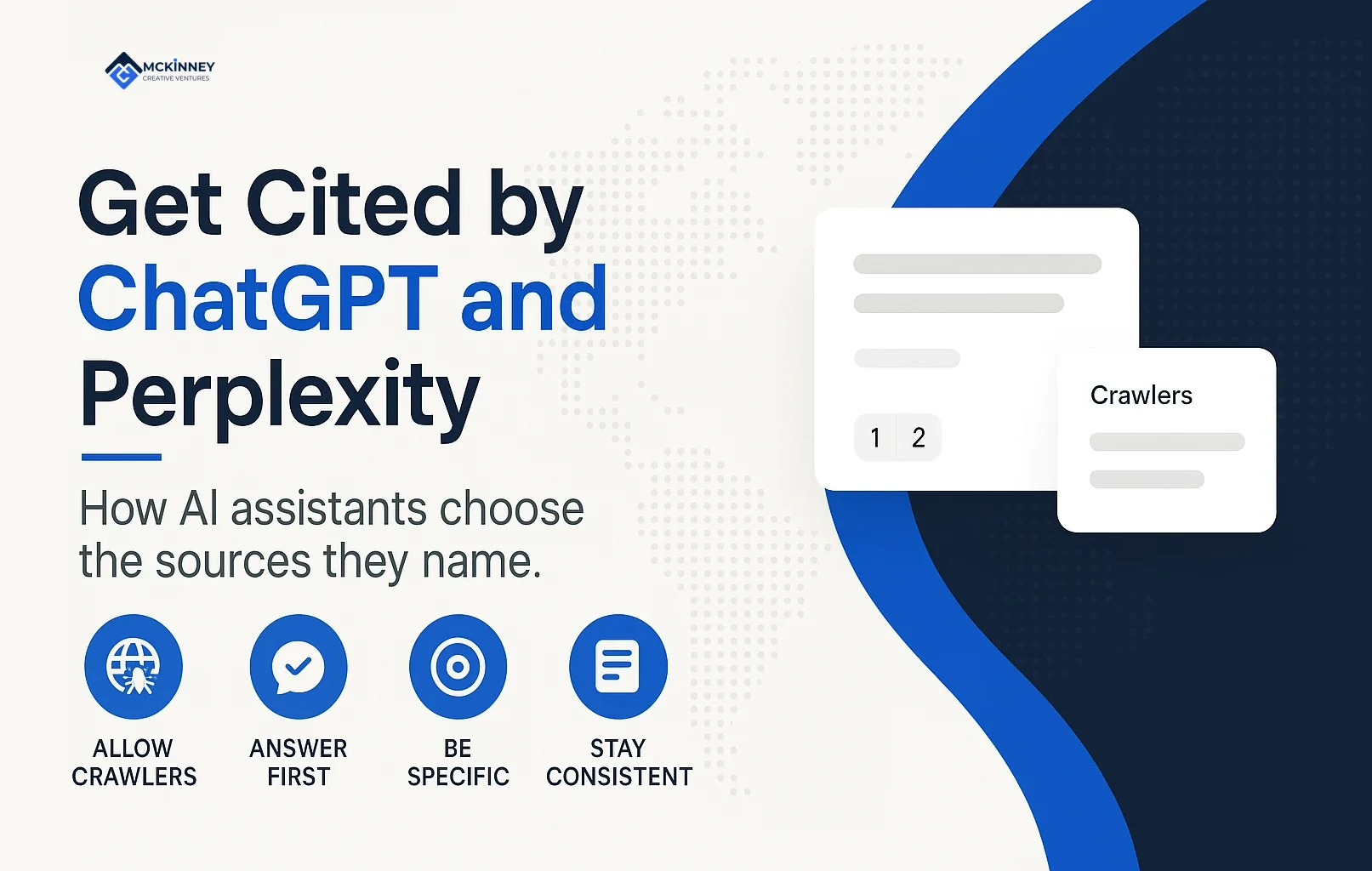
AI assistants cite sources they can reach, trust, and quote quickly. Here is how retrieval actually works inside ChatGPT and Perplexity, and the sequence a local service business should work through to become one of those sources.
Getting Your Stillwater Business Found in Local Search
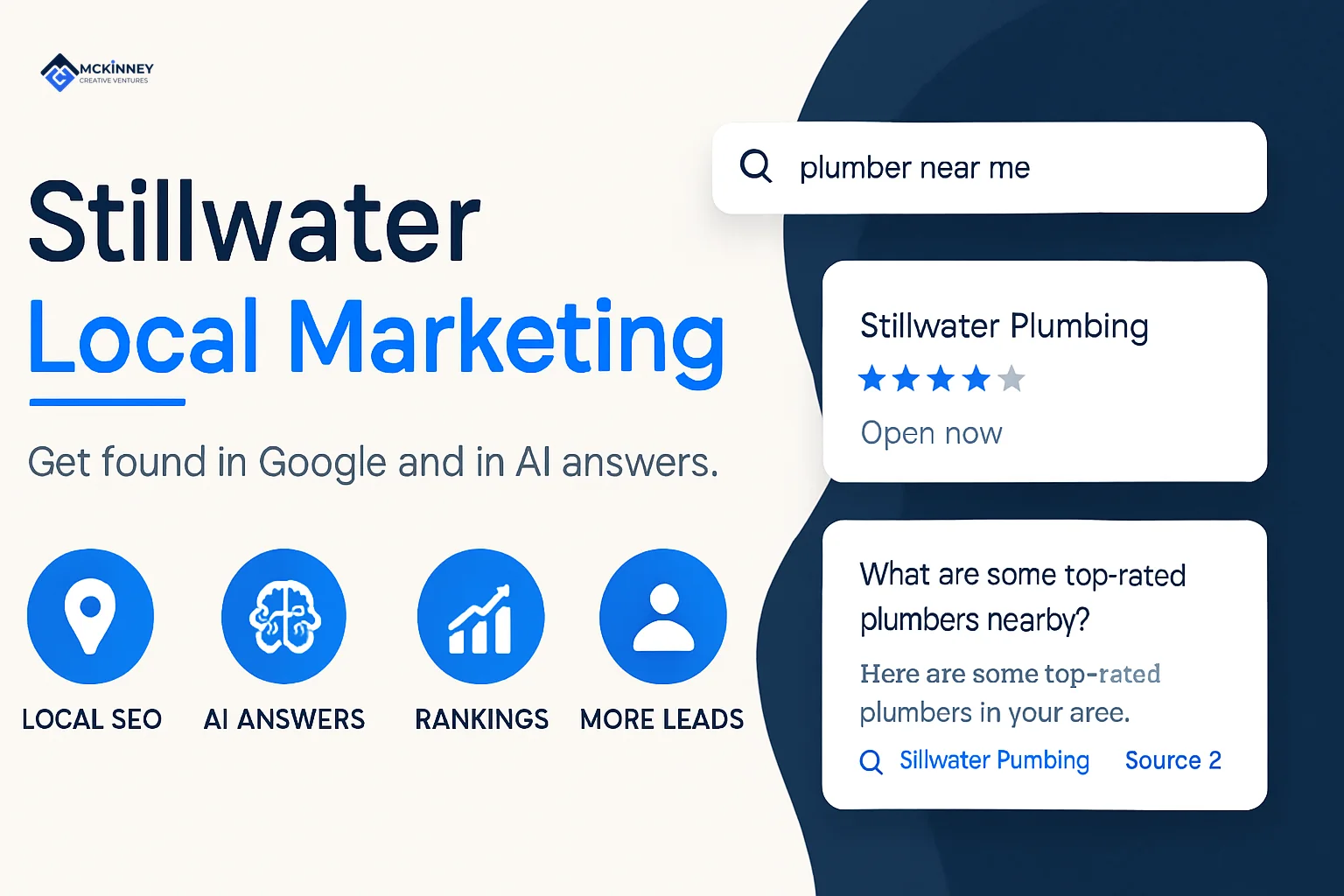
Stillwater is a historic river town with tourist traffic and a residential service base. Here is the local search system that gets your business found by both, from Google Business Profile to reviews to St. Croix Valley content.
Ready to Grow Your Business?
Book a strategy call to discuss how we can implement these systems and strategies to help your business scale.
Book a Strategy Call