
How to Get Cited by ChatGPT and Perplexity as a Local Business
Sam McKinney
Founder & Lead Strategist • August 4, 2026
Overview
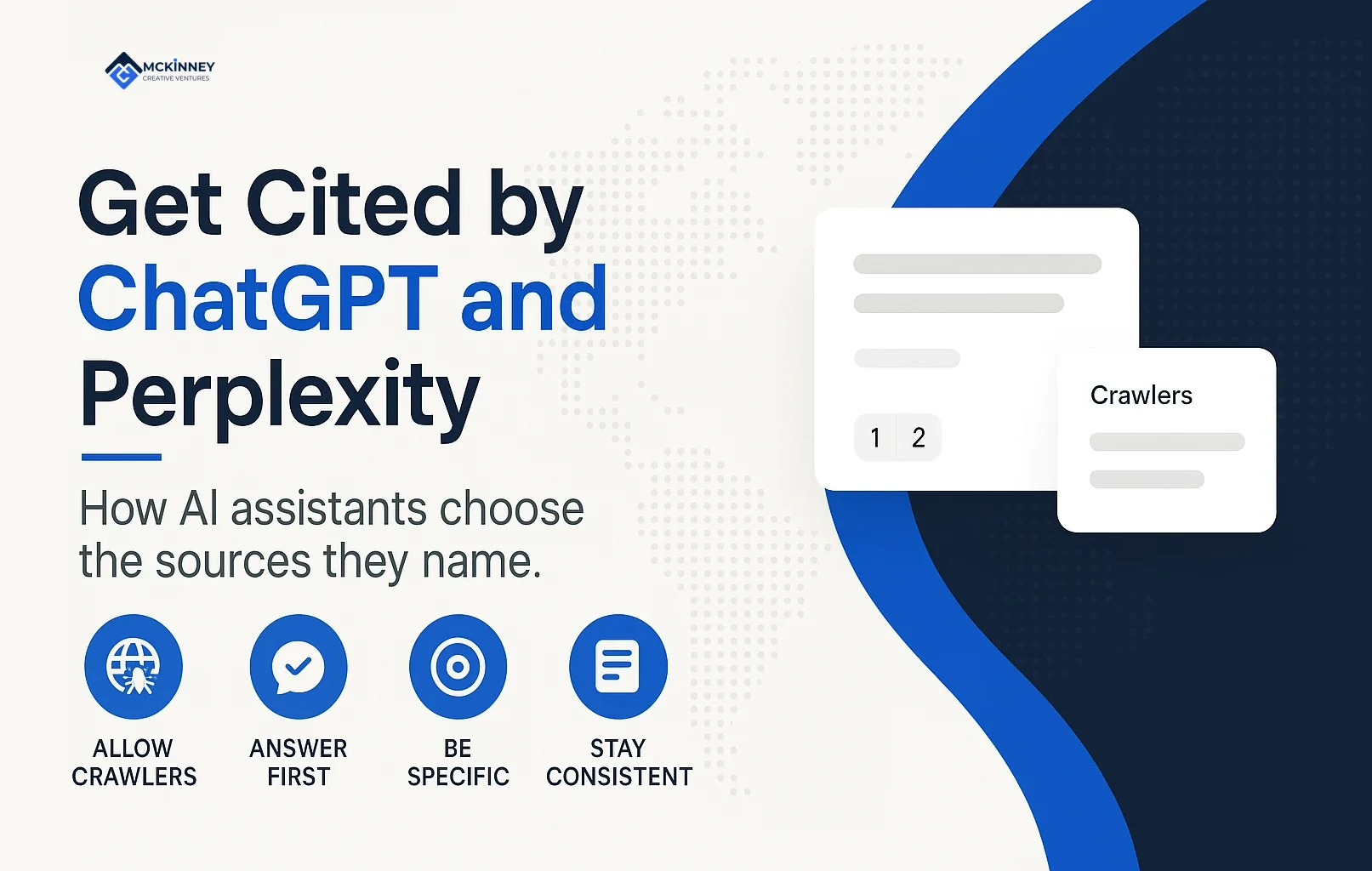
AI assistants cite sources they can reach, trust, and quote quickly. Here is how retrieval actually works inside ChatGPT and Perplexity, and the sequence a local service business should work through to become one of those sources.
To get cited by ChatGPT or Perplexity, your page has to survive three filters in order: the assistant's crawler has to be allowed to fetch it, a search index has to consider it relevant to the question, and the model has to find it easier to quote than the other candidates it pulled back. Most local businesses fail on the first or the third filter, not the second.
This is retrieval, not magic. When someone asks a question that needs current or specific information, the assistant runs live searches, collects candidate pages, ranks them, and builds an answer out of the handful it trusts most. Citation is the visible end of that process, and everything you can influence happens earlier. The work is concrete and mostly unglamorous. The catch is that one misconfigured firewall rule can remove you from an entire assistant, and nobody will tell you it happened.
What it means to get cited by ChatGPT, and what it does not mean
Two different processes get confused constantly, and the difference decides what you can control.
Training is when a model learns from a large body of text long before anyone asks a question. You cannot reliably engineer a citation through training, and training data is not where day to day answers about your business come from.
Retrieval is what produces citations. The assistant searches the live web at the moment of the question, fetches pages, and links to the ones it used. That process runs on crawlers with published names and documented rules, which makes it auditable. Both OpenAI and Perplexity run separate bots for separate jobs, and both are explicit that those bots are managed independently.
The crawlers that decide whether you are even a candidate
| Crawler | Operator | What it does | What blocking it costs you |
|---|---|---|---|
| OAI-SearchBot | OpenAI | Surfaces websites in ChatGPT's search features | OpenAI states that sites opted out of OAI-SearchBot "will not be shown in ChatGPT search answers" |
| GPTBot | OpenAI | Crawls content to train generative AI foundation models | Signals that your content should not be used in training. Managed separately from search visibility |
| ChatGPT-User | OpenAI | Fetches a page when a user action inside ChatGPT requires it | OpenAI notes it is not used for automatic crawling and does not determine search visibility |
| PerplexityBot | Perplexity | Surfaces and links websites in Perplexity search results | Removes you from what Perplexity can surface. Perplexity states this bot does not crawl for model training |
| Perplexity-User | Perplexity | Visits a page to answer a specific user question | Perplexity states it generally ignores robots.txt because the fetch is user initiated |
| Googlebot | Standard Search crawl, which also feeds AI Overviews and AI Mode | Removes Search eligibility, and therefore eligibility for Google's AI features |
Those distinctions come from the operators themselves: OpenAI's crawler documentation and Perplexity's bot documentation. Both publish IP ranges so you can verify a request is genuine rather than a scraper wearing the user agent as a costume.
Step one: confirm the assistants can actually reach you
This is the filter that quietly removes small businesses, and it usually happens by accident. A security plugin blocks "AI bots" as a category, or a firewall rule written to stop scrapers catches OAI-SearchBot alongside the bad actors. The site keeps ranking in Google, so nothing looks broken, and the business is simply absent from ChatGPT.
Two checks worth doing this week:
- Read your own robots.txt. Load yourdomain.com/robots.txt and look for any Disallow aimed at OAI-SearchBot or PerplexityBot, or a blanket rule catching everything not explicitly allowed. Decide each bot deliberately. Blocking GPTBot to stay out of training while allowing OAI-SearchBot to stay in answers is a legitimate position, and it is only possible because they are separate.
- Check the layer above robots.txt. Your CDN or security provider can block a crawler before robots.txt is ever read. Perplexity recommends combining user agent matching with IP verification so you can allow the real bot without opening the door to impersonators.
If you cannot control robots.txt or firewall rules on your platform, that is a real constraint on AI visibility. It is one of the first things we audit in an SEO, GEO, and AEO engagement.
Step two: stop optimizing for things that do nothing
An entire cottage industry has grown up around AI visibility, and a good share of its advice is invented. Google addressed this in its own guidance on optimizing for generative AI features, and the language is unusually blunt.
On special files and markup, Google says: "You don't need to create new machine readable files, AI text files, markup, or Markdown to appear in Google Search," and confirms Search ignores them. On fragmenting content, the guide says there is "no requirement to break your content into tiny pieces for AI to better understand it." It also notes that AI systems understand synonyms, so you do not need to chase long tail keyword variants.
What Google does require is ordinary: "To be eligible to be shown in generative AI features on Google Search, a page must be indexed and eligible to be shown in Google Search with a snippet" (Google Search Central, guide to optimizing for generative AI features). Structured data is still worth using for rich result eligibility, but there is no special AI schema to add.
Google also explains that AI Overviews and AI Mode use a query fan-out technique, issuing multiple related searches behind a single question, which lets them surface a wider set of links than a standard results page (Google Search Central, AI features and your website). One customer question can spawn searches for the service, the city, the price, and the qualifications, and different pages of yours can win different branches.
Step three: write pages that are easy to quote
Once you are reachable and eligible, the competition is about quotability. An assistant assembling an answer wants a passage it can lift with confidence. Four properties make that easy.
Answer in the first paragraph
Put the direct answer at the top and the context underneath. If the question is who needs an RPZ backflow test in Washington County, the first sentence should say so, not open with the history of municipal water systems. This is the highest leverage edit on most service pages, and it improves the page for human readers at the same time.
Be specific and verifiable
Named facts beat adjectives. License numbers, cities served, response windows, hours, brands installed, years in business, and named team members give a retrieval system something to anchor to. "Fast, friendly service" gives it nothing.
Publish something that only you have
Google's guidance emphasizes a unique point of view, contrasting a first-hand review based on personal experience with "a summary of existing content" that "simply restates information already available elsewhere." For a local operator that is an advantage. You know what fails in this climate, what the local inspectors ask for, what a job in a 1970s split level actually costs to do right. Nobody else can generate that, which is why it earns citations.
Keep it current and dated
Freshness carries weight in AI answers, and stale pages get passed over. Publish and update with visible dates, keep your sitemap accurate, and consider IndexNow so participating engines learn about changes quickly rather than on a crawl cycle.
Step four: fix the facts about you that live somewhere else
For local questions, assistants are not only reading your website. They are reading your Google Business Profile, map listings, review platforms, directories, and news mentions. When those sources disagree about your hours, address, phone number, or service area, the assistant has a confidence problem, and low confidence sources get dropped from answers.
The practical work is boring and effective:
- Make your name, address, and phone number identical everywhere, down to the formatting.
- Complete your Google Business Profile, including services, service areas, and hours, and keep it active.
- Build genuine review volume on the platforms your customers actually use. Reviews are third party evidence, worth more to a retrieval system than anything you say about yourself.
- State the entity clearly on your own site: legal name, license numbers, cities served, and who does the work. Your about page does more work than most owners realize.
- Correct old listings carrying a prior address, name, or phone number. Contradiction is worse than absence.
This is the same groundwork that drives local pack rankings, which is why AEO is not a separate discipline bolted onto your marketing. We cover the ranking side in how local service businesses rank in Google AI Overviews.
Step five: measure it, because the traffic pattern has changed
Measure AI citation separately from clicks, because a citation increasingly does not produce a visit. Pew Research Center analyzed the March 2025 browsing of 900 U.S. adults and found that on Google result pages containing an AI summary, users clicked a search result on 8 percent of visits, compared with 15 percent of visits to pages without one. Users clicked a link inside the AI summary itself on just 1 percent of those visits (Pew Research Center, July 22, 2025).
Read that carefully before you panic. It is a finding about Google AI summaries, not assistants generally. What it means is that being the cited source is worth more than it used to be, and a traffic-only dashboard understates what your content is doing.
Where to actually look
| Source | What it tells you | Effort |
|---|---|---|
| Search Console, generative AI performance report | How your content performs in Google's generative AI features and Discover | Free, already connected on most sites |
| Bing Webmaster Tools, AI Performance | How often your URLs are cited across Microsoft Copilot and Bing's AI answers | Free, in public preview as of February 2026 |
| Manual prompt testing | Whether you appear for the questions your customers actually ask, and who appears instead | Thirty minutes monthly, done consistently |
| Analytics referral traffic from assistant domains | The visits that citations do send, and what those visitors do next | Free, requires a saved report to be useful |
Microsoft's AI Performance report in Bing Webmaster Tools is the most direct citation reporting a small business can get for free right now, because it names the URLs being referenced instead of leaving you to guess.
Manual testing deserves more respect than it gets. Write down the ten questions a good customer asks before hiring you, run them monthly in ChatGPT and Perplexity, and record who gets named. That log shows the answer the assistant currently prefers, which tells you what to publish next.
A sane order of operations
- Audit access. Confirm nothing is blocking OAI-SearchBot, PerplexityBot, or Googlebot by accident.
- Confirm eligibility. A page that cannot produce a snippet cannot feed a generative answer.
- Fix the entity. Make your business facts agree across your site, your Google Business Profile, and the directories that already list you.
- Rewrite the top of your money pages. Lead with the answer, add specifics, cut the throat clearing.
- Publish what only you know, on pages built to be found. This is where a conversion focused site and a content plan stop being separate projects.
- Baseline and measure. Run your ten questions, save the results, check again in thirty days.
Only the first step is genuinely new. The rest is what good local marketing has always been, done with more discipline because the machines reading your site are less forgiving of vagueness than a human skimmer.
Extended Recap & Conclusion
Getting cited by ChatGPT and Perplexity comes down to three filters. Access decides whether their crawlers can fetch you at all, and both companies document which bots do what, so this is auditable rather than mysterious. Eligibility is ordinary search hygiene: indexed pages that can show a snippet, with no need for llms.txt files, special AI schema, or content chopped into fragments, all of which Google states plainly are unnecessary. Quotability is where the remaining opportunity sits: answer directly at the top, be specific enough to verify, publish something only you could write, and keep it current.
Underneath all of it is entity consistency. A retrieval system builds confidence from agreement across independent sources, so your website, your Google Business Profile, your reviews, and every directory that lists you need to tell the same story. Measure the result as citation rather than clicks, because a dashboard that only counts sessions will tell you your best content is failing. None of this requires a new marketing department. It requires the local search foundation you should already have, held to a standard where a machine can read it without guessing.
Frequently Asked Questions
Do I need an llms.txt file to get cited by AI?
No. Google states that you do not need to create machine readable files, AI text files, markup, or Markdown to appear in Google Search, and that Search ignores them. No major assistant documents llms.txt as a requirement. Spend the effort on making your actual pages reachable, indexed, and clear.
Does blocking GPTBot stop me from appearing in ChatGPT answers?
Not by itself. OpenAI runs GPTBot and OAI-SearchBot as separate crawlers. GPTBot is for training foundation models, while OAI-SearchBot surfaces sites in ChatGPT's search features, and OpenAI states that sites opted out of OAI-SearchBot will not be shown in ChatGPT search answers. You can disallow one and allow the other.
How long does it take to start getting cited?
There is no published timeline, and anyone quoting a specific number is guessing. Access fixes can take effect as soon as the crawler returns, while content and entity work compounds over months the way local SEO does. Baseline with manual prompt testing first so you can tell whether anything changed.
Is AEO different from SEO for a local business?
Less different than the marketing around it suggests. Google's guidance is that its generative features are rooted in core Search ranking and quality systems, so the fundamentals carry over. What changes is emphasis: crawler access becomes an explicit decision, direct answers matter more than clever intros, and consistency of your business facts carries more weight.
If AI answers reduce clicks, is content still worth producing?
Yes, but the scoreboard changes. Pew found that on Google pages with an AI summary, users clicked a result on 8 percent of visits versus 15 percent without one, so measuring content purely by sessions undercounts it. Being the source an assistant names in front of a buyer deciding who to call has real value, and that buyer still has to contact somebody.
What should a local business do first?
Read your own robots.txt and check your bot mitigation settings. It takes ten minutes and it is the one filter that no amount of content work overcomes.
If you want to know whether AI assistants can actually reach and understand your business right now, that is a specific, answerable question. Book a strategy call and we will audit your access, your entity consistency, and the pages that should be earning citations across the Twin Cities East Metro, St. Croix Valley, and western Wisconsin.
About Sam McKinney
Sam McKinney is the Founder and Lead Strategist at McKinney Creative Ventures. He helps local service businesses scale through connected marketing systems, SEO, and AI automation.
More About MCVRelated Articles
Getting Your Stillwater Business Found in Local Search
Stillwater is a historic river town with tourist traffic and a residential service base. Here is the local search system that gets your business found by both, from Google Business Profile to reviews to St. Croix Valley content.
Your Customers Are Asking AI About You
People are asking ChatGPT and Google's AI for local recommendations. The question is whether it names your business or your competitor's.
Ready to Grow Your Business?
Book a strategy call to discuss how we can implement these systems and strategies to help your business scale.
Book a Strategy Call