
Google Review Policies in 2026: What Is Allowed, What Is Banned, and How to Stay Compliant

Sam McKinney
Founder & Lead Strategist • June 10, 2026
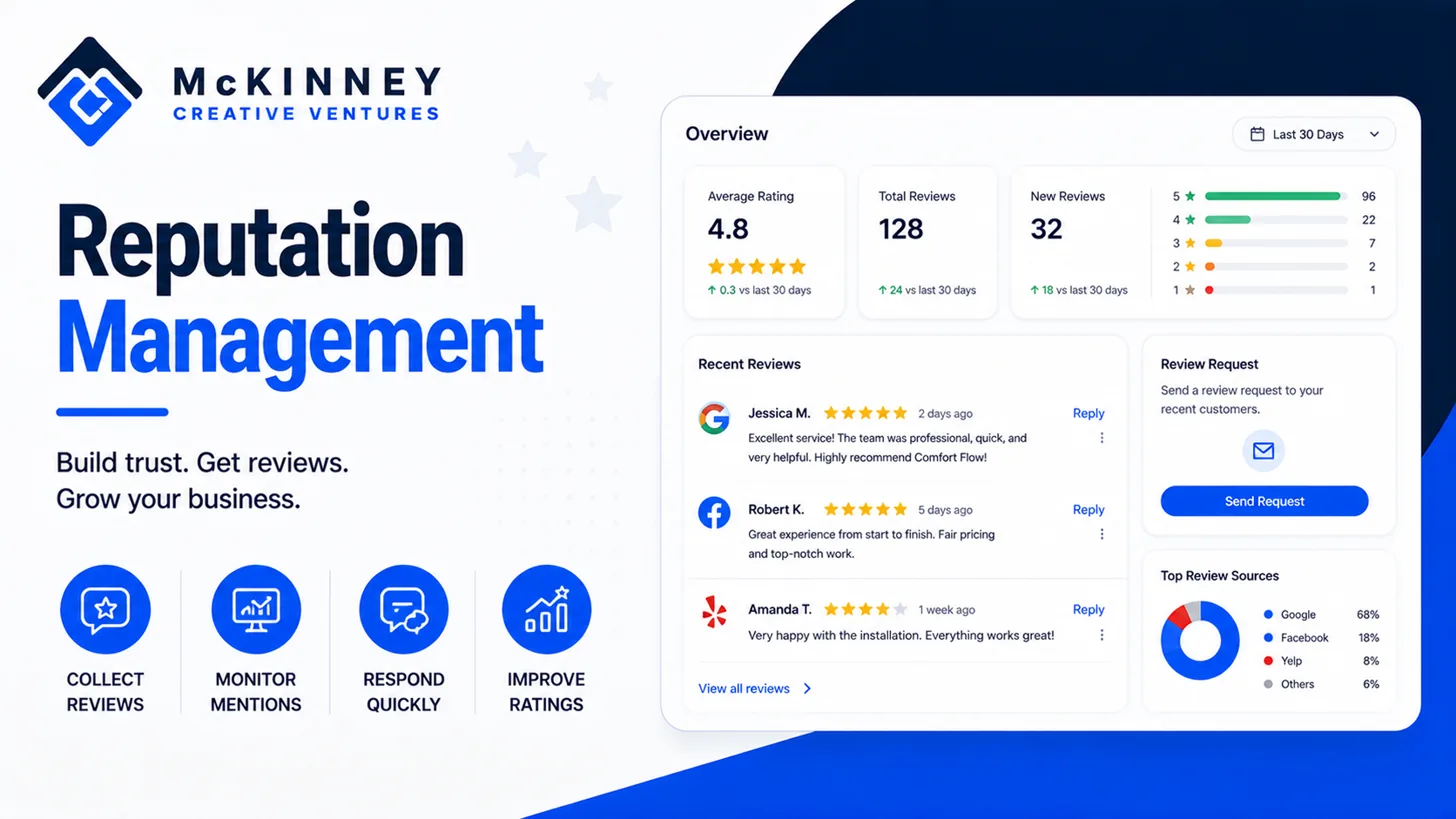
Listen to the podcast episode
The 2026 Google Review Policy Updates
The McKinney Creative Ventures Podcast · Episode 1 · 13:40
Prefer to read? The full guide is below. Browse all episodes.
Overview
Google tightened its review rules in April 2026. Here is a plain-English guide to what is allowed, what is banned, and exactly how local businesses can get more reviews without breaking policy or the law.
Google's review policies come down to one principle: every review must reflect a real, firsthand experience, and a business cannot manufacture, filter, or buy the outcome. As of an April 2026 update, Google explicitly bans review quotas and directing staff to solicit reviews that name a specific employee. The other long-standing rules still apply: no incentives, no review gating, no insider reviews, and no pressuring customers to review on-site. Break them and you risk having reviews stripped, your Google Business Profile suspended, and, in the United States, exposure under a new FTC rule.
Reviews are the most valuable trust signal a local service business has, which is exactly why the rules around them are strict and getting stricter. Many of the tactics that agencies and vendors sold as best practices a few years ago are now policy violations. This guide lays out what Google actually permits, what it prohibits, and how to build more reviews the right way, so you can share it with your team and stop relying on advice that could get your profile flagged.
The core rule: a review must reflect a genuine experience
Everything in Google's review policy flows from a single requirement in its Maps user-generated content rules: content must be based on a real experience and must accurately represent the location. Google's policy prohibits "content that is not based on a real experience or does not accurately represent the location" (Google Maps user-generated content policy). If a review is invented, incentivized, written by someone with a stake in the business, or coached into existence, it fails that test, no matter how positive it is.
Google is enforcing this at scale. In its 2025 Trust and Safety reporting, Google said it blocked or removed more than 292 million policy-violating reviews in a single year. The volume of fake reviews is rising, driven in part by AI making them cheap to produce, which is why the company keeps tightening both the rules and the automated systems behind them.
What Google added in April 2026
On April 17, 2026, Google added two new clauses to the rating manipulation section of its policy, closing loopholes that local businesses had leaned on for years (PPC Land). The policy now explicitly prohibits:
- Review quotas: "merchants requesting that staff solicit a certain number of reviews." Telling your team to bring in ten reviews a month is now a stated violation.
- Scripted staff-name reviews: "merchants requesting that staff solicit reviews that include specific content, including content that identifies a staff member."
This second clause is the one most people are getting wrong, so it is worth being precise. Google did not ban reviews that mention employees. A customer who writes "Jake was fantastic" is completely fine, and that review can still be published and featured. What is banned is the business engineering it: coaching staff to ask customers to name them, or running campaigns built around staff-name mentions. The line is between a genuine, unprompted mention and a manufactured one.
The practices that violate Google's review policy
Here is the full set of prohibited practices, stated plainly so your team can avoid them.
Review gating
Review gating means selectively asking only happy customers for a public review while routing unhappy ones to a private channel. A common version is a survey that sends four-star-and-up responses to Google and everything below to an internal form. Google prohibits discouraging or prohibiting negative reviews and selectively soliciting positive ones. You must ask everyone the same way, regardless of how you expect them to respond.
Incentivized reviews
You cannot offer anything of value in exchange for a review. Google's policy bars merchants from offering "incentives, such as payment, discounts, free goods and/or services, in exchange for posting any review." That includes entry into a giveaway, a discount on the next service, or a small gift. The incentive taints the review whether it is positive or not.
On-premises pressure and shared review devices
Google's policy states that merchants should not "require or pressure users to leave ratings or write reviews while on the premises." That is the basis for the widely reported crackdown on review kiosks and shared tablets. A dedicated in-store device that customers use to leave a review pressures an on-the-spot rating, often from a single device and IP address, which also looks like manipulation to Google's spam systems. The compliant pattern is the opposite: the customer reviews later, on their own device, after they have left.
Scripted content
You cannot tell customers what to say. Google instructs that merchants should not "request that specific content be included." Asking a customer to mention a particular product, phrase, or staff member crosses the line. You can invite a review. You cannot dictate its contents.
Insider reviews and conflicts of interest
Reviews from people connected to the business are prohibited under the conflict-of-interest rule, which covers "current or former employment, a contractual or consultory relationship, or other professional or personal affiliations." In practice that means owners, employees, contractors, family members, and close friends should not be reviewing the business. It also means you should not review your competitors.
The legal layer: the FTC's fake review rule
In the United States, this is no longer only a platform-policy issue. A Federal Trade Commission rule that took effect on October 21, 2024 makes it unlawful to buy or sell fake reviews and addresses insider reviews that do not disclose the relationship, company-controlled review sites posing as independent, and certain review-suppression tactics, with civil penalties available against knowing violators (Federal Trade Commission). So a tactic like having staff and family post glowing reviews is now both a Google violation and a potential legal liability.
How to get more reviews, the compliant way
None of this means you cannot actively build reviews. Google clearly permits soliciting and encouraging genuine reviews, as long as there are no incentives and no pressure. The compliant playbook is straightforward and, done consistently, outperforms the shortcuts anyway:
- Ask everyone, not just the happy ones. A neutral, universal request is both compliant and a more accurate picture of your business.
- Ask after they leave, on their own device. A follow-up text or email shortly after the job, with a direct link to your Google review page, is the cleanest method.
- Make it easy, not scripted. A review link or QR code on a receipt, an emailed invoice, or a take-home card is fine. Just do not tell them what to write.
- Automate the timing, not the content. Trigger the request when a job is marked complete so it happens every time, while the experience is fresh.
- Respond to every review. Responding is allowed, encouraged, and builds trust with the next reader.
This is exactly how we build review engines for clients inside our CRM and automation work, and it pairs with the broader Google Business Profile optimization guide.
What to do about a fake or unfair review
If a competitor, a former employee, or a person who was never a customer posts a review, do not retaliate with fake positives. Flag the review through your Google Business Profile for removal, citing the specific policy it breaks, such as conflict of interest or content not based on a real experience. Then respond publicly, calmly, and factually, because that response is written for the next reader far more than for the reviewer. Removal is not guaranteed and can be slow, but a professional response protects your reputation regardless of the outcome.
Extended Recap & Conclusion
Google's review rules reward businesses that earn reviews and punish those that manufacture them. The core requirement is that every review reflect a genuine, firsthand experience. The April 2026 update added explicit bans on review quotas and on directing staff to solicit reviews that name an employee, while the long-standing prohibitions remain: no incentives, no review gating, no on-premises pressure or shared review kiosks, no scripted content, and no insider reviews from owners, staff, family, or close friends. In the US, the FTC's 2024 rule adds real legal exposure on top of platform risk.
The good news is that the compliant path is also the durable one. Ask every customer, ask after they leave on their own device, make it frictionless without scripting it, automate the timing, and respond to everything. That builds a review profile that lifts your local ranking and survives Google's enforcement, instead of one that can vanish overnight.
Frequently Asked Questions
Can customers mention an employee by name in a Google review?
Yes. A customer naming an employee in a genuine, unprompted review is allowed. What Google banned in April 2026 is the business soliciting reviews that name a staff member, meaning coaching your team to ask customers to mention them by name. The organic mention is fine. The engineered one is not.
Is it against Google policy to use a review kiosk or tablet in my store?
It runs against Google's rule that merchants should not require or pressure users to review while on the premises, and shared-device reviews also tend to trigger spam filtering because they come from one device and IP address. The compliant approach is to have customers leave reviews later, on their own devices, after they have left your location.
Can I offer a discount or enter customers in a giveaway for leaving a review?
No. Google prohibits offering incentives, including payment, discounts, free goods or services, or giveaway entries, in exchange for any review. The incentive violates policy whether the resulting review is positive or negative.
What is review gating and why is it not allowed?
Review gating is filtering customers so only the satisfied ones are asked for a public Google review while unhappy ones are diverted to a private channel. Google prohibits selectively soliciting positive reviews and discouraging negative ones. You must invite all customers to review using the same process.
Can my employees or family members leave reviews for my business?
No. Reviews from owners, current or former employees, contractors, family, and close friends fall under Google's conflict-of-interest prohibition. In the United States, undisclosed insider reviews are also covered by the FTC's 2024 fake reviews rule, so this carries legal as well as platform risk.
If you are not sure whether your current review process is compliant, or you want a review engine that builds reviews automatically and within the rules, that is exactly what we set up for local service businesses. Book a free 30-minute strategy call and we will audit how you collect reviews and fix anything that puts your profile at risk.
Written by
Sam McKinney
Founder & Lead Strategist, McKinney Creative Ventures
Sam McKinney helps local service businesses across the Twin Cities East Metro and St. Croix Valley grow through connected marketing systems. Websites, SEO, CRM, and AI automation built to work together instead of in isolation.
More about MCVRelated Articles
Can Google's AI Actually Find Your Business?
People ask Google full questions now, not keywords. With AI-powered Maps, your Google Business Profile is how Google understands your business in the first place. Here is how to make it clear enough to get recommended.
Getting Your Stillwater Business Found in Local Search
Stillwater is a historic river town with tourist traffic and a residential service base. Here is the local search system that gets your business found by both, from Google Business Profile to reviews to St. Croix Valley content.
Ready to Grow Your Business?
Book a strategy call to discuss how we can implement these systems and strategies to help your business scale.
Book a Strategy Call