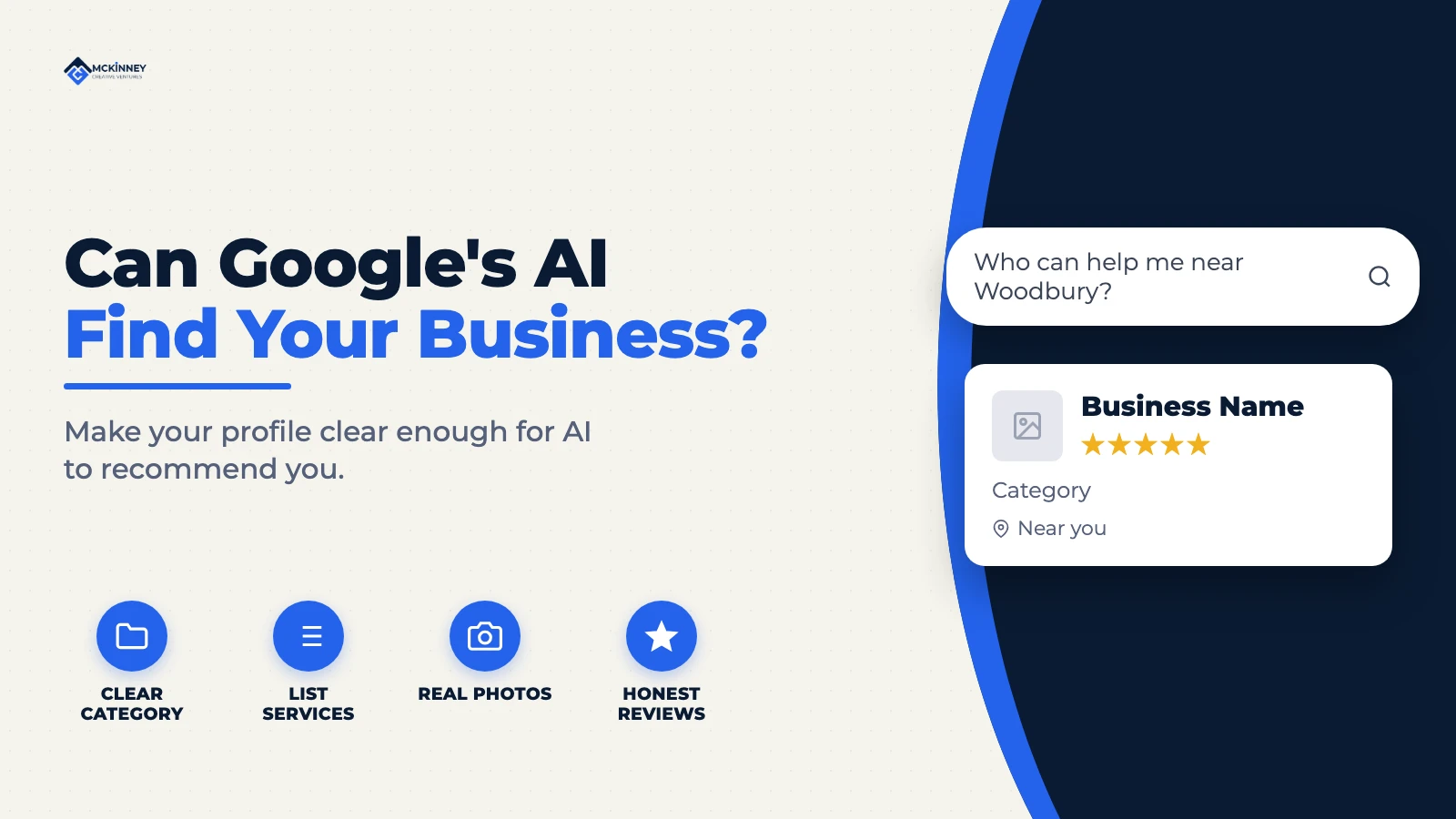
Can Google's AI Actually Find Your Business?

Sam McKinney
Founder & Lead Strategist • July 18, 2026
Listen to the podcast episode
Can Google's AI Actually Find Your Business?
The McKinney Creative Ventures Podcast · Episode 7 · 6:42
Prefer to read? The full guide is below. Browse all episodes.
Overview
People ask Google full questions now, not keywords. With AI-powered Maps, your Google Business Profile is how Google understands your business in the first place. Here is how to make it clear enough to get recommended.
When someone needs a plumber, a photographer, or a marketing company, they are not always searching Google the way they used to. Instead of typing "plumber near me," they might ask, "Who can replace a water heater near Woodbury this week, has strong reviews, and offers upfront pricing?" That is a much more specific question, and with Google's new AI-powered Maps experience, Google is getting much better at answering it.
So today's question is simple: can Google's AI actually find your business?
Your Google Business Profile is now an input, not just a listing
Google Maps is no longer just a digital map or a directory of nearby companies. Its AI features, sometimes called Ask Maps, let people have a conversation with Google about what they need. Someone can describe the service, the location, the timing, and even the kind of experience they prefer, and Google recommends businesses that appear to match. To build those recommendations, Google says Maps analyzes information from hundreds of millions of places, including what customers write in reviews.
That changes what your profile is for. It is no longer just something customers look at after they find you. It is part of the information Google uses to understand your business in the first place. So the real question becomes, what does Google actually know about your company? Does your profile clearly explain what you do? Are your services listed individually? Is your primary category accurate? Are your hours current? Do your photos show the work you actually perform? And do your reviews describe the problems you solve?
A tale of two plumbers
Picture two plumbing companies. The first has a profile that simply says "plumber," a phone number, a few old photos, and reviews that mostly say things like "great company." The second lists water heater replacement, drain cleaning, water treatment, boiler repair, and emergency plumbing. Its photos show technicians performing those services. Its reviews mention fast response times, honest pricing, specific repairs, and the communities it serves. Which business do you think Google can understand more clearly?
This is not about stuffing keywords everywhere or trying to manipulate the system. It is about giving Google complete, accurate, and useful information. Google says local results are primarily influenced by relevance, distance, and prominence. You cannot control how close you are to every customer, but you can improve how relevant and established your business appears.
Four things to fix this week
Start with your categories. Your primary category should describe the main thing your business actually is, not simply one service you happen to provide. Then add a limited number of accurate secondary categories where they fit.
Review your services. Do not assume Google automatically knows everything you offer. List your major services clearly, using the same language your customers would naturally use when searching for them.
Look at your photos. Upload recent, authentic images of your team, your location, your products, and your work. Google specifically recommends category-relevant photos that help customers understand what a business offers.
Keep reviews honest and specific. Continue asking real customers for reviews. Do not write them for people or pressure them to use certain language. But a review that naturally explains what service was performed and what the experience was like gives future customers, and Google's systems, far more useful context than a generic five-star rating.
Finally, make sure your website supports what your profile says. Your services, business name, contact information, location, and service area should be clear and consistent, with dedicated, useful pages for the services you want to be known for.
Your action step for today
Open your Google Business Profile and look at it as though you know absolutely nothing about your company. Could someone immediately understand what you do, where you work, and why they should choose you? More importantly, could an AI system understand it? The future of local search is not just about ranking for a short keyword. It is about becoming the most relevant answer to a very specific question. And if Google cannot clearly understand your business, it cannot confidently recommend it.
Frequently Asked Questions
What is Google's Ask Maps?
Ask Maps is Google's AI-powered way of searching Maps by describing what you need as a full question, like "who can replace a water heater near Woodbury this week with strong reviews," instead of a short keyword. Google analyzes information from hundreds of millions of places, including reviews, to recommend businesses that match.
How does Google decide which local businesses to recommend?
Google says local results are primarily influenced by relevance, distance, and prominence. You cannot change your distance from every searcher, but you can improve relevance and prominence with an accurate, complete Google Business Profile, clear service listings, real photos, and genuine reviews.
Does my website still matter if Google is using my Business Profile?
Yes. Your website should support and match your profile, with consistent business information and dedicated pages for the services you want to be found for. The profile and the website work together to help Google, and AI systems, understand and trust your business.
Written by
Sam McKinney
Founder & Lead Strategist, McKinney Creative Ventures
Sam McKinney helps local service businesses across the Twin Cities East Metro and St. Croix Valley grow through connected marketing systems. Websites, SEO, CRM, and AI automation built to work together instead of in isolation.
More about MCVRelated Articles
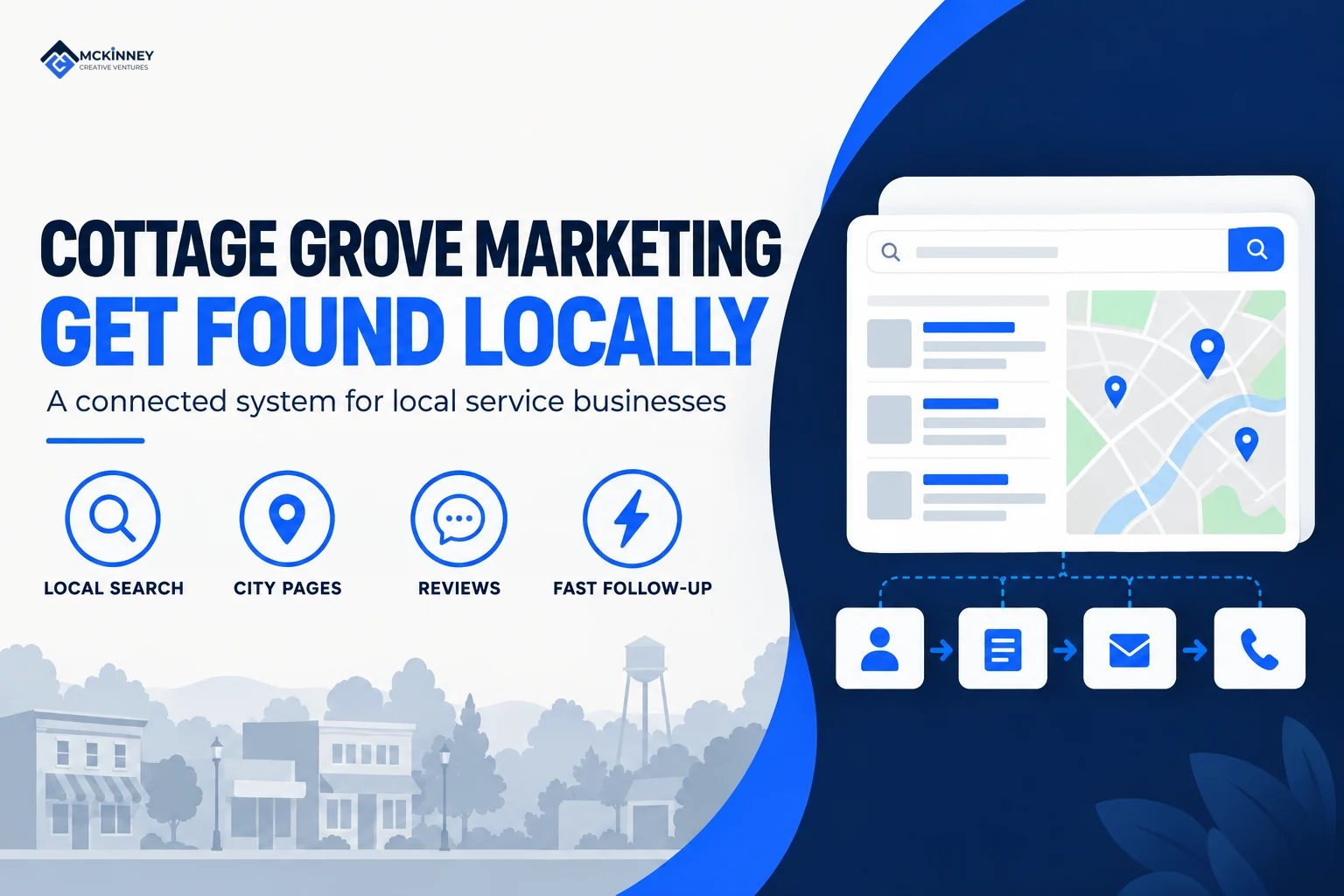
Cottage Grove MN Marketing: How Local Service Businesses Get Found
Cottage Grove is growing, but growth does not automatically send the right customers to your door. Build a local marketing system that connects search visibility, useful city content, reviews, and fast follow-up.

Hudson, WI Service Businesses: Marketing Across the Border
A Hudson service business that works both sides of the St. Croix is running one brand across two states, two licensing regimes, and two separate local search markets. Here is how to set that up so neither side gets treated as an afterthought.
Ready to Grow Your Business?
Book a strategy call to discuss how we can implement these systems and strategies to help your business scale.
Book a Strategy Call