
Cottage Grove MN Marketing: How Local Service Businesses Get Found
Sam McKinney
Founder & Lead Strategist • September 8, 2026
Overview
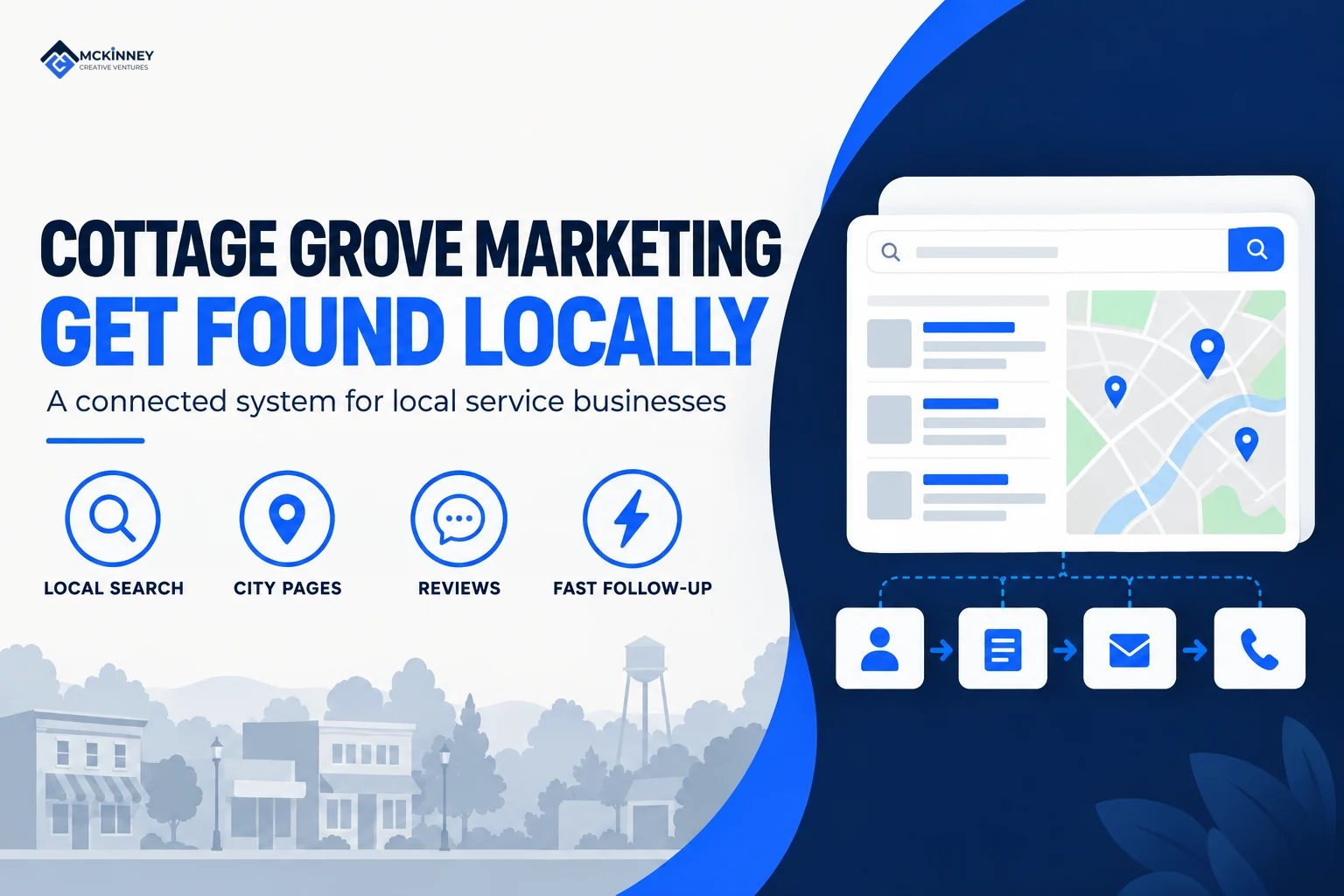
Cottage Grove is growing, but growth does not automatically send the right customers to your door. Build a local marketing system that connects search visibility, useful city content, reviews, and fast follow-up.
Cottage Grove MN marketing works when a local service business connects four jobs: show up where nearby customers search, prove it understands the area, make the next step obvious, and follow up before the opportunity goes cold. A city page or Google Business Profile can start that process, but neither can carry it alone.
That matters in Cottage Grove because the market is changing. New households create new demand, established homeowners still need ongoing service, and every visible growth signal attracts more competitors. The business that wins is usually not the one doing the most marketing. It is the one with the clearest system from local search to booked work.
Cottage Grove MN marketing starts with the market you actually serve
The phrase "growing suburb" is easy to repeat and easy to misuse. The useful question is what the growth changes for a service business. The U.S. Census Bureau's current QuickFacts profile for Cottage Grove estimates 43,604 residents as of July 1, 2025, up 12.3 percent from the April 2020 estimates base. It also reports that 88.2 percent of occupied housing units were owner occupied during 2020 to 2024.
Those figures do not promise leads. They do tell you that Cottage Grove has added residents quickly and remains a heavily homeowner market. For contractors, cleaners, landscapers, clinics, and other local operators, that creates several different customer situations that should not be flattened into one generic message.
- New residents need orientation. They are choosing providers without years of local referrals to lean on. Clear service-area information, visible reviews, and useful explanations reduce uncertainty.
- Established homeowners need confidence. They may already know several local names. Proof of process, current work, and responsive communication matter more than another broad claim about quality.
- Older and newer housing create different questions. A useful page addresses the conditions relevant to the work you actually perform, based on real jobs and verified local knowledge.
- Commercial buyers need operational clarity. Property managers and business owners care about service coverage, scheduling, documentation, and whether you can keep a commitment.
The city's own Comprehensive Housing Needs Analysis looks ahead through 2035 and identifies expected growth among both young adults and older residents. That mix is a reminder to write for real customer situations, not a single imaginary "Cottage Grove homeowner." A first-time buyer, a household maintaining a long-owned property, and an older resident planning ahead do not search, compare, or schedule the same way.
Build one connected path from local search to booked work
Most local marketing problems are handoff problems. The Business Profile says one thing, the website says another, the form asks too much, and the lead lands in an inbox nobody checks. Each tool may be working as configured while the system still loses the customer.
Start by mapping the complete path. A Cottage Grove customer searches for a specific service, sees a map result or organic page, checks whether the business genuinely serves the city, looks for evidence, and decides whether calling is worth the risk. After the click or call, the business still has to respond, qualify the request, schedule the next step, and keep the promise.
| Stage | Customer question | Asset that should answer it | Signal to measure |
|---|---|---|---|
| Discovery | Who provides this service near Cottage Grove? | Google Business Profile, focused service page, useful city page | Search impressions, profile actions, qualified visits |
| Trust | Do they understand my kind of property or problem? | Specific copy, real project evidence, reviews, clear process | Calls, form starts, engaged visits to proof sections |
| Conversion | What happens if I contact them? | Visible call button, short form, scheduling option, response expectation | Completed calls, forms, and appointments |
| Follow-up | Will they get back to me and keep me informed? | CRM routing, missed-call text back, reminders, pipeline ownership | Response time, contact rate, estimates scheduled |
| Retention | Should I hire them again or refer someone? | Completion follow-up, review request, maintenance reminder | Repeat work, reviews, referrals |
This map keeps channel decisions honest. If people find you but do not call, buying more traffic will not fix the trust or conversion problem. If calls arrive and sit unanswered, rewriting the homepage will not fix the response problem. Diagnose the broken stage before adding another tactic.
Make Google Business Profile accurate before making it busy
For many local service businesses, Google Business Profile is the first page a Cottage Grove customer sees. Accuracy comes before posting frequency. Your real-world business name, primary category, phone number, hours, website, and service area should agree with the business customers actually encounter.
Google's current service-area guidance says a business that does not serve customers at its address should remove that address from the profile. It also allows up to 20 service areas, requires areas to be entered as cities, postal codes, or similar places rather than a radius, and says the overall area generally should not extend beyond about two hours of driving time from the business base.
The practical lesson is restraint. Add Cottage Grove because you genuinely serve Cottage Grove, not because every nearby city looks like a free keyword. A tight service area supports clear scheduling, relevant reviews, and pages backed by actual experience. An inflated area creates bad-fit calls and makes every local claim thinner.
What to maintain every month
- Services: Use the closest accurate categories and service descriptions. Do not turn the business name into a keyword list.
- Photos: Publish real work, real staff, and real equipment with customer privacy protected. A steady record is more credible than a one-day upload spree.
- Reviews: Ask every eligible customer through the same completion process. Never gate the request based on whether you expect a positive rating.
- Questions and changes: Check hours, links, calls, and suggested edits. A profile can drift even when nobody on your side changes it.
Our SEO, GEO, and AEO work treats the profile, website, structured data, and content as one source of truth. That consistency helps customers and search systems reach the same conclusion about who you are, what you do, and where you work.
A Cottage Grove page has to earn its city name
A city page is not local because the heading says Cottage Grove. It is local when the useful parts would change if the city changed. That means the page should reflect the work you actually do there, the customer questions you actually hear, and the service boundaries you actually honor.
Start with a clear statement of coverage. Then explain the services most relevant to the market, show real proof when you have permission to use it, and answer local questions without pretending to know more than you do. If permitting, property conditions, seasonal access, or travel policies matter to the service, verify them from a primary source before publishing. If they do not matter, do not add them just to sound local.
The city-page evidence ladder
- Verified service coverage. Say where you go and any real limits on scheduling or minimum job size.
- Specific service relevance. Explain why customers in this area commonly need the work, without turning an assumption into a fact.
- Real proof. Use approved project photos, customer reviews, or examples tied to work that actually happened.
- Useful local detail. Link to the municipality, utility, or regulator when its current information affects the customer's decision.
- A direct next step. Tell the customer whether to call, request an estimate, or schedule, and what information to have ready.
MCV's own Cottage Grove marketing page follows that principle by describing the market we serve and the system we build, rather than pretending a city name alone creates authority. One strong page can support several services. Do not create a separate Cottage Grove page for every service until each one has enough distinct, honest information to stand on its own.
Reviews and response speed turn visibility into trust
Local visibility creates a shortlist. Reviews and response determine who survives it. The goal is not to collect a giant number for display. It is to create a steady, representative record that helps the next customer understand what working with you is like.
Build the review request into job completion. Confirm the work is done, send the same direct request to every eligible customer, make the link easy to use, and respond to the review. Keep the language neutral. Customers decide the rating.
Then fix the first-response gap. A service lead is often contacting more than one business, especially when the need is urgent. Route calls and forms into one system, alert the responsible person, acknowledge the request immediately, and define what happens when a call is missed. A short automated response should set an expectation and help the customer continue, not impersonate a human conversation.
This is where CRM and automation earns its place. The right workflow does not replace the owner or office staff. It prevents a paid-for opportunity from disappearing between voicemail, email, and a paper estimate.
Use a 90-day plan instead of a pile of disconnected tasks
A local marketing system does not need to launch all at once. It does need an order. Spend the first month correcting the foundation, the second building useful local proof, and the third improving the handoffs that turn interest into scheduled work.
| Timing | Priority | Work to complete | Evidence of progress |
|---|---|---|---|
| Weeks 1 to 2 | Accuracy | Audit profile, website contact details, categories, service areas, hours, and tracking | One consistent business record and working conversion paths |
| Weeks 3 to 4 | Local page | Improve the Cottage Grove page with verified coverage, services, proof, FAQs, and a clear CTA | Page indexed, internal links live, calls and forms attributable |
| Weeks 5 to 8 | Proof | Add approved work, maintain photos, request reviews through the completion process | Fresh proof appears steadily, without fabricated claims |
| Weeks 9 to 12 | Follow-up | Route every inquiry, add missed-call handling, define estimate reminders, review the pipeline | Fewer unowned leads and clearer response-time reporting |
Measure the chain, not vanity totals. Search impressions can reveal visibility. Profile actions and qualified visits show consideration. Calls, forms, and appointments show conversion. Response time and estimate outcomes show whether operations are capturing the demand. No single number tells the whole story.
Extended Recap & Conclusion
Cottage Grove MN marketing is not a city-page project. It is a connected operating system for being found, trusted, contacted, and remembered. Cottage Grove's population growth and high owner-occupancy make the local opportunity real, but opportunity is not the same as automatic demand. Businesses still have to match their visibility to the services they can deliver and the customers they are equipped to serve.
Get the facts consistent first. Build a Cottage Grove page that earns its name. Maintain real proof. Route every lead into a defined follow-up process. Then measure where the path breaks before buying more traffic. That sequence produces a system you can improve instead of a collection of marketing tasks you have to keep restarting.
Frequently Asked Questions
What should a Cottage Grove service business do first for local marketing?
Start with accuracy. Confirm that your Google Business Profile, website, phone number, hours, categories, and service area all describe the same real business. Then test the call, form, and scheduling paths so every inquiry reaches a responsible person.
Do I need a separate Cottage Grove landing page?
Yes, if you genuinely serve Cottage Grove and can publish useful information specific to that market. No, if the page only swaps the city name into generic copy. A strong page needs verified coverage, relevant services, real proof when available, useful local details, and a clear next step.
How many cities should I add to my Google Business Profile?
Add only the cities and postal areas you truly serve. Google currently permits up to 20 service areas and says the overall boundary generally should stay within about two hours of driving time from the business base. Operational fit matters more than filling every available slot.
How often should I ask customers for reviews?
Ask consistently when an eligible job or service is complete. Use the same neutral process for every customer rather than selecting only people likely to leave a positive rating. A steady workflow is easier to maintain and produces a more honest record.
Should I run ads before improving my local page?
Only if the page and follow-up path already convert. Ads can create traffic quickly, but they also expose weak trust, unclear offers, broken forms, and slow response. Fix the path first so paid demand has somewhere credible to land.
If you want a connected Cottage Grove marketing system instead of another disconnected tactic, book a free strategy call. We will map the first constraint to fix and the simplest path forward.
Written by
Sam McKinney
Founder & Lead Strategist, McKinney Creative Ventures
Sam McKinney helps local service businesses across the Twin Cities East Metro and St. Croix Valley grow through connected marketing systems. Websites, SEO, CRM, and AI automation built to work together instead of in isolation.
More about MCVRelated Articles
Marketing for Electricians: How to Win More Panel, EV, and Service Work
Electricians lose money averaging emergency calls and panel upgrades into one marketing plan. Here is how to route each kind of demand to the channel that actually wins it.
Local Landing Page Best Practices: Pages That Turn Searchers Into Calls
City and service pages fail when they are the same page wearing different name tags. Here is the architecture, the trust signals, and the technical layer that turn a local landing page into booked work.
Ready to Grow Your Business?
Book a strategy call to discuss how we can implement these systems and strategies to help your business scale.
Book a Strategy Call