
Marketing for Electricians: How to Win More Panel, EV, and Service Work
Sam McKinney
Founder & Lead Strategist • September 3, 2026
Overview
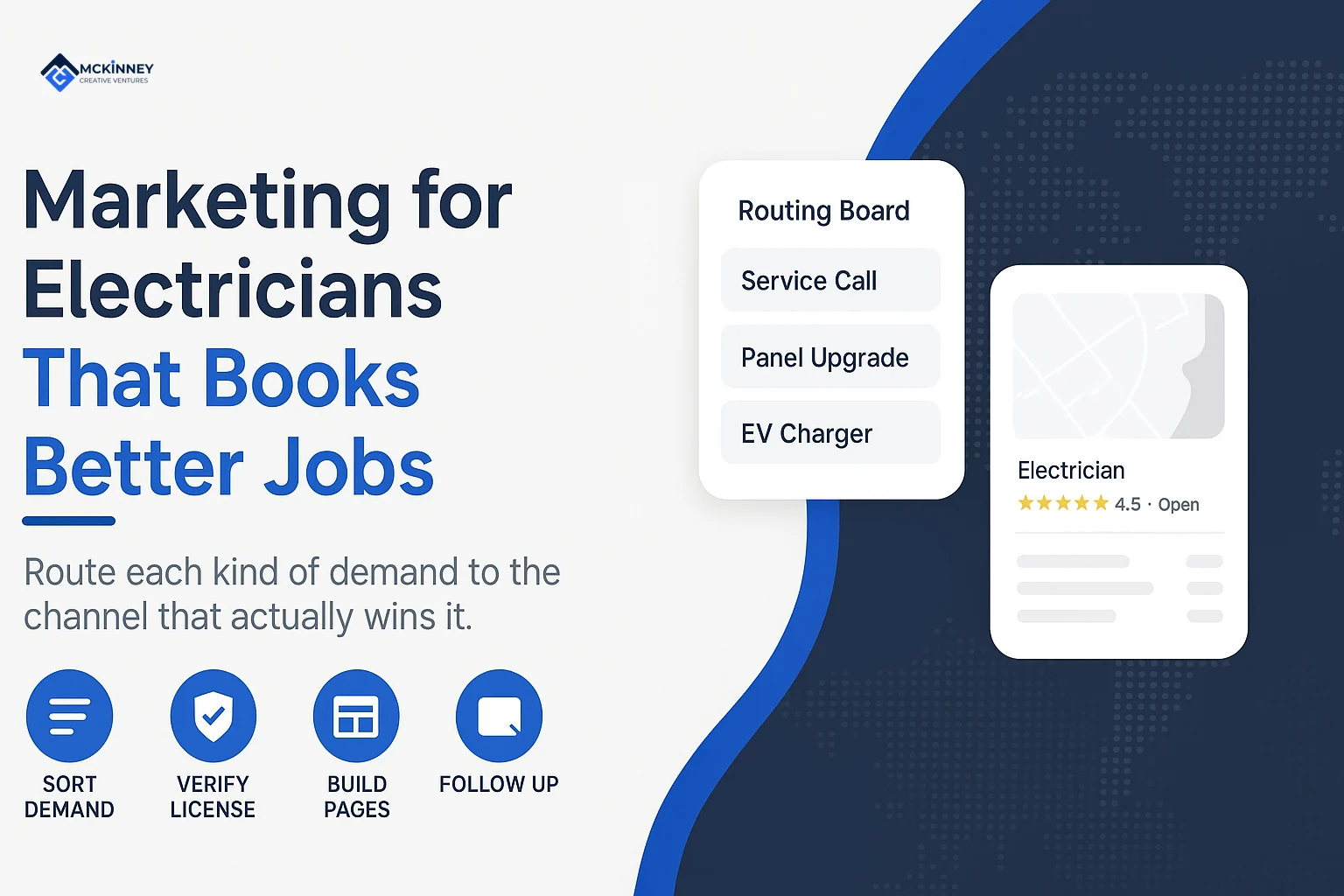
Electricians lose money averaging emergency calls and panel upgrades into one marketing plan. Here is how to route each kind of demand to the channel that actually wins it.
Marketing for electricians works differently than marketing for most trades, and the reason is the demand mix. An electrical contractor's schedule gets filled by three completely different buyers: the homeowner with a dead circuit who hires whoever answers first, the homeowner planning a panel upgrade or EV charger who researches for two weeks before calling anyone, and the builder or property manager who never searches at all and just calls the electrician they trust. One plan cannot serve all three, which is why so many contractors spend every month and still chase low-margin service calls.
The fix is not buying more leads. It is routing. Send each kind of demand to the channel built for it, then make sure nothing that comes in gets dropped. Get that right and an electrician in the Twin Cities East Metro or the St. Croix Valley stops competing on price for emergency work and starts booking the panel, service, and project work that carries margin.
Here is how the pieces fit: which channel wins which job, what has to be true before you spend on ads, and the follow-up that turns quotes into signed work.
Marketing for electricians starts with sorting demand, not buying leads
Most electrical contractors buy marketing as one undifferentiated thing. They pay for "leads" and hope enough turn into work. But a quick troubleshooting call and a full service upgrade do not come from the same search, convert on the same page, or close on the same timeline. Average them together and the emergency calls make your cost per lead look fine while the high-value work goes to someone else. Sort the work you want into buckets, then match each bucket to the channel that reaches it. This is the grid that decides your budget.
| Job type | How the customer behaves | Channel that wins it | What the destination has to do |
|---|---|---|---|
| Emergency and troubleshooting | Searches on a phone, calls the first credible result, does not compare | Local Services Ads, Google Business Profile, Search ads | Get answered by a human fast, or text back within a minute |
| Panel upgrades and service changes | Researches for days or weeks, wants to understand cost and process | Organic search, a dedicated service page, AI answer engines | Explain the work, the signs they need it, and what happens next |
| EV charger installation | Research-heavy, often triggered by a vehicle purchase or a utility program | Organic search plus a specific EV charger page | Cover load capacity, permits, and rebate mechanics honestly |
| Generator and whole-home backup | Long consideration, spikes after outages, high ticket | Organic search, remarketing, past-customer email | Show installed examples and give a real range of scope |
| Commercial and property maintenance | Does not search, buys on relationship and responsiveness | Direct outreach, referrals, CRM follow-up | Stay in front of them between projects without nagging |
| Builder and GC subcontract work | Buys on capacity, licensing, and reliability | Relationships plus a credible website that survives a check | Prove licensing, insurance, and completed scope quickly |
Notice what falls out of that grid: two of the six buckets are not search problems at all. If most of your revenue comes from builders and property managers, your marketing dollar belongs in follow-up systems and reputation, not a bigger ad budget. Deciding that on purpose is most of the work.
Fix licensing and verification before you spend on ads
Electrical work is one of the most heavily verified categories in local advertising, and verification happens before your ads run. If the paperwork is not in order, you cannot buy your way onto the page.
What Minnesota requires of the business
The Minnesota Department of Labor and Industry licenses electrical contractors through the Board of Electricity. Per DLI's electrical contractor licensing basics, a contractor license requires a $25,000 surety bond and liability coverage of at least $100,000 per occurrence, $300,000 aggregate, and $50,000 in property damage. The responsible individual must hold an active master electrician license, must be an owner, officer, member, or W-2 employee actively engaged in electrical work, and cannot serve two contractors at once. DLI also requires the company license number on company vehicles.
Wisconsin licenses separately through its Department of Safety and Professional Services, which matters for anyone working both sides of the St. Croix. If you serve Hudson or River Falls, say so plainly on the site. A homeowner in Wisconsin has no way to know a Minnesota company can legally do their work unless you tell them.
What Google requires before Local Services Ads will run
Google screens electricians harder than most categories. Per Google's business screening and verification requirements, electricians must pass state-level license checks for both the business and the owner, carry general liability and professional liability insurance, clear background checks, and maintain a public, verified Google Business Profile. Screening typically takes three to four weeks after documents are submitted.
Plan around that timeline. If you decide in March that you want Local Services Ads running for spring, you are already late. Document gathering, an insurance certificate matching your legal business name exactly, and the background check queue are the real schedule, not the campaign build.
Your Google Business Profile is the storefront most electricians neglect
For a service-area electrician, the Business Profile is not a directory listing. It is the storefront. It is where map pack ranking comes from, where Local Services Ads pull their identity, and increasingly where AI answer engines get their facts about who you are and where you work.
Three rules from Google's service-area business guidelines catch people out constantly. First, "if you don't serve customers at your business address, remove your address from your Business Profile." Most electricians work out of a shop or home office no customer visits, so the address should be hidden. Leaving it visible is a suspension risk and aims your ranking at the wrong geography. Second, "the boundaries of your overall area shouldn't be more than about 2 hours of driving time from where your business is based." Third, "you can have up to 20 service areas."
That last limit forces a decision. Twenty entries will not cover every suburb between Forest Lake and Lakeville, so pick the twenty where your trucks actually go and where the work you want lives. Listing towns you rarely serve dilutes the profile and produces calls you will decline anyway.
The profile also rewards use. Photos of real jobs, service descriptions naming the specific work, and steady review activity feed the same system. That is the local foundation behind our SEO, GEO, and AEO work, and it is the cheapest visibility an electrical contractor can own.
Local Services Ads and Search ads solve different problems
Electricians routinely run one when they should run the other, or run both without knowing what each is for. Here is the honest comparison.
| Factor | Local Services Ads | Google Search Ads |
|---|---|---|
| Position | Above the map pack, at the top of the page | Below LSAs, above organic |
| You pay for | Qualified leads (calls and messages) | Clicks, whether or not they contact you |
| Entry requirement | License, insurance, background check, verified profile | A working landing page and a budget |
| Best for | Urgent, high-intent service calls | Specific high-value jobs and research-stage searches |
| Message control | Minimal, Google builds the unit | Full control of headline, offer, and landing page |
| Main failure mode | Missed calls burn budget and hurt ranking | Broad keywords drain spend on unqualified clicks |
The practical read: Local Services Ads win the emergency bucket, where being first beats being persuasive. Search ads are better for a specific considered job like a 200 amp panel upgrade, because you control the message and the landing page. Running both is fine once each has a job to do. Running both because an agency set them up is how budget disappears. Building that structure deliberately is what our digital advertising work is for.
Build pages for the jobs you want, not just "electrician near me"
A homepage listing ten services ranks for none of them. Electricians who win high-value work have a real page for each high-value job, written for a person deciding rather than a search engine counting keywords.
Google's guidance on creating helpful, reliable, people-first content frames this as Who, How, and Why: make clear who created the content, be transparent about how it was made, and write primarily to help people rather than to rank. For an electrician that is easy, because you have what no content mill has. You know what a 1960s panel looks like in a Cottage Grove split level, how a service upgrade gets permitted in your city, and why an older Stillwater home needs a load calculation before anyone talks about a charger. Write that down and you have outranked every generic page in your market.
The pages worth building first
- Panel upgrades and service changes. High ticket, high volume, and the customer genuinely does not understand what they are buying. Explain the warning signs, the permit and inspection process, and what a load calculation is.
- EV charger installation. Tied to real programs. Xcel Energy runs EV charging incentives for Minnesota customers, and homeowners arrive half-informed asking about eligibility. Cover load capacity, circuit requirements, and permitting, then point people to the utility for current program terms rather than quoting numbers that change.
- Knob and tube, aluminum wiring, and older home rewiring. The East Metro and the river towns have real pre-modern housing stock. No national franchise can write this page.
- Generator installation. Spikes after storms, long consideration windows, and a strong fit for remarketing.
- Commercial and tenant improvement work. Written for property managers and general contractors, who scan for licensing, capacity, and scheduling.
Then mark those pages up properly. Schema.org publishes a dedicated Electrician type, sitting in the hierarchy Thing, Organization, LocalBusiness, HomeAndConstructionBusiness, Electrician. Using the specific type instead of a generic LocalBusiness gives search engines and AI systems an unambiguous statement of what your business is. Small change, outsized clarity, and part of how we structure every website we build.
Speed to lead and follow-up decide more revenue than ad spend
This is where most electrical contractors leak money, and fixing it costs almost nothing compared to buying more traffic. Two failures account for most of it.
The first is the unanswered call. Electrical demand is urgent and interchangeable in the caller's mind. A homeowner smelling burning at an outlet will not leave a voicemail and wait. They call the next result. With Local Services Ads the damage compounds, because missed calls affect how Google ranks you in the unit you are paying for. An automated text back on every missed call is the highest-return automation an electrician can turn on.
The second is the quote that goes quiet. A panel upgrade or generator install is a considered purchase, and a homeowner who asked for a number in April may be ready in June. Most contractors send the quote and then do nothing, so the job goes to whoever followed up. A short sequence that checks in a few days out, then again a couple of weeks later, closes work that was already yours. That is the core of what we build in CRM and automation, and it works for the trades because it stays short and useful instead of becoming a drip campaign nobody reads.
Reviews close the loop
Reviews feed map pack ranking, Local Services Ads position, and the human decision of which of three electricians to call. The mistake is asking manually, which means asking only when someone remembers. Trigger the request when the job is marked complete, send it by text, and make it one tap. Recent, steady reviews beat a bigger pile of old ones.
Extended Recap & Conclusion
Marketing for electricians is a routing problem before it is a budget problem. Emergency work is won by being first and available, so Local Services Ads, a clean Google Business Profile, and instant response are the right stack. Panel upgrades, EV chargers, and generators are won by being genuinely useful on a real page for that job, so organic search and specific service pages are the stack. Commercial and builder work is won by relationships and follow-up, which is a CRM problem, not an advertising one. Serving all three with one generic campaign is why the spend feels wasted.
The order matters too. Handle licensing, insurance, and verification first, because Google's screening for electricians runs on its own timeline. Fix the Business Profile next, because it is free and feeds everything else. Then build pages for the jobs you want. Only after that does more ad budget make sense, and even then the follow-up system matters more, because leads you already paid for are the cheapest ones you will ever get.
Frequently Asked Questions
How much should an electrician spend on marketing?
Any percentage you see online is someone else's average, not your business. The better question is what a booked job is worth to you and what your close rate on quotes is now. An electrician converting a third of panel upgrade quotes has very different budget math than one converting a tenth. Fix the close rate first. It costs nothing and it changes what any ad budget is worth.
Are Local Services Ads worth it for electricians?
They are worth it when you can answer the phone fast and already meet the entry requirements. Google requires state-level license verification for the business and owner, general liability and professional liability insurance, background checks, and a verified Google Business Profile, with screening typically taking three to four weeks. If calls routinely go to voicemail, hold off. Missed calls waste the spend and hurt your position.
Should an electrician hide their address on Google Business Profile?
Yes, if customers do not come to you. Google's guidance is direct: if you do not serve customers at your business address, remove it from the profile. Most electricians work from a shop or home office no customer visits, which makes them a service-area business. Leaving a residential address visible is a suspension risk and aims your ranking at the wrong place.
What is the fastest way for an electrician to get more high-value jobs?
Two moves, in this order. Build a real page for the specific high-value job you want more of. Then add follow-up on every quote that does not close within a week. Most contractors have quoted work sitting in a folder that would close on a second call, which is faster and cheaper than generating new demand.
Do I need separate pages for each city I serve?
Only if each page has something genuinely specific to say about that city. A page on older home rewiring in Stillwater's historic housing stock earns its place. Fifteen pages that swap the city name into the same paragraph do not, and Google treats that pattern as spam. Good test: delete every mention of the city and see whether you can still tell which city the page is about.
If you run an electrical contracting business in the Twin Cities East Metro, the St. Croix Valley, or western Wisconsin and you want the demand sorted and the follow-up running without you touching it, get in touch and we will map out what to fix first.
Written by
Sam McKinney
Founder & Lead Strategist, McKinney Creative Ventures
Sam McKinney helps local service businesses across the Twin Cities East Metro and St. Croix Valley grow through connected marketing systems. Websites, SEO, CRM, and AI automation built to work together instead of in isolation.
More about MCVRelated Articles
Cottage Grove MN Marketing: How Local Service Businesses Get Found
Cottage Grove is growing, but growth does not automatically send the right customers to your door. Build a local marketing system that connects search visibility, useful city content, reviews, and fast follow-up.

Local Landing Page Best Practices: Pages That Turn Searchers Into Calls
City and service pages fail when they are the same page wearing different name tags. Here is the architecture, the trust signals, and the technical layer that turn a local landing page into booked work.
Ready to Grow Your Business?
Book a strategy call to discuss how we can implement these systems and strategies to help your business scale.
Book a Strategy Call