
How Much Should a Local Service Business Actually Spend on Marketing in 2026

Sam McKinney
Founder & Lead Strategist • April 5, 2026
Overview
A grounded breakdown of what local service businesses should actually spend on marketing in 2026, with real numbers and benchmarks.
McKinney Creative Ventures helps local business owners in the Twin Cities calculate realistic marketing budgets based on their growth goals, not generic formulas.
The Standard Answer and Why It Misses the Mark
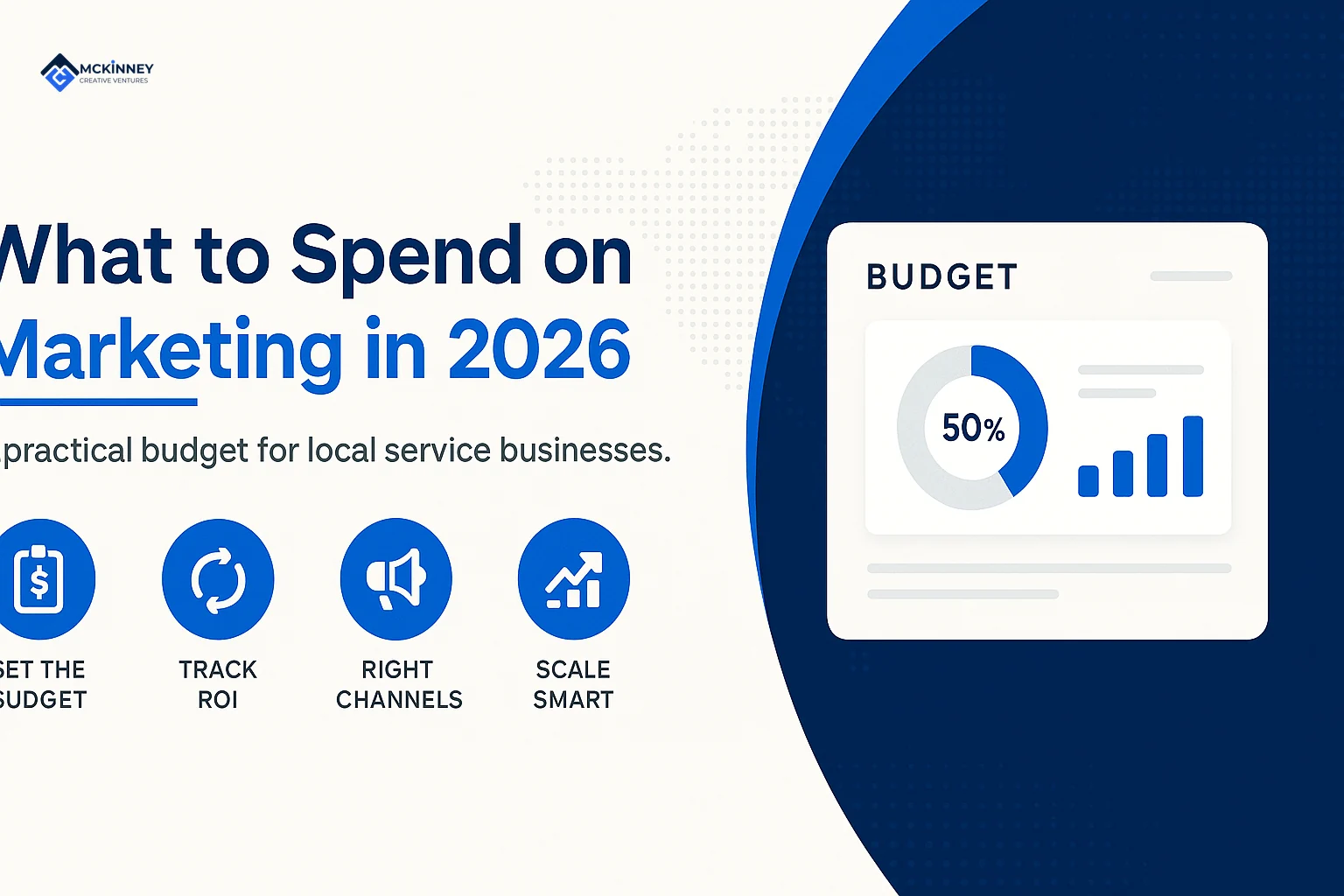
The old advice is to spend 5-10% of revenue on marketing. This is flawed. A new business needing aggressive growth might need to spend 20%, while an established business at capacity might spend 3% just on retention.
How to Calculate a Real Marketing Budget
Calculate your Customer Acquisition Cost (CAC) and determine how many new customers you need to hit your revenue targets. Multiply the two to find your baseline budget.
Where to Allocate the Budget
Prioritize high-intent channels first: Google Local Services Ads, Search Ads, and Local SEO. Once those are maximized, invest in brand awareness and Meta Ads.
The Minimum Viable Marketing Budget
At a minimum, every local business must invest in a functional website, a CRM, and basic Google Business Profile management. This foundational stack is non-negotiable.
Extended Recap & Conclusion
A realistic marketing budget should be based on your Customer Acquisition Cost (CAC) and specific growth goals, rather than an arbitrary percentage of revenue. By prioritizing high-intent channels and foundational technology, you ensure every dollar spent contributes to measurable growth. Learn more about calculating CAC at HubSpot.
- Base your budget on growth goals and CAC, not a fixed percentage.
- Fund high-intent search channels before brand awareness.
- Invest in foundational tech (Website, CRM) first.
- Track every dollar to closed revenue.
Frequently Asked Questions
Should I spend more on SEO or Paid Ads?
If you need leads immediately, prioritize Paid Ads. If you want sustainable, long-term growth with a lower CAC, invest heavily in SEO.
How do I track my marketing spend ROI?
Use a CRM to track the source of every lead and attribute closed revenue back to the specific campaign that generated it.
Written by
Sam McKinney
Founder & Lead Strategist, McKinney Creative Ventures
Sam McKinney helps local service businesses across the Twin Cities East Metro and St. Croix Valley grow through connected marketing systems. Websites, SEO, CRM, and AI automation built to work together instead of in isolation.
More about MCVRelated Articles
Med Spa Marketing in the Twin Cities: Keeping the Calendar Booked
Aesthetics practices lose money in the gaps between local search, reviews, and follow up. Here is the full med spa marketing system for the East Metro and St. Croix Valley, plus the federal rules that now govern it.

Hudson, WI Service Businesses: Marketing Across the Border
A Hudson service business that works both sides of the St. Croix is running one brand across two states, two licensing regimes, and two separate local search markets. Here is how to set that up so neither side gets treated as an afterthought.
Ready to Grow Your Business?
Book a strategy call to discuss how we can implement these systems and strategies to help your business scale.
Book a Strategy Call