HVAC Marketing in Minnesota: How to Fill the Schedule Year-Round

Sam McKinney
Founder & Lead Strategist • July 7, 2026
Overview
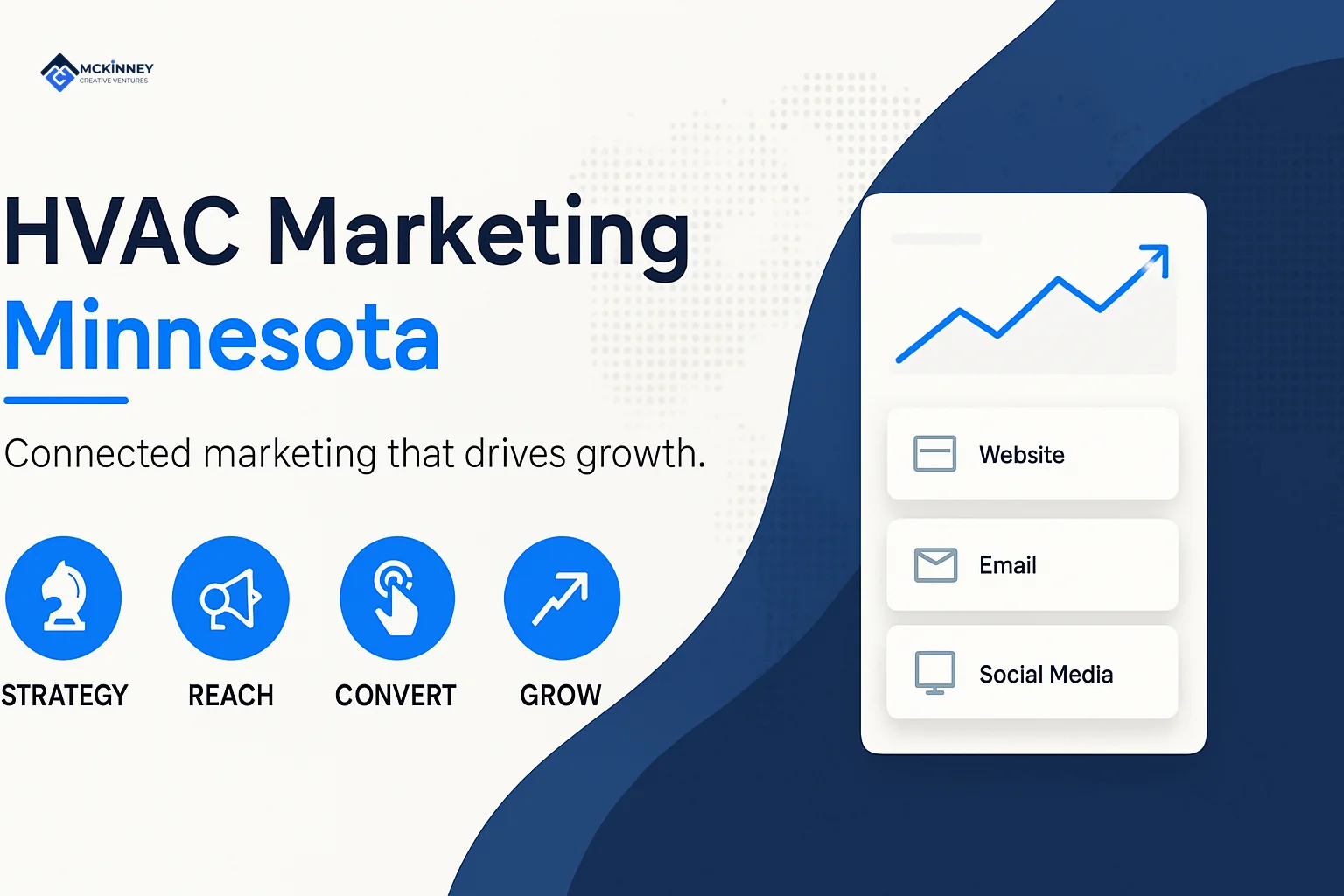
HVAC demand in Minnesota swings hard with the seasons. This is the connected marketing system that captures the peaks, smooths the slow months, and keeps your calendar full all year.
HVAC marketing in Minnesota is a year-round problem disguised as a seasonal one. Demand spikes when the first cold snap hits and again during the summer's first heat wave, then falls off in the shoulder seasons. The heating and cooling companies that stay busy all year are not the ones that spend the most. They are the ones that run a connected system: capturing every high-intent lead during the peaks, converting those leads faster than competitors, and using their existing customer base to smooth out the slow months in between.
Most HVAC marketing advice treats each tactic in isolation. Run some ads, claim your Google profile, ask for reviews. That produces a pile of disconnected activity and a schedule that still empties out every spring and fall. The better approach is to build the pieces so they feed each other, so that a lead from a Local Services Ad, a call from a Google search, and a maintenance reminder to a past customer all land in the same place and get worked the same disciplined way.
This guide lays out that system for a Minnesota heating and cooling business: how to read the seasonal demand curve, which paid and organic channels actually deliver bookable calls, why speed to lead decides who wins the job, and how a maintenance plan turns a one-time repair into a customer who books with you for a decade. It is written for owners serving the Twin Cities East Metro, the St. Croix Valley, and western Wisconsin, but the structure holds anywhere winters are real.
HVAC marketing starts with the Minnesota demand curve
You cannot smooth a demand curve you have not mapped. In this climate, HVAC demand is driven by weather events more than by any calendar date. The first hard freeze sends furnaces into failure and phones ringing. The first stretch of 90-degree days does the same for air conditioners. Between those events sit the shoulder seasons, spring and fall, when nothing is straining and homeowners are not thinking about their systems at all. Those quiet windows are where undermarketed HVAC companies lose money, and where a smart one books tune-ups and installs.
The strategic move is to match your marketing spend and message to where you are on that curve. During peak demand you compete for urgent, high-intent buyers who will hire whoever answers first, so you lean into paid channels and speed. During the shoulder seasons you shift toward your existing database and toward planned work: maintenance, aging-system replacement, indoor air quality. The table below shows how the priorities move through a Minnesota year.
| Season | Demand driver | Primary marketing focus | Highest-value job types |
|---|---|---|---|
| Late fall and winter | Furnace failures, first freeze | Local Services Ads, Search Ads, speed to lead | Emergency heat repair, furnace replacement |
| Spring shoulder | Low urgency, planning season | Database reactivation, maintenance reminders | AC tune-ups, pre-season checks, IAQ |
| Summer | Heat waves, AC failures | Local Services Ads, Search Ads, speed to lead | Emergency cooling repair, AC and heat-pump installs |
| Fall shoulder | Low urgency, planning season | Database reactivation, maintenance reminders | Furnace tune-ups, aging-system replacement |
Read that table as a spending and messaging schedule, not a rulebook. The point is that a heating and cooling company should never be doing the same marketing in April that it does in January. The channels that win an emergency furnace call are the wrong tools for booking a spring tune-up, and vice versa.
Win the peaks with Local Services Ads and Search
When a furnace dies at 6am in January, the homeowner is not researching. They are searching for someone to come now and hiring whoever looks trustworthy and answers first. Two Google channels put you in front of that buyer at the exact moment of need, and they work differently enough that most HVAC companies should run both.
Google Local Services Ads: pay per lead, badge included
Local Services Ads sit at the very top of the results, above traditional search ads, and you pay per lead rather than per click. According to Google, you are charged when a customer contacts you through the ad by phone or message, not for impressions or clicks, and customers only reach you after choosing your profile out of the options shown (Google Local Services Help). For HVAC specifically, Google requires business verification before you can run: proof of licensing and insurance plus background checks for the business owner and field workers who enter homes, a screening process Google notes can take up to a couple of weeks (Google Local Services Help). That verification is friction, but it is also the moat: the Google Guaranteed badge it earns you is a trust signal your unbadged competitors do not have. We cover the mechanics in depth in our Local Services Ads setup guide.
Google Search Ads: control over the exact query
Search Ads give you something Local Services Ads do not: precise control over which queries you show for and what your ad says. That matters for higher-margin, less-commoditized work like a full system replacement or a heat-pump conversion, where you want to speak to the specific job rather than compete purely on who answers first. Run both, and let Local Services Ads carry the urgent repair volume while Search Ads target the considered, higher-ticket searches. Managing the two together, and the budget between them, is the core of a paid program we build inside our paid advertising service.
Speed to lead is the whole game during a peak
Buying the lead is the expensive part. Losing it because you called back too late is the avoidable part. During peak demand every lead you generate is also being generated for two or three competitors, and the research on response time is blunt about what happens next.
The landmark Lead Response Management study led by Dr. James Oldroyd at MIT, analyzing years of data across thousands of leads and over one hundred thousand call attempts, found that the odds of even contacting a lead drop by 100 times when you call at 30 minutes versus 5 minutes, and the odds of qualifying that lead drop by 21 times over the same delay (Lead Response Management Study). A separate Harvard Business Review analysis of 2,241 US companies found that firms responding within an hour were seven times more likely to qualify a lead than those that waited even an hour longer, and 60 times more likely than those that waited 24 hours, yet the average first response took 42 hours and 23 percent of companies never responded at all (Harvard Business Review, 2011).
Read those two findings together and the takeaway for an HVAC business is simple. The difference between a full schedule and a slow week is often just who called back first. You cannot beat that gap by trying harder. You beat it with automation: the instant the form submits or the call is missed, an automated text goes out and the lead lands in a system that will not let it sit. That is exactly what a missed-call text-back and speed-to-lead workflow does, and it is the highest-return automation most heating and cooling companies are not running. We walk through the build in our guide to lead follow-up automation.
Smooth the shoulder seasons with your existing database
Here is the mistake that keeps HVAC companies on the seasonal roller coaster: they treat every past customer as a finished transaction instead of a standing relationship. The database you have already built, every furnace and AC unit you have ever touched, is the single best asset for filling a slow April or a quiet October. It costs nothing to acquire because you already paid to acquire it.
Maintenance plans turn one job into a decade
A maintenance plan is a marketing system dressed as a service offering. It gives a customer a reason to hear from you twice a year, it books shoulder-season tune-up work on a schedule, and it puts a technician in front of the equipment before a small problem becomes an emergency, which is where replacement conversations start. Enroll a repair customer into a plan and you have converted a single transaction into a relationship that generates predictable work for years and makes you the obvious call when the system finally needs replacing.
Event-based reactivation books the quiet weeks
Even without a formal plan, your customer records hold the timing you need. A furnace installed 12 to 15 years ago is a replacement conversation waiting to happen. A customer who has not had a tune-up in 18 months is a maintenance booking. An automated reminder triggered by the age of the equipment or the time since last service turns those records into booked appointments during exactly the weeks your paid channels go quiet. This is the reactive-plus approach we favor: not aggressive nurture funnels, but timely, relevant reminders driven by events you can already see in the data. All of it runs on a real CRM system that keeps the customer, the equipment, and the timing in one place.
The foundation: local visibility and reviews
Paid channels and database reactivation both work better on top of strong organic visibility, because a homeowner who sees your ad often checks your Google profile before calling. Two things carry the most weight here.
First, your Google Business Profile and local search presence. Google names prominence, which reviews feed directly, as one of the three factors behind local ranking alongside relevance and distance (Google Business Profile Help). A complete, active profile with recent reviews lifts you in the local map results, which is free visibility at the top of the exact searches your paid ads are competing for. We handle this as part of our local SEO and AI search work.
Second, review velocity. A steady flow of recent 5-star reviews does double duty: it lifts your ranking and it reassures the next homeowner deciding between you and the other name in the map pack. The way to keep that flow steady is the same principle as speed to lead: automate the ask so a review request goes out the moment a job is marked complete, rather than depending on a technician to remember. For a vertical parallel to everything above, our plumbing marketing playbook covers the same connected system applied to another home-service trade.
Extended Recap & Conclusion
HVAC marketing in Minnesota is not about outspending competitors during the winter rush. It is about building one connected system that behaves differently across the year: aggressive paid capture and fast follow-up during the peaks, and quiet, event-driven reactivation of your own database during the shoulder seasons. Local Services Ads and Search Ads win the urgent buyer, speed-to-lead automation makes sure you actually convert the leads you paid for, and maintenance plans plus reactivation reminders keep the schedule full when the phones would otherwise go quiet.
The pieces are only as strong as their connection to each other. When a Local Services Ad lead, a Google search call, and a maintenance reminder all flow into the same CRM and get worked with the same discipline, a heating and cooling company stops riding the seasonal roller coaster and starts running a predictable, year-round business. That connected system, not any single tactic, is what fills the schedule.
Frequently Asked Questions
What is the best marketing channel for an HVAC company in Minnesota?
There is no single best channel. During peak demand, Google Local Services Ads and Search Ads capture urgent, high-intent buyers, while during the shoulder seasons your own customer database, worked through maintenance reminders and reactivation, delivers the highest return. The best results come from running these together as one system rather than choosing one channel.
How do Google Local Services Ads work for HVAC businesses?
Local Services Ads appear at the top of Google results and charge you per lead rather than per click. HVAC companies must first pass Google's verification, which includes proof of licensing and insurance plus background checks for the owner and field workers, a process Google says can take up to a couple of weeks. Once verified, you earn the Google Guaranteed badge and only pay when a customer contacts you through the ad.
Why does lead response time matter so much for HVAC?
Because during a peak the same lead is reaching several competitors at once, and the homeowner tends to hire whoever answers first. Research from MIT found the odds of contacting a lead drop 100 times between a 5-minute and a 30-minute callback. Automated text-back and speed-to-lead workflows let you respond instantly so you are not paying for leads that a faster competitor closes.
How do I keep my HVAC schedule full during spring and fall?
Use your existing customer database. Maintenance plans give you a reason to book tune-up work on a schedule, and automated reminders triggered by equipment age or time since last service turn past customers into booked appointments during the exact weeks paid demand goes quiet. This event-based reactivation costs almost nothing because the customers are already yours.
Are maintenance plans worth it for a heating and cooling company?
Yes, because a maintenance plan is a marketing system as much as a service. It creates recurring shoulder-season work, puts a technician in front of aging equipment before it fails, and makes you the obvious choice when the system finally needs replacement. One repair customer enrolled in a plan can generate predictable work for a decade.
If you run a heating and cooling business in the Twin Cities East Metro, the St. Croix Valley, or western Wisconsin and your schedule still empties out every shoulder season, the fix is a connected system, not another disconnected tactic. Book a strategy call with McKinney Creative Ventures and we will map the exact system for your market.
Written by
Sam McKinney
Founder & Lead Strategist, McKinney Creative Ventures
Sam McKinney helps local service businesses across the Twin Cities East Metro and St. Croix Valley grow through connected marketing systems. Websites, SEO, CRM, and AI automation built to work together instead of in isolation.
More about MCVRelated Articles
Med Spa Marketing in the Twin Cities: Keeping the Calendar Booked
Aesthetics practices lose money in the gaps between local search, reviews, and follow up. Here is the full med spa marketing system for the East Metro and St. Croix Valley, plus the federal rules that now govern it.
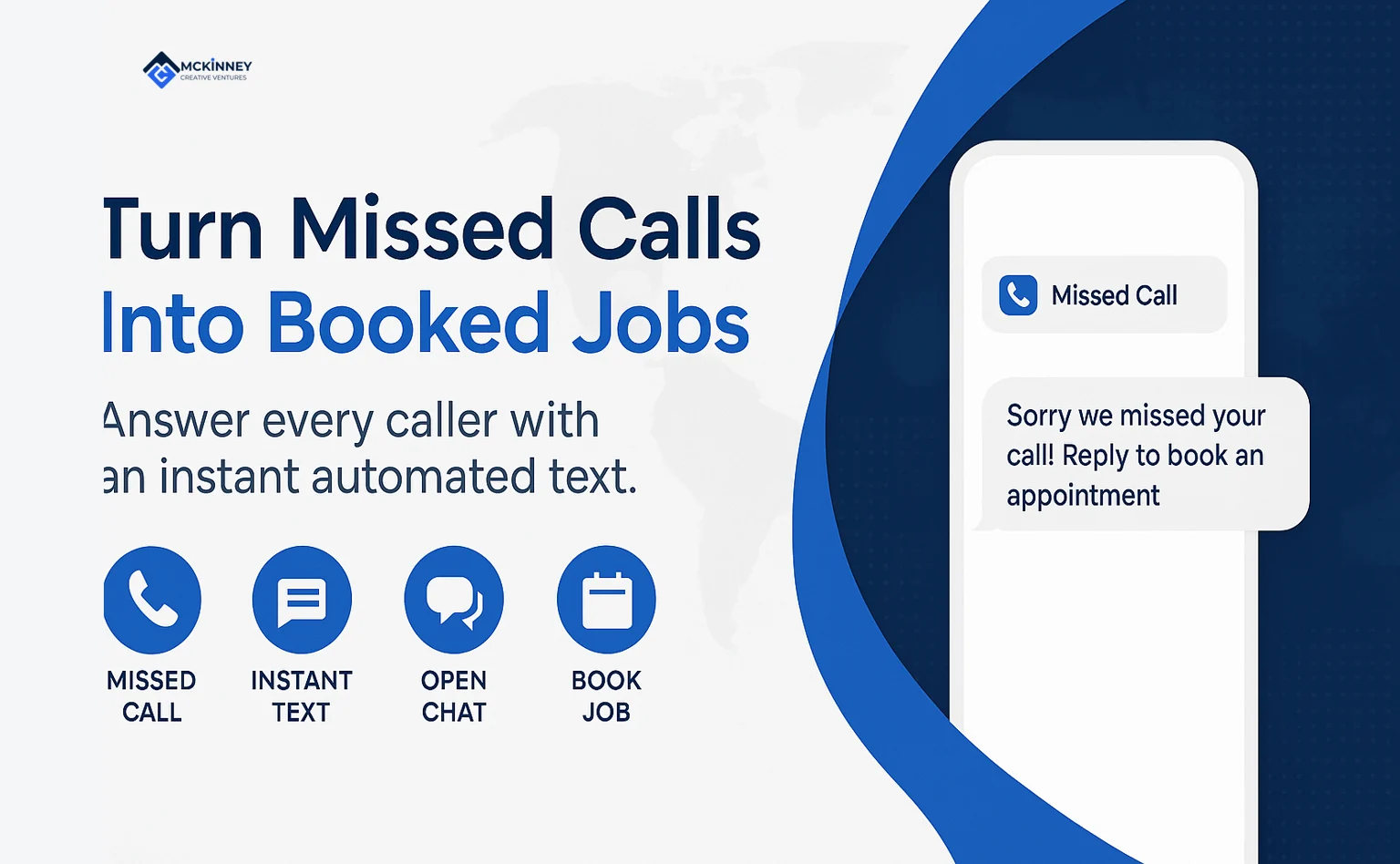
Missed-Call Text-Back: The Easiest Lead You Are Not Capturing
When a service business misses a call, the caller usually dials the next name on the list. Missed-call text-back closes that gap automatically. Here is how it works, the math of recovered jobs, and the 2026 rules that keep your texts landing.
Ready to Grow Your Business?
Book a strategy call to discuss how we can implement these systems and strategies to help your business scale.
Book a Strategy Call