Why Small Business Marketing Management Matters

Sam McKinney
Founder & Lead Strategist • January 6, 2026
Overview
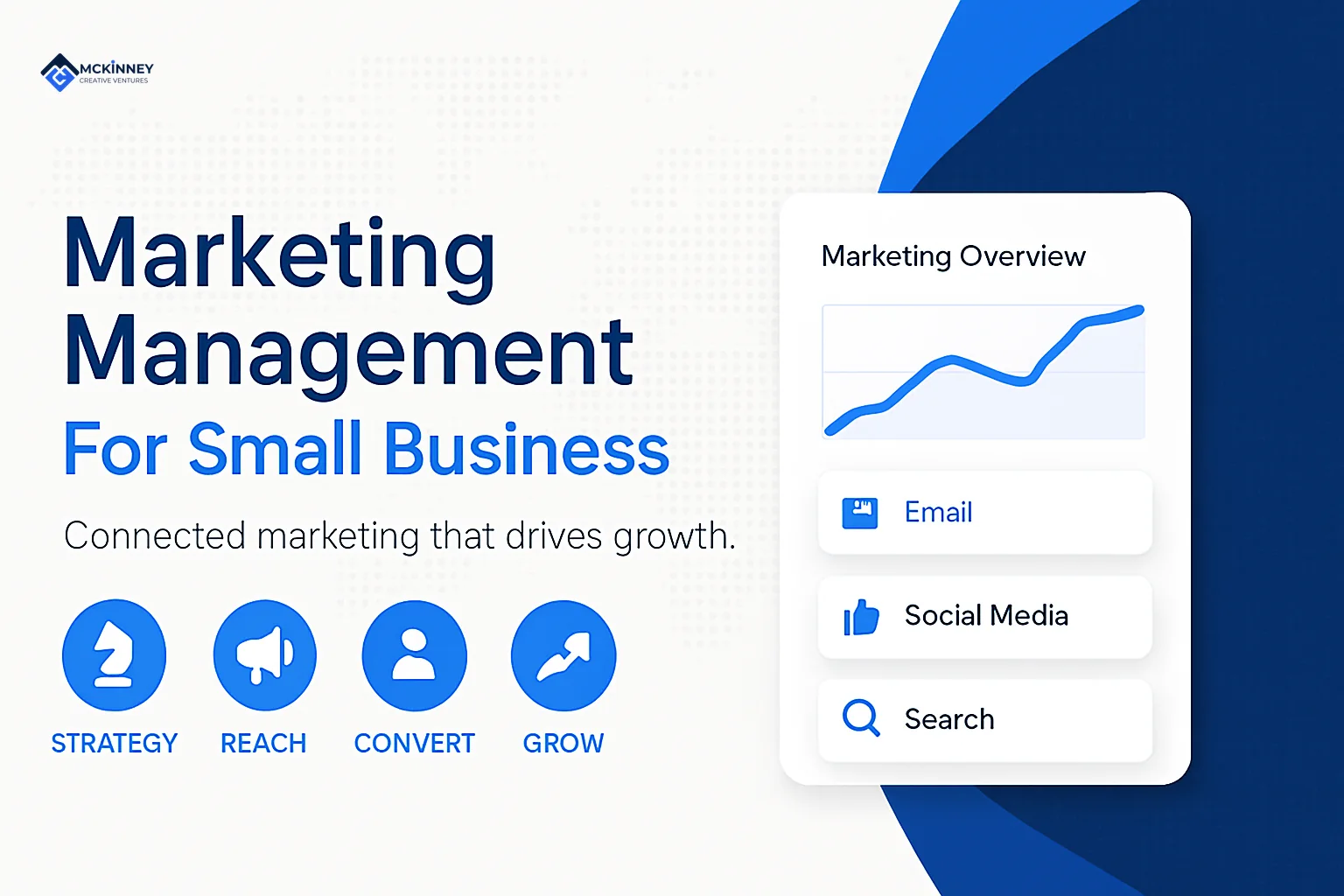
Marketing management for small business is the process of planning, organizing, and tracking your marketing activities so they work together to grow your business.
Marketing management for small business is the process of planning, organizing, and tracking your marketing activities so they work together to grow your business consistently. Here's what effective marketing management involves:
- Planning: Define your target audience, set clear goals, and choose the right marketing channels
- Executing: Create consistent content, manage your online presence, and engage with customers
- Measuring: Track key metrics like website traffic, leads, and conversion rates
- Refining: Adjust your strategy based on what's working and what's not
Many small business owners wear every hat in their company. Marketing often gets pushed aside until there's a slow week or a competitor threat. The result? Scattered efforts, wasted budget, and frustration.
The difference between businesses that grow steadily and those that struggle often comes down to one thing: treating marketing as a system instead of a series of random tasks. When you organize your marketing, you stop reacting to every new idea and start building real momentum.
This guide will show you how to create a marketing system that fits your business, your budget, and your goals. You'll learn how to plan strategically, execute consistently, and measure what matters.
I'm Sam McKinney, and I've spent over 15 years helping small and mid-sized businesses build smarter marketing systems that drive sustainable growth. Through McKinney Creative Ventures, I work with service-based businesses on marketing management for small business, helping them turn fragmented efforts into consistent results.
Why Marketing Management Drives Sustainable Growth
Disorganized marketing wastes valuable time and hard-earned money. When we organize our marketing efforts, we set ourselves up for consistent, predictable results. We believe in treating marketing as a strategic investment in your company's growth, not just another expense. A clear, well-managed system helps us do several critical things for your business in the East Metro Twin Cities and St. Croix Valley:
- Establish Our Brand: Marketing helps us distinguish our business from competitors, building a unique identity that resonates with our community.
- Attract New Customers: Consistent marketing efforts are designed to bring in new business, which is essential for increasing revenue and ensuring cash flow. We know it costs five times as much to acquire a new customer as to retain an existing one, so efficient acquisition is key.
- Improve Customer Loyalty: Engaging with our current customers through marketing helps foster loyalty and encourages repeat business. This is a practical and cost-effective way to grow.
- Drive Revenue Growth: Research shows that businesses with brand consistency report it contributes to 10% or more of their revenue growth. Organized marketers are almost seven times more likely to report success than their peers.
Effective marketing management for small business means we're not just throwing spaghetti at the wall. We're building a reliable process that helps us attract the right customers, build our reputation, and grow our presence in the local market.
The Core Elements of a Strong Marketing Plan
A marketing plan is a roadmap. It summarizes what we've learned about our market and outlines how we'll achieve our marketing objectives. While there's no single perfect format, a well-structured plan typically includes these key elements:
- Situation Analysis: This is where we take a snapshot of where our business stands today. We look at our current products or services, recent sales performance, market trends, and who our competitors are. A SWOT analysis (Strengths, Weaknesses, Opportunities, Threats) is a valuable tool here to understand our position.
- Defining Your Target Audience: Many entrepreneurs mistakenly believe everyone is their customer. But trying to market to everyone spreads our message too thin. We need to clearly identify our ideal customer, understanding their demographics, motivations, and pain points. This focus makes all our marketing efforts more effective.
- Setting Clear Goals and Objectives (using SMART goals): Our marketing objectives are what we want to achieve. These goals should be SMART: Specific, Measurable, Achievable, Relevant, and Time-bound. For example, "Increase website traffic by 20% in the next six months" is a SMART goal. This ensures we have clear targets and can track our progress.
- Outlining Strategies and Tactics: This section details how we will achieve our objectives. It covers the "four Ps" of marketing: Product, Pricing, Place (distribution), and Promotion. We decide which channels we'll use (like social media or email), what kind of content we'll create, and how we'll communicate our message.
- Planning Your Budget: Marketing is an investment, so we need to allocate resources wisely. Our budget covers costs like paid advertising, software subscriptions, and any outsourced marketing support. We ensure our budget aligns with our goals, focusing on activities that offer the best return.
- Deciding How You Will Measure Success: We can't manage what we don't measure. This part of the plan outlines the metrics we'll track to evaluate our marketing efforts. This includes sales income, website analytics, customer feedback, and how many new leads we generate. Regular evaluation allows us to adjust our plan and optimize our spending.
A robust marketing plan is crucial. Studies show that 75% of small businesses have a marketing plan, and those with a structured plan are 6.7 times more likely to report success than those without one. Having this blueprint guides our actions and ensures we're always moving forward with purpose.
Understanding Your Audience and Value Proposition
Knowing who we serve best is the bedrock of effective marketing management for small business. We go beyond basic demographics like age and location (though those are a start for our local East Metro and St. Croix Valley clients). We dig deeper to understand what truly motivates our customers, what problems they face, and how our services uniquely solve those problems.
Building simple buyer personas helps us clarify our messaging. A buyer persona is a semi-fictional representation of our ideal customer, based on market research and real data about our existing customers. It includes their goals, challenges, and purchasing behaviors. This allows us to craft marketing messages that resonate directly with their needs. 66% of customers expect companies to understand their unique needs and expectations.
Our value proposition is simply why a customer should choose us over the competition. It's a clear statement that highlights the specific benefits we deliver. We focus on outcomes and solutions, not just the features of our services. For example, instead of saying, "We offer web design," we might say, "We build user-friendly websites that attract more local leads and grow your business." This helps us stand out and makes our business the clear choice in our market.
Building a Consistent Brand Identity
Trust and recognition are hard-won assets for any small business. They come from consistency. Our brand identity is more than just a logo; it's the sum of every experience a customer has with our business. We define our brand's voice (e.g., friendly, authoritative, witty), tone (how we express that voice in different situations), and visual style (colors, fonts, imagery).
Consistency means using the same logo, colors, and fonts across all our materials: our website, social media, business cards, and any print advertising. For visual elements, we might choose a couple of primary colors and one or two fonts (Google Fonts offers many excellent free options) that reflect our brand personality. This consistent application helps customers remember us, builds familiarity, and instills confidence in our business. When our brand messaging is consistent across all channels, it contributes significantly to revenue growth, with 68% of businesses reporting a positive impact. It shows professionalism and reliability, which are crucial for building lasting relationships with clients in our local communities.
Putting Your Marketing Plan into Action
Once we have our strategic blueprint, it's time to put our marketing plan into action. Small businesses, especially those in the East Metro Twin Cities and St. Croix Valley, need to get the most out of every marketing effort due to often limited resources. We focus on activities that have the biggest impact and align directly with our goals.
A marketing calendar is an invaluable tool here. It's a centralized place where we list all our scheduled content and activities: blog posts, social media updates, email campaigns, and more. This helps us stay organized, ensures consistency, and allows us to plan ahead, typically one to six months in advance.
The key is to choose marketing channels where our customers already spend their time. We don't need to be everywhere; we need to be where our ideal clients are, engaging them with valuable content and solutions. This targeted approach is a cornerstone of effective marketing management for small business.
Laying Your Digital Foundation with SEO and Content
Owning our online presence is non-negotiable in today's market. For local service businesses, this starts with a strong digital foundation built on Search Engine Optimization (SEO) and helpful content.
We begin with the basics of local SEO. This means ensuring our business information (name, address, phone number, and website) is accurate and consistent across all online directories. Optimizing our Google Business Profile is critical; this free tool allows us to manage our online presence on Google Maps and Search, respond to reviews, and showcase photos. When potential clients in Woodbury, Cottage Grove, or Hudson search for services we offer, we want to be found easily. Ranking first on the first page of search results can earn approximately 29% of users' clicks, a significant advantage.
Next, we focus on creating helpful content that answers our customers’ questions. This could be blog posts, FAQs on our website, or even short videos. By addressing common concerns and providing valuable information, we establish our expertise and build trust. Tools like Ahrefs, Semrush, or HubSpot's free SEO tools can help us find keywords our audience is searching for, so we can create content around those topics.
Our website acts as our 24/7 salesperson. It needs to be professional, mobile-friendly, and clearly articulate our value proposition. A strong content and SEO strategy helps our potential customers learn about us, our offerings, and our industry. It's a long-term investment that brings in organic traffic and positions us as a trusted resource.
Building Relationships with Social Media and Email
Connecting with our audience is about building genuine relationships. For social media, we advise choosing one or two platforms that best fit our business and where our target audience is most active. For example, a B2B business might find more success on LinkedIn, while a local retail business could thrive on Facebook or Instagram. Consistency in posting is often more important than posting every day; businesses that post consistently on social media see a 50% increase in visibility and a 30% boost in organic reach. Our goal is to build a real community, not just chase follower counts. Tools like HubSpot's social media management tools or Later can help us plan and schedule posts, ensuring we show up consistently. We also use these platforms for customer service, responding promptly to DMs and comments, which builds trust and improves algorithm visibility.
Email remains a powerhouse for communication. It's customers’ number one preferred channel for communicating with companies, offering a high return on investment. We use email to stay in touch with our customers, sharing valuable content, special offers, and updates. Segmenting our email list, perhaps into leads, current customers, and past clients, allows us to send the right message to the right people. This personalization significantly improves engagement. Simple email automation helps us nurture relationships without constant manual effort, such as sending welcome sequences to new subscribers or follow-up emails after a service.
Growing Through Reputation and Referrals
Our reputation is one of our most valuable assets. In the East Metro Twin Cities and St. Croix Valley, word-of-mouth and local trust are paramount. Research shows that close to 90% of all online customers think reviews and referrals are more important than any information provided by a salesperson. This is where reputation marketing shines.
We actively ask happy customers for reviews on platforms like Google, Yelp, and Facebook, and we make it easy for them to share their positive experiences. Showcasing these testimonials on our website and social media builds significant social proof and trust with new prospects. For example, a local pest control company in our area might share customer reviews directly to their Facebook Business Page to build confidence.
Encouraging referrals is also a highly effective strategy. We can develop a simple referral program or loyalty incentive that rewards existing customers for recommending us. This taps into the power of trusted recommendations. It costs five times as much to acquire a new customer as to retain an existing one, so fostering loyalty and encouraging referrals is a smart investment in our business's long-term health. A local carpet cleaning company, for instance, might donate a percentage of each job to a local humane society, attracting new business and building goodwill within the community.
Measuring Results and Planning Your Next Steps
Effective marketing management for small business isn't just about doing things; it's about doing the right things and knowing they're working. We look beyond surface-level numbers like likes or followers. Our focus is on how our marketing activities directly contribute to real business results: new leads, booked appointments, and increased sales.
We set up a simple dashboard to track our key numbers, allowing us to see our progress at a glance. Regularly monitoring and adjusting our approaches based on performance data is crucial for maximizing our marketing spend. As the saying goes, "You can't manage what you don't measure." We make it a habit to review our results and refine our plan as needed, ensuring our efforts are always optimized for growth.
Key Metrics for Tracking Your Marketing ROI
To understand our marketing return on investment (ROI), we track several key metrics:
- Website Traffic and Where It Comes From: Using tools like Google Analytics, we monitor how many people., which pages they view, and where they come from (e.g., search engines, social media, direct links). This helps us understand which channels are most effective at driving awareness.
- Conversion Rate (How Many Visitors Become Leads): This metric tells us the percentage of website visitors who complete a desired action, such as filling out a contact form, downloading a guide, or making a phone call. A high conversion rate means our website is effective at turning interest into potential business.
- Lead-to-Customer Rate: This tracks how many of our generated leads ultimately become paying customers. It helps us evaluate the quality of our leads and the effectiveness of our sales process.
- Customer Acquisition Cost (CAC): This is the total cost of our marketing efforts divided by the number of new customers acquired. Keeping an eye on CAC ensures our customer acquisition strategies are financially sustainable.
- Customer Lifetime Value (LTV): LTV estimates the total revenue we can expect from a single customer over the course of our relationship. Comparing LTV to CAC helps us understand the long-term profitability of our customer relationships.
By tracking these metrics, we gain clear insights into what's working, what needs improvement, and where we should strategically invest our marketing dollars for maximum impact.
When to Bring in Outside Marketing Help
It's a common scenario for small business owners in the East Metro Twin Cities and St. Croix Valley: marketing tasks start to pile up, pulling you away from the core work you love and excel at. If you find yourself consistently stuck, overwhelmed, or if your marketing results have plateaued despite your best efforts, it might be time to bring in outside help.
We've seen it firsthand: marketing can easily become an afterthought when you're juggling operations, client work, and everything else. Without a dedicated focus, efforts can become sporadic and inconsistent. This is often when small businesses reach out to us at McKinney Creative Ventures.
Outsourcing marketing isn't a sign of weakness; it's a strategic growth hack. It gives you access to specialized expertise, saves you the time and expense of hiring a full-time employee, and allows you to focus on running your business. According to recent reports, 37% of small businesses outsource at least one business process, and digital marketing is a common area. Outsourcing adds capacity and brings a fresh perspective, helping you scale your marketing efforts without the significant overhead of an internal team.
What to Look for in a Small Business Marketing Partner
When considering a marketing partner, especially for a local business in our service areas, we believe it's important to look beyond basic service lists. Here's what we recommend:
- Strategic Thinking and Planning: A good partner doesn't just execute tasks; they help you define your overall marketing strategy. They should understand your business goals and develop a plan that aligns with them, rather than just suggesting random tactics.
- Broad Marketing Knowledge with Deep Expertise in Key Areas: Look for someone with a "T-shaped" skill set: broad knowledge across various marketing disciplines (like SEO, social media, email) but deep expertise in one or two areas most critical to your business. This ensures a holistic approach while still delivering specialized results.
- Ability to Analyze Data and Measure Results: Your partner should be able to track key metrics, interpret data, and provide clear reports on what's working and what needs adjustment. They should be focused on your ROI, not just activity.
- Strong Content Creation Skills: Whether it's website copy, blog posts, social media updates, or email content, the partner should be able to craft compelling messages that resonate with your target audience and reflect your brand's voice.
- Project Management Experience: Marketing involves many moving parts. A partner with strong project management skills will keep things organized, on schedule, and ensure consistent follow-through.
- Clear and Reliable Communication: This is paramount for any successful partnership. You need a partner who communicates openly, provides regular updates, and is accessible to discuss your marketing efforts.
Extended Recap & Conclusion
Marketing management for small business is about building a system that transforms scattered, reactive efforts into a steady, proactive engine for growth. With a clear plan, focused execution, and regular measurement, you can take precise control of your business’s trajectory.
At McKinney Creative Ventures, we understand the unique challenges and opportunities for small businesses in the East Metro Twin Cities and St. Croix Valley. We are passionate about helping our local entrepreneurs build trust, cultivate strong relationships, and achieve consistent growth. If you are ready to put a professional marketing system in place without the overhead of hiring a full-time team, we are here to help. Learn more about our flexible marketing services.
If you want a connected marketing system that brings this together for your business, we can help. Book a free strategy call and we will map out a plan built around your goals. No pitch, just a clear next step.
Frequently Asked Questions
What is the most effective marketing for a small business?
There's no single, one-size-fits-all answer here because every business is unique. The most effective approach for a small business in the East Metro Twin Cities or St. Croix Valley comes from deeply understanding your customers and reaching them precisely where they are.
For most local service businesses, we find that a strong online presence is foundational. This includes an optimized website, an up-to-date Google Business Profile, and consistent presence on relevant social media platforms. Alongside this, cultivating positive customer reviews and implementing targeted email marketing are often the most effective starting points. These strategies build trust, improve visibility, and allow for direct, personalized communication.
How much should a small business spend on marketing?
A common guideline suggests allocating 5% to 10% of your gross revenue to marketing. However, this can vary. New businesses, especially those just starting out in Woodbury, Stillwater, or Hudson, may need to invest more initially to build brand awareness and gain momentum. This early investment can be crucial for establishing a foothold in the market.
For established businesses, the focus might shift to more targeted spending aimed at specific growth goals, such as expanding into a new service area or launching a new offering. What's most important is to treat marketing as an investment, not just an expense. We always recommend tracking your results diligently to ensure you're getting a solid return on that investment. For example, some businesses see marketing expenses fluctuate from around 9% of sales in an initial growth year down to 3% as they become more established.
Can I manage my own marketing with no experience?
Yes, you absolutely can start managing your own marketing, even without prior experience. We encourage business owners to begin with the basics. Focus on one or two things you can do consistently and well. For instance, keeping your Google Business Profile updated with accurate hours and photos, and actively asking happy customers for reviews, are excellent starting points that yield significant local impact.
However, as your business grows and your marketing needs become more complex, managing everything yourself can quickly become overwhelming. This is often the point where many business owners realize they need to bring in outside help. It's not about being unable to do it, but rather about maximizing your time and ensuring your marketing efforts are professionally managed for sustained growth. We've seen how challenging it can be when you're short on time, budget, or a full-time marketing team, but we've also seen how businesses can thrive with the right support.
Written by
Sam McKinney
Founder & Lead Strategist, McKinney Creative Ventures
Sam McKinney helps local service businesses across the Twin Cities East Metro and St. Croix Valley grow through connected marketing systems. Websites, SEO, CRM, and AI automation built to work together instead of in isolation.
More about MCVRelated Articles
Med Spa Marketing in the Twin Cities: Keeping the Calendar Booked
Aesthetics practices lose money in the gaps between local search, reviews, and follow up. Here is the full med spa marketing system for the East Metro and St. Croix Valley, plus the federal rules that now govern it.

Hudson, WI Service Businesses: Marketing Across the Border
A Hudson service business that works both sides of the St. Croix is running one brand across two states, two licensing regimes, and two separate local search markets. Here is how to set that up so neither side gets treated as an afterthought.
Ready to Grow Your Business?
Book a strategy call to discuss how we can implement these systems and strategies to help your business scale.
Book a Strategy Call