
Automated Review Generation: How to Build a System That Earns 5-Star Reviews

Sam McKinney
Founder & Lead Strategist • June 30, 2026
Overview
A review generation system turns your happy customers into a steady stream of 5-star Google reviews, automatically and within Google's rules. Here is how to build one for a local service business.
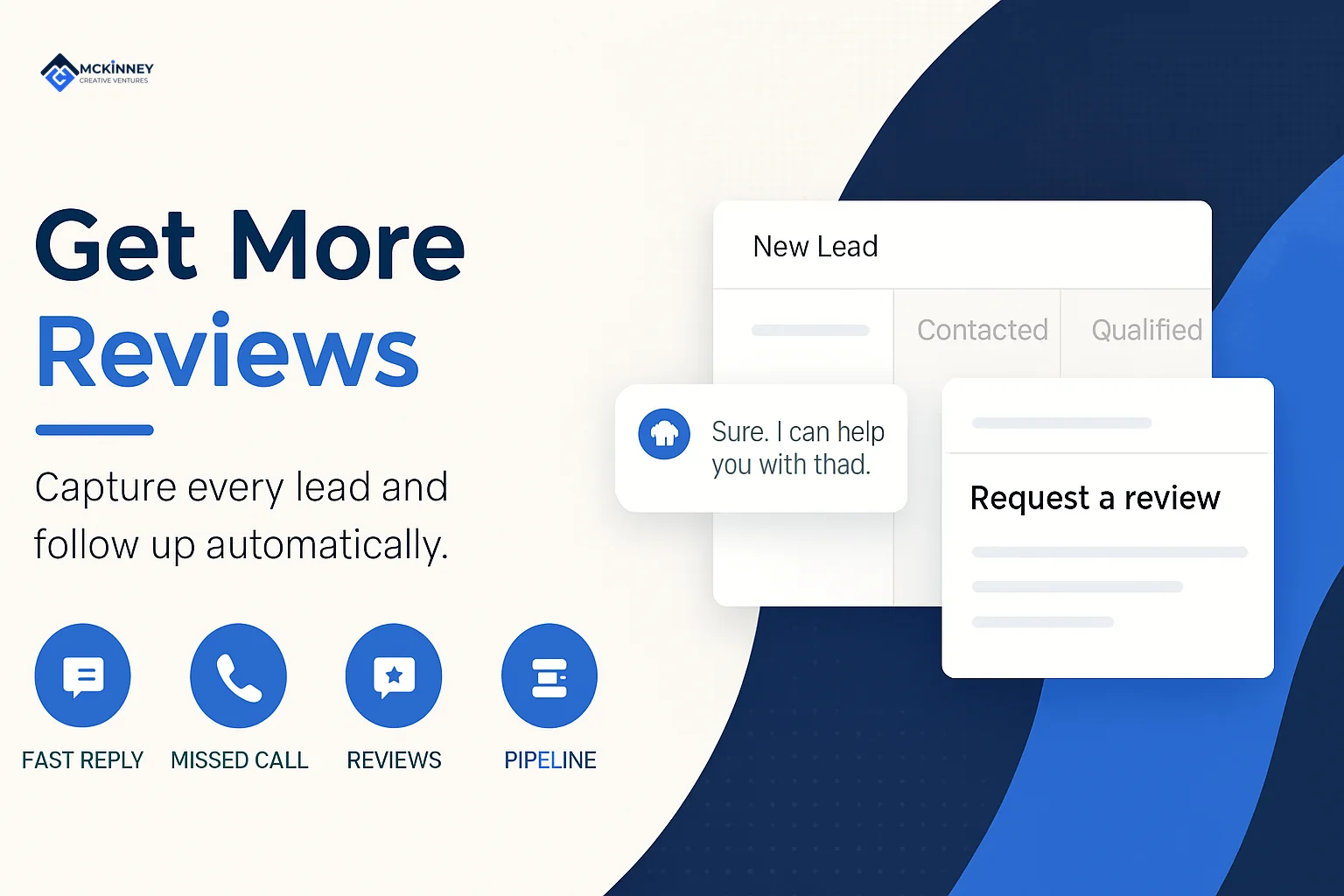
Automated review generation is a simple system: every time you finish a job, the customer who was just thrilled with your work gets a timely, personal request to leave a review, sent on its own without anyone on your team remembering to do it. Done right, it turns the goodwill you already earned into a steady stream of recent 5-star reviews that lift your Google ranking and reassure the next person deciding whether to call you.
Most local service businesses are not short on happy customers. They are short on reviews from those happy customers, because the ask never happens. The job wraps up, everyone moves on, and the one moment the customer would gladly have left five stars passes by. A review generation system closes that gap by making the request automatic, fast, and personal, so reviews accumulate without becoming one more thing on your plate.
This guide explains why review volume and recency matter so much for a local business, how an automated review request actually works, the timing and channel choices that get the most responses, and the compliance rules you cannot ignore now that both Google and the Federal Trade Commission are enforcing them. If you serve the Twin Cities East Metro, the St. Croix Valley, or western Wisconsin, this is one of the highest-return systems you can put in place.
Why automated review generation beats asking by hand
The case for automating the ask comes down to two things humans are bad at: remembering, and timing. A crew that just finished a long install is not thinking about review links. The owner catching up on invoices at 8pm is not either. So the request that should go out at the peak of a customer's satisfaction goes out late, or never. Automation removes the memory problem entirely. The moment a job is marked complete in your system, the request fires.
The payoff is not just more reviews, it is fresher ones, and recency carries real weight with the people reading them. In BrightLocal's 2024 Local Consumer Review Survey, 26 percent of consumers said they only read reviews written within the past month, and 22 percent paid attention only to reviews from the past two weeks (BrightLocal, 2024). A wall of glowing reviews from two years ago does far less for you than a handful from last week. A steady drip of recent reviews is something only a system produces reliably.
Reviews also feed directly into how you rank. Google names prominence as one of the three factors behind local search ranking, alongside relevance and distance, and review count and score are part of how it measures that prominence (Google Business Profile Help). More genuine, recent reviews help you show up higher in the map pack, which puts you in front of more local searchers, who then read those same reviews before deciding. The loop compounds.
Reviews are read by nearly everyone, and they decide the call
This is not a niche behavior. BrightLocal's 2024 survey found that 98 percent of people at least occasionally read online reviews for local businesses, and 49 percent trust online reviews as much as a personal recommendation from a friend or family member (BrightLocal, 2024). For a service business, your review profile is the modern version of word of mouth, and an automated system is how you keep it full and current instead of letting it stall.
How an automated review request actually works
The mechanics are straightforward once your customer data lives in one place. The job is to detect the right trigger, wait the right amount of time, and send a short personal message with a direct link to your Google review form. Here is the typical flow:
- Trigger. A job is marked complete, an invoice is paid, or a service is closed out in your CRM or field-service software. That status change starts the sequence.
- Short delay. The system waits a set window, often a few hours to a day, so the request lands while the work is fresh but not before the customer has caught their breath.
- Personal message. An SMS or email goes out using the customer's first name and, ideally, a reference to the job, with a single tap-to-review link straight to your Google profile.
- One gentle reminder. If there is no response after a few days, a single follow-up nudges the customer. One reminder lifts response without becoming pestering.
- Stop on action. The moment the customer leaves a review, the sequence ends so they never get a redundant message.
The reason this belongs inside a real CRM system rather than a sticky note is that the CRM already knows who the customer is, what job they had, and how to reach them. The review request becomes one more automation riding on data you are already capturing, which is exactly the connected, systemized approach we build for clients instead of bolting on disconnected tools.
Make it effortless to leave the review
Every extra step costs you reviews. The link in your message should open directly to the Google review window, not your homepage or a profile the customer then has to navigate. Keep the message short, written like a person, and clear about the one action you want. The easier you make it, the more of your happy customers actually follow through.
Timing and channel: what gets the most responses
The two biggest levers on response rate are when you ask and how you reach the customer. There is no single perfect setting for every trade, but the principles are consistent, and the table below lays out a practical starting framework you can adjust to your business.
| Decision | Practical default | Why it works |
|---|---|---|
| When to send the first request | Within a few hours to one day of job completion | Satisfaction and memory of the work are highest right after, so the ask feels natural |
| Primary channel | Text message (SMS) | Texts are opened quickly and the review link is one tap away on the phone already in hand |
| Backup channel | Useful for customers you do not have a mobile number for, or who prefer email | |
| Reminders | One follow-up after three to five days | Recovers customers who meant to respond without crossing into nagging |
| Personalization | First name plus a reference to the specific job | A request that sounds human and specific gets acted on far more than a generic blast |
| Volume control | Steady, spread across every completed job | A natural, ongoing pace looks authentic to customers and to Google, unlike a sudden spike |
One more note on pace. A sudden flood of reviews after months of silence can look unnatural. A system that simply asks after every job produces a steady, believable flow, which is healthier for both trust and ranking. That steadiness is the whole point of automating it.
Stay inside the rules: Google and the FTC are both watching
This is the part too many businesses get wrong, and the consequences have grown teeth. There is a clear line between encouraging honest reviews, which is encouraged, and manipulating them, which can get your reviews removed, your profile penalized, or worse.
Do not gate reviews
Review gating is the practice of screening customers first, sending the happy ones to Google while routing the unhappy ones to a private form so their negative feedback never goes public. It is tempting, and it violates Google's policies. Google's content policies prohibit fake engagement and require that businesses do not selectively solicit only positive reviews. Your automated request must go to every completed-job customer the same way, not just the ones you expect to praise you.
Do not pay for reviews or incentivize them
Google's prohibited content policy is explicit that businesses cannot offer incentives, money, discounts, free goods, or services, in exchange for reviews (Google Maps User-Generated Content Policy). And as of 2024 this is no longer only a platform rule. The Federal Trade Commission finalized a rule on the use of consumer reviews and testimonials, announced in August 2024 and effective October 21, 2024, that bans buying and selling fake reviews, undisclosed insider reviews, and certain review suppression practices, with civil penalties of up to $51,744 per violation (Federal Register, FTC final rule, 2024). The safe and durable strategy is the honest one: ask everyone, ask well, and let the reviews be real.
Here is the simple compliance test for any review tactic:
- Allowed: asking every customer for an honest review after the job, making it easy, and reminding once.
- Not allowed: screening out unhappy customers, offering anything of value for a review, writing reviews yourself, or posting from multiple accounts.
Close the loop: respond to every review you earn
Generating reviews is half the system. Responding to them is the other half, and it is where a lot of the trust gets built. BrightLocal's 2024 survey found that 89 percent of consumers read businesses' responses to reviews, and 88 percent said they would use a business that responds to all of its reviews, compared with just 47 percent for one that never responds (BrightLocal, 2024). A thoughtful reply to a negative review can actually improve how a reader sees you. The same survey found 56 percent of consumers said a good response to a negative review improved their perception of the business.
Replying to every review also signals to Google that your profile is active and cared for, which supports the prominence that helps you rank. If keeping up with responses feels like a burden, it does not have to be. We wrote a short walkthrough on how to answer every review in about two minutes with a free AI assistant. Pair an automated request engine on the front end with a fast response habit on the back end, and your review profile becomes a genuine competitive advantage.
How review generation fits the bigger system
A review engine is not a standalone gadget. It works because it sits on top of the customer data your CRM already holds, and it feeds the local authority that your SEO, GEO, and AEO work is building. Recent, genuine reviews lift your Google Business Profile prominence, which lifts your map pack ranking, which puts you in front of more searchers, who then read those reviews and call. Each piece makes the others stronger. That is the difference between a one-off tactic and a connected system, and it is why review generation belongs in the same plan as your follow-up automation, your website, and your local search strategy.
Extended Recap & Conclusion
Automated review generation solves a problem nearly every local service business has: plenty of satisfied customers, not nearly enough reviews from them. By triggering a short, personal review request the moment a job is complete, sending it by text with email as backup, and following up once, you convert the goodwill you already earned into a steady stream of recent reviews. Recency matters, with a meaningful share of consumers reading only reviews from the past few weeks, and volume and score feed the prominence Google uses to rank local businesses.
The rules are not optional. Google prohibits incentivized reviews and review gating, and the FTC's 2024 rule put real civil penalties behind fake and suppressed reviews. The winning approach is also the compliant one: ask every customer honestly, make it effortless, respond to what comes back, and let the system run quietly in the background. Build it once and it keeps paying you in trust, ranking, and booked jobs.
Frequently Asked Questions
What is a review generation system?
It is an automated process that sends a personal review request to a customer right after their job is complete, usually by text or email, with a direct link to your Google review form and a single gentle reminder if there is no response. It runs from your CRM so the ask happens every time without anyone having to remember it.
Is it against Google's rules to ask customers for reviews?
No. Asking customers for honest reviews is allowed and encouraged. What is prohibited is offering incentives in exchange for reviews and review gating, the practice of screening customers so only the happy ones are sent to Google. Your request should go to every completed-job customer the same way, with no payment or reward attached.
When is the best time to ask for a review?
Soon after the work is finished, typically within a few hours to a day, while the customer's satisfaction and memory of the job are at their peak. A single follow-up three to five days later recovers people who meant to respond but forgot. Asking too late, or only once, leaves reviews on the table.
Should I ask for reviews by text or email?
Text tends to get the strongest response because messages are opened quickly and the review link is one tap away on the phone the customer is already holding. Email is a good backup for customers without a mobile number on file or who prefer it. Many businesses use text first and email as a fallback.
Can I offer a discount or gift card for leaving a review?
No. Google's policies prohibit offering any incentive in exchange for a review, and the FTC's 2024 rule added legal penalties for manipulating reviews. You can make it easy and personal to leave a review, but you cannot pay for one. Keeping it honest protects both your Google profile and your business legally.
How many reviews does my business need?
There is no fixed number that wins, because what matters is being competitive in your market and keeping reviews recent and genuine. A steady ongoing flow from every completed job, rather than a one-time push, builds the volume and freshness that help you rank and reassure new customers over time.
If happy customers are walking away without leaving the reviews that would win you the next ten jobs, that gap is fixable, and it is exactly what we set up inside a connected CRM and local search system. Book a free 30-minute strategy call and we will map out the review engine that fits how your business actually runs. No pitch, just a plan.
Written by
Sam McKinney
Founder & Lead Strategist, McKinney Creative Ventures
Sam McKinney helps local service businesses across the Twin Cities East Metro and St. Croix Valley grow through connected marketing systems. Websites, SEO, CRM, and AI automation built to work together instead of in isolation.
More about MCVRelated Articles
Missed-Call Text-Back: The Easiest Lead You Are Not Capturing
When a service business misses a call, the caller usually dials the next name on the list. Missed-call text-back closes that gap automatically. Here is how it works, the math of recovered jobs, and the 2026 rules that keep your texts landing.
Speed to Lead: Why the First Five Minutes Decide the Job
The homeowner who contacts you is contacting your competitors too. Here is the research behind the five-minute rule, and the automation that lets a local service business answer first every time.
Ready to Grow Your Business?
Book a strategy call to discuss how we can implement these systems and strategies to help your business scale.
Book a Strategy Call