
Answer Engine Optimization for Local Service Businesses: The New Rules of Getting Found

Sam McKinney
Founder & Lead Strategist • April 16, 2026
Overview
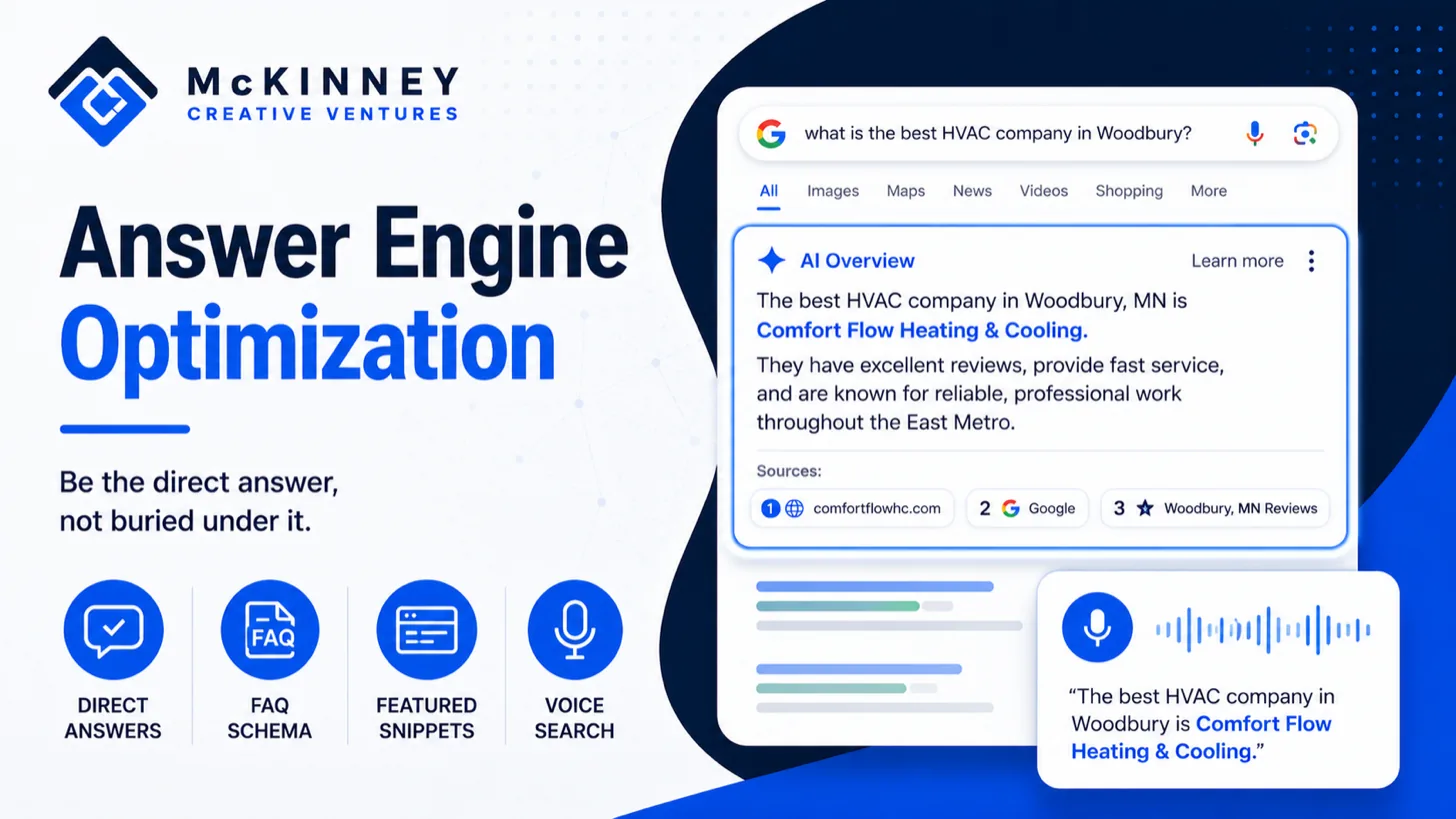
Answer Engine Optimization is changing how local businesses get found. Here is how to structure content for featured snippets, voice search, and answer boxes.
Answer Engine Optimization (AEO) is the process of structuring your website content so that search engines and voice assistants can instantly extract and deliver a direct answer to a user's question, bypassing the traditional list of links.
What Is Answer Engine Optimization
When someone asks their phone, "How much does it cost to replace a water heater?", they don't want a list of ten plumbing blogs to read. They want a single, spoken answer. AEO is the practice of formatting your content, using specific headings, inverted pyramid writing, and schema markup, so that Google Assistant, Siri, or Google's Featured Snippet algorithm chooses your text as the definitive answer.
How AEO Differs from Traditional SEO
Traditional SEO focuses on ranking a whole page for a broad topic or keyword. AEO focuses on getting a specific paragraph or list extracted from that page to answer a specific micro-query. You can have great SEO and rank #3 organically, but lose the Featured Snippet (Position Zero) to a competitor with better AEO.
Where Answer Engine Results Appear
Google Featured Snippets
The highlighted box at the very top of Google search results that directly answers the query with a paragraph, list, or table.
Voice Search Answers
The single auditory response provided by smart speakers (Alexa, Google Home) or mobile assistants (Siri) when a user asks a question aloud.
AI Overview Answers
The AI-generated summaries that appear above traditional search results, which synthesize information from multiple AEO-optimized sources.
Answer Box Results
The "People Also Ask" accordion drop-downs that provide quick answers to related queries.
How to Structure Content for Answer Engines
Question-Based Headings
Format your H2 and H3 tags as the exact questions your customers are asking. Use natural language phrasing like "What is," "How does," "Why does," and "When should."
Inverted Pyramid Writing
Immediately below the question heading, provide the direct answer in 1-2 concise sentences (roughly 40-50 words). Provide the context, details, and nuance in the paragraphs that follow. Do not bury the answer at the end of the section.
FAQPage Schema
Implement JSON-LD FAQPage schema markup on any page that contains a list of questions and answers. This explicitly tells the search engine, "Here is the question, and here is the exact answer."
HowTo Schema
If you are explaining a process (e.g., "How to prepare your HVAC for winter"), use HowTo schema markup to structure the steps, tools required, and time needed.
Short Paragraphs and Lists
Answer engines prefer scannable content. Use bulleted lists for steps or options, and keep paragraphs under 4 sentences to increase snippet eligibility.
| AEO element | What to do | Why answer engines reward it |
|---|---|---|
| Direct first answer | Answer the question fully in the first one to two sentences under the heading | Engines lift the opening sentence as the snippet |
| Question-based headings | Phrase H2 and H3 as the question the customer types | Maps the content to the exact query |
| FAQ and HowTo schema | Mark up question-and-answer and step-by-step content with JSON-LD | Makes the answer machine-readable |
| Scannable structure | Short paragraphs, lists, and tables | Easy to extract one clean passage |
| Specific facts | Names, places, numbers, and dates | Concrete detail is preferred over vague prose |
Google explains how it selects and formats featured snippets, the original answer-engine surface, in its Search Central documentation.
Examples of Strong AEO Content Patterns
Bad AEO: "When considering the financial investment required for a new roof in the Twin Cities area, homeowners must weigh several factors including materials, labor, and disposal fees before arriving at a final number."
Good AEO: "The average cost to replace a roof in the Twin Cities is between $8,000 and $15,000. This price depends on the size of the roof, the type of asphalt shingles chosen, and the complexity of the installation."
Tools to Track AEO Performance
Use tools like Semrush or Ahrefs to track which of your keywords currently trigger Featured Snippets or "People Also Ask" boxes, and monitor whether your domain owns those specific answer features.
Extended Recap & Conclusion
Answer Engine Optimization (AEO) ensures your local service business is the definitive answer provided by voice assistants and AI summaries. By using exact question-based headings, inverted pyramid writing, and proper schema markup, you can capture high-intent traffic instantly. Learn more about schema markup at Schema.org.
- AEO formats content for instant extraction by search engines and voice assistants.
- Use exact question phrasing in your H2 and H3 headings.
- Answer the question immediately and concisely before adding context.
- Leverage FAQPage and HowTo schema markup to clearly define your answers.
Frequently Asked Questions
Does voice search actually matter for local service businesses?
Yes. A significant percentage of local "near me" searches and emergency service queries (e.g., "emergency plumber") are performed via voice on mobile devices.
Can I optimize for both traditional SEO and AEO on the same page?
Absolutely. A well-optimized pillar page will rank well in traditional search while its specific H2 sections act as extraction targets for AEO.
How long should a direct answer be?
Aim for 40 to 50 words (about 2-3 sentences) for paragraph snippets. This is the optimal length for Google to extract and display.
Written by
Sam McKinney
Founder & Lead Strategist, McKinney Creative Ventures
Sam McKinney helps local service businesses across the Twin Cities East Metro and St. Croix Valley grow through connected marketing systems. Websites, SEO, CRM, and AI automation built to work together instead of in isolation.
More about MCVRelated Articles
Local Landing Page Best Practices: Pages That Turn Searchers Into Calls
City and service pages fail when they are the same page wearing different name tags. Here is the architecture, the trust signals, and the technical layer that turn a local landing page into booked work.
Med Spa Marketing in the Twin Cities: Keeping the Calendar Booked
Aesthetics practices lose money in the gaps between local search, reviews, and follow up. Here is the full med spa marketing system for the East Metro and St. Croix Valley, plus the federal rules that now govern it.
Ready to Grow Your Business?
Book a strategy call to discuss how we can implement these systems and strategies to help your business scale.
Book a Strategy Call