
Med Spa Marketing in the Twin Cities: Keeping the Calendar Booked
Sam McKinney
Founder & Lead Strategist • August 19, 2026
Overview
Aesthetics practices lose money in the gaps between local search, reviews, and follow up. Here is the full med spa marketing system for the East Metro and St. Croix Valley, plus the federal rules that now govern it.
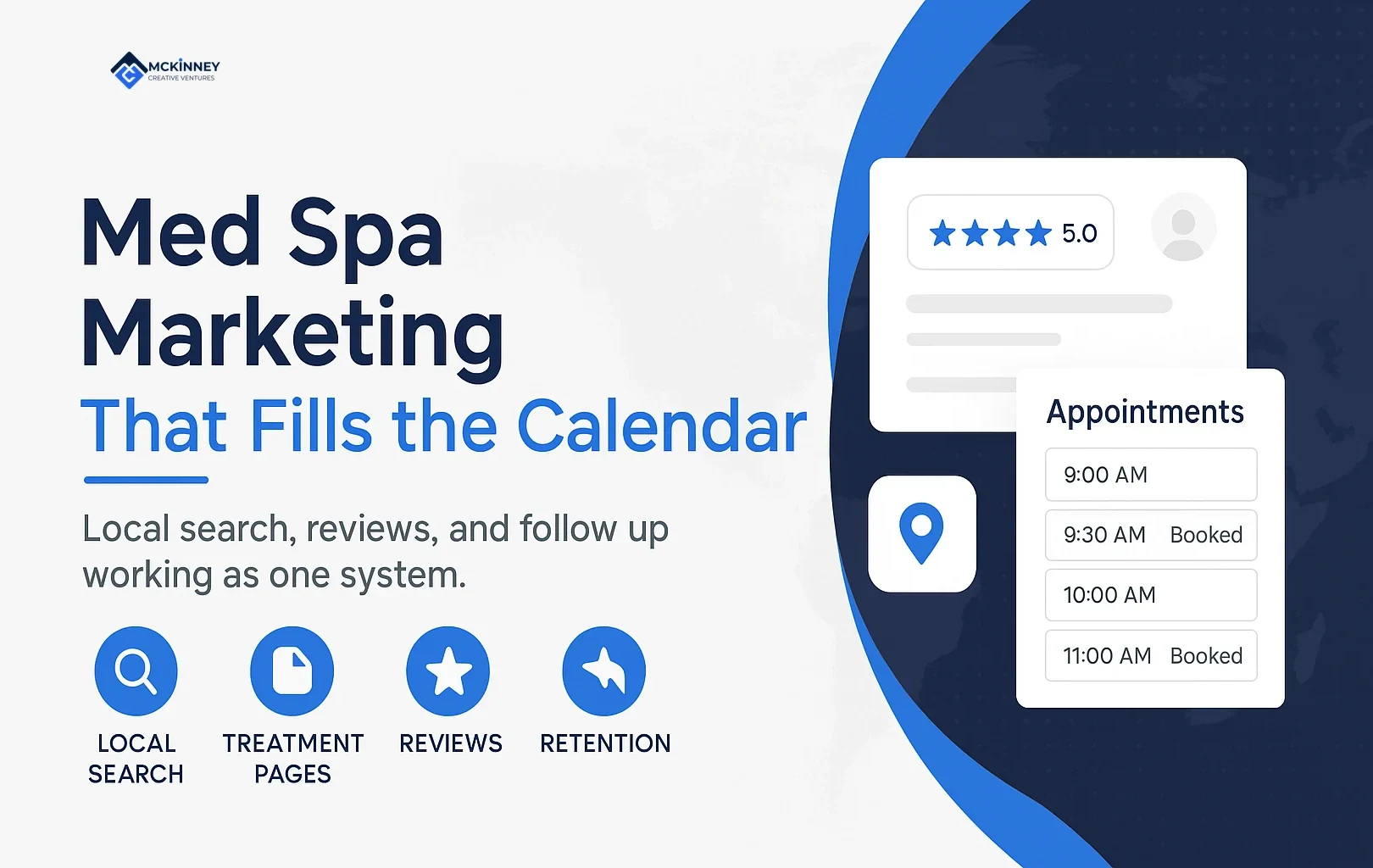
Med spa marketing works when it is built as one connected system: local search visibility that gets you found for high intent treatment searches, a website that turns a browser into a booked consultation, a review engine that compounds trust, and follow-up automation that brings clients back on schedule. Most Twin Cities aesthetics practices have pieces of that. Very few have all four wired together, which is why their calendars swing between overbooked and uncomfortably quiet.
The category is unusual. Demand is durable, the buyer researches heavily before calling, and the treatments are repeat purchases by nature. A neuromodulator client is not a transaction, she is a client who needs you again in three to four months. Acquisition matters, but retention and reactivation are where the margin lives, and those are the two things most practices leave to staff memory.
Here is the playbook for a med spa in the Twin Cities East Metro and St. Croix Valley: what the demand data says, how to build the local search foundation, why advertising here is different, the review rules that changed in 2024, and the systems that keep the schedule full.
What med spa marketing has to solve
Start with demand, because it determines where effort goes. The American Society of Plastic Surgeons publishes an annual procedural statistics report, and the 2024 edition shows what people are booking and what they are booking less of.
| Cosmetic minimally invasive procedure | 2024 procedures | 2023 procedures | Change |
|---|---|---|---|
| Neuromodulator injection (Botox, Dysport, Xeomin, Jeuveau, Daxxify) | 9,883,711 | 9,480,949 | Up 4 percent |
| Hyaluronic acid fillers | 5,331,426 | 5,294,603 | Up 1 percent |
| Skin resurfacing (peels, lasers, microdermabrasion) | 3,703,305 | 3,501,696 | Up 6 percent |
| Skin treatment using lasers (hair removal, IPL, tattoo removal) | 3,112,056 | 3,101,772 | Flat |
| Non-hyaluronic acid fillers (Radiesse, Sculptra, Bellafill, Renuva) | 932,861 | 924,549 | Up 1 percent |
| Nonsurgical skin tightening | 439,032 | 438,211 | Flat |
| Noninvasive fat reduction (CoolSculpting, Kybella and similar) | 447,581 | 745,967 | Down 40 percent |
Source: ASPS 2024 Procedural Statistics Report.
Two things jump out. Injectables are the anchor, with neuromodulators alone accounting for nearly ten million procedures and holding the top spot. If your marketing does not own injectable searches in your service area, you are competing for scraps. And demand is not uniform. Noninvasive fat reduction fell sharply in a single year while skin resurfacing grew. Building a budget around a device you bought three years ago is a real risk if buyer interest has moved on.
The decision also takes longer than owners assume. Someone booking a first filler appointment is trusting a stranger with a needle. She reads the gallery, checks reviews on more than one platform, looks at who performs the treatment and what their credentials are, and often asks an AI assistant for the best med spa near Woodbury before she fills out a form. The job is not to be found. It is to be found and then survive scrutiny.
The local search foundation for a med spa
Local search is the highest intent traffic you will get and the cheapest to hold. Three components carry most of the weight.
Google Business Profile, set up correctly
Your profile is the most valuable asset in local aesthetics marketing, and where most practices quietly break the rules. Google's guidelines for representing your business on Google are specific about multi-practitioner businesses, which describes nearly every med spa:
- Practitioner listings follow rules. If a practitioner is one of several public facing practitioners at a location, the organization keeps a profile for the location, separate from the practitioner's own, and the practitioner's title should contain only their name.
- A solo practitioner is different. When one practitioner is the only public facing practitioner and represents a branded organization, Google's guidance is a single shared profile in the format brand or company, then practitioner name.
- One practitioner, one profile. A practitioner should not create separate profiles for each specialization. Injector, laser tech, and skin specialist are not three businesses.
- No keyword stuffing in the name. Adding "Botox Filler Laser" to your business name violates the guidelines and commonly triggers a suspension.
Fix the categories, load the services list with the treatments you actually perform, keep hours accurate, and post regularly. Unglamorous work that outperforms most of what practices spend on.
A page for every treatment you want to be found for
A single Services page listing twelve treatments will not rank for any of them. Each revenue treatment deserves its own page covering what it is, who it is for, what the appointment is like, recovery, and roughly what it costs. Those pages are also what AI answer engines pull from when summarizing options, because they hold the specific question answering content those systems prefer. That is the practical core of SEO, GEO, and AEO for an aesthetics practice.
Layer city pages on top if you genuinely serve multiple communities. A practice in Woodbury pulling clients from Stillwater, Cottage Grove, Oakdale, and across the river into Hudson has real reason to speak to each market. Thin duplicate pages with the town name swapped in have not worked for years.
Content that earns trust, not just traffic
Aesthetics is a health topic, the category Google treats most carefully. Google's guidance on creating helpful content is explicit that its systems give even more weight to strong experience, expertise, authoritativeness, and trustworthiness for topics that could significantly affect health or safety, and that trust matters most. In practice: named authors with real credentials, provider bios that say who trained where, honest discussion of risk and candidacy. A page bylined "Admin" about the safety of a medical injectable will not carry the same weight, and it should not.
Paid advertising for aesthetics is a different sport
You can run excellent paid campaigns for a med spa, but the targeting toolkit is deliberately narrower than it is for other local businesses. Google classifies health as a sensitive interest category in its personalized advertising policy. Advertisers promoting health related services cannot use advertiser curated audiences, because those may carry sensitive user signals. What remains is still substantial: predefined Google audiences including in market segments, affinity segments, demographics, life events, location targeting, and custom segments, all configured by Google without sensitive signals.
The strategic read is simple. Do not build an aesthetics strategy on remarketing lists of people who visited your Botox page. Build it on high intent search and on geography, where you know the drive time works. That is how we structure digital advertising for health and wellness clients. And send that traffic to the treatment page, not the homepage. The click is expensive and the buyer is cautious.
Reviews are the conversion engine, and the rules changed
Reviews do more work in aesthetics than in almost any other local category, because the buyer is evaluating a person's skill and judgment, not a product spec. They are also where well meaning practices most often break federal law without realizing it. The Federal Trade Commission announced its final Rule on the Use of Consumer Reviews and Testimonials on August 14, 2024, and it took effect October 21, 2024, giving the FTC authority to seek civil penalties for knowing violations. Here is what changed for a practice asking clients for reviews.
| Practice | Status under the FTC rule | What to do instead |
|---|---|---|
| Offering a discount or product for a review, with no strings attached | Permitted by the rule | Disclose the incentive, since failing to can still violate the FTC Act |
| Asking clients to "tell us how much you loved your visit" for a perk | Prohibited, it implies the review must be positive | Ask for an honest review, in neutral wording |
| Paying for five star reviews, even with a disclosure attached | Prohibited | Remove sentiment conditions from every incentive |
| Staff, owners, or managers reviewing without disclosing the relationship | Prohibited | Require clear and conspicuous disclosure, or do not solicit insiders |
| Screening clients first and sending only happy ones to Google | Review gating, treated as suppression | Send the same request to every client |
| Threatening a client legally to get a negative review removed | Prohibited | Respond publicly and professionally, resolve privately |
| Running a review site you control that ranks your own practice | Prohibited | Compete on real third party platforms |
Source: FTC staff guidance on the Consumer Reviews and Testimonials Rule.
The FTC's own example of an implied sentiment requirement is close to how most practices word review requests today. Change the wording, keep the incentive if you want one, and disclose it.
Responding to reviews when you handle patient information
There is a second trap specific to medically adjacent practices. If your business is a covered entity under HIPAA, a public reply that confirms someone was a patient, names their treatment, or corrects their account of their care can be an impermissible disclosure of protected health information, and federal regulators have pursued providers for exactly this. The safe pattern is a short, warm, generic public reply that invites a direct conversation, with clinical detail handled offline. The same rule governs before and after photos and testimonials, which need documented authorization first.
Retention and reactivation, where the real money is
Aesthetics is a recurring revenue business that most practices run like a transactional one. A neuromodulator client returns on a predictable cycle. A laser series has defined intervals. A skincare client runs out of product on a knowable date. Each is a follow up that either happens automatically or does not happen at all.
- Treatment cycle reminders. Trigger outreach from the last treatment date and expected interval, not from someone remembering.
- Pre-booking at checkout. The best time to book the next appointment is while the client is still in the building and happy.
- Lapsed client reactivation. A defined campaign for anyone past their return window. The highest return list you own, because they already trust you.
- Memberships. Recurring billing that smooths revenue and gives you a reason for monthly contact.
- Speed to lead. Form fills and missed calls need an immediate automated response. These leads shop several practices in one sitting.
All of it runs off the same client database, which is why CRM and automation is not a separate line item from marketing here. It is what makes acquisition spend pay off more than once. We build these for clients across health and wellness, and the pattern holds: practices that grow steadily stopped relying on staff memory to bring people back.
Minnesota specifics that shape your marketing
Minnesota has no statute written specifically for medical spas. What governs your practice are the rules for the individual procedures and the licensed professionals performing them, primarily through the Minnesota Board of Medical Practice and the Minnesota Board of Nursing. The Minnesota Board of Nursing is direct that neither the Nurse Practice Act nor the Board publishes a list of tasks that are in or out of scope. Nurses are accountable for practice they are educated, competent, and authorized to perform, and delegation is situation specific.
Why a marketing post cares: your website makes claims. If a page implies a physician performs a treatment that a delegated nurse performs, that is a compliance exposure your marketing created. Review provider pages, service pages, and ad copy against how the practice actually operates, and confirm your arrangement with the relevant board rather than assuming.
A practical sequence for the next 90 days
Starting from the typical position, meaning a decent website, an unmanaged Google profile, sporadic reviews, and no automation, run it in this order:
| Window | Focus | What gets done |
|---|---|---|
| Weeks 1 and 2 | Google Business Profile | Audit against Google's guidelines. Correct categories, load every service, fix a stuffed name, sort practitioner listings. |
| Weeks 3 and 4 | Reviews | Rewrite the request so it is compliant, automate it to every client, and set a response protocol that keeps clinical detail out of public replies. |
| Weeks 5 through 8 | Treatment pages | Build pages for the top four revenue services, with named providers, candidacy information, and price ranges. |
| Weeks 9 and 10 | Retention automation | Turn on treatment cycle reminders and a lapsed client reactivation campaign against the existing database. |
| Weeks 11 and 12 | Paid search | Start or restructure campaigns pointed at the new treatment pages, using search intent and tight geography. |
The order is deliberate. Paid traffic sent to an unconvincing site with a weak review profile is money spent teaching people to choose your competitor.
Extended Recap & Conclusion
Med spa marketing in the Twin Cities is a sequencing problem more than a tactics problem. Demand is documented and durable, with injectables anchoring the category at nearly ten million neuromodulator procedures nationally in 2024, while device driven categories like noninvasive fat reduction have cooled considerably. Your job is to be visible for the treatments people actually search, credible enough to survive the research phase, compliant in how you gather and answer reviews, and systematic about bringing clients back on cycle.
The four pieces work together or they underperform separately. A correct Google profile and real treatment pages get you found. Credentialed content and a deep review profile get you chosen. Search focused advertising accelerates the pipeline inside the narrower targeting rules health categories carry. Follow up automation turns one appointment into a multi year relationship. Build all four and the calendar stops depending on who happened to find you last week.
Frequently Asked Questions
How long does med spa marketing take to produce results?
It depends on the lever. Google Business Profile corrections and a compliant review system can shift call volume within weeks, because they improve how you appear in searches you already rank for. New treatment pages generally need a few months to mature. Reactivation against your existing client list is usually the fastest new revenue.
Can med spas use remarketing and audience targeting in Google Ads?
Not in the usual way. Google treats health as a sensitive interest category in its personalized advertising policy, so advertisers promoting health related services cannot use advertiser curated audiences. Predefined Google audiences remain available, including in market and affinity segments, demographics, life events, location, and custom segments. High intent search plus tight geographic targeting is the reliable structure.
Is it legal to offer clients a discount for leaving a Google review?
The FTC's Consumer Reviews and Testimonials Rule does not prohibit incentives, but it prohibits conditioning the incentive on the review expressing a particular sentiment, stated or implied. Asking someone to share how much they loved their visit in exchange for a perk implies a positive review is required. Ask for an honest review, and disclose the incentive.
Should each injector at my practice have their own Google Business Profile?
Possibly, and the rules are specific. Google's guidelines say that when a practitioner is one of several public facing practitioners at a location, the organization keeps its own profile and the practitioner may have a separate one titled with only their name. No practitioner should hold multiple profiles for different specializations, and stuffing treatment keywords into a business name violates the guidelines.
How should I respond to a negative review of a treatment?
Publicly, briefly, and without clinical detail. If your practice is a HIPAA covered entity, confirming someone was a patient or describing their treatment in a public reply can be an impermissible disclosure of protected health information, and regulators have acted against providers for that. Acknowledge the feedback, apologize, and move the conversation to a private channel.
If you run a med spa in the East Metro, the St. Croix Valley, or western Wisconsin and these pieces are only half built, that is a fixable and predictable problem. Book a strategy call and we will look at your Google profile, treatment pages, review flow, and follow up automation, then tell you which part of the 90 days to start first.
Written by
Sam McKinney
Founder & Lead Strategist, McKinney Creative Ventures
Sam McKinney helps local service businesses across the Twin Cities East Metro and St. Croix Valley grow through connected marketing systems. Websites, SEO, CRM, and AI automation built to work together instead of in isolation.
More about MCVRelated Articles

Hudson, WI Service Businesses: Marketing Across the Border
A Hudson service business that works both sides of the St. Croix is running one brand across two states, two licensing regimes, and two separate local search markets. Here is how to set that up so neither side gets treated as an afterthought.

How to Get Cited by ChatGPT and Perplexity as a Local Business
AI assistants cite sources they can reach, trust, and quote quickly. Here is how retrieval actually works inside ChatGPT and Perplexity, and the sequence a local service business should work through to become one of those sources.
Ready to Grow Your Business?
Book a strategy call to discuss how we can implement these systems and strategies to help your business scale.
Book a Strategy Call