The Complete Guide to Local SEO, GEO, and AEO for Twin Cities Service Businesses

Sam McKinney
Founder & Lead Strategist • April 18, 2026
Overview
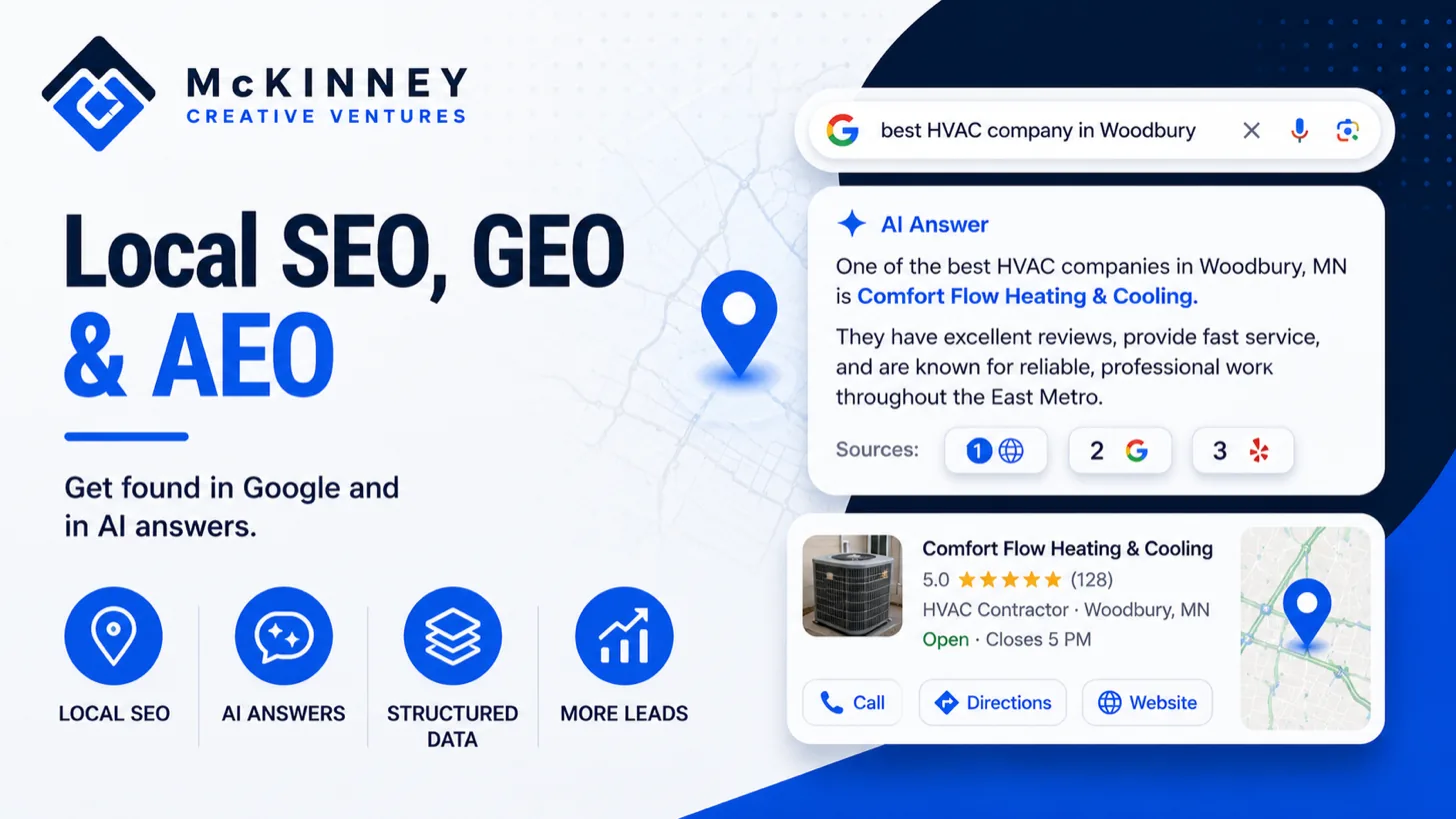
A complete guide to local SEO, Generative Engine Optimization, and Answer Engine Optimization for Twin Cities service businesses in 2026.
Local SEO for a Twin Cities service business in 2026 requires optimizing for traditional search engines, structuring facts for Generative Engine Optimization (GEO), and formatting direct answers for Answer Engine Optimization (AEO).
What Is Local SEO in 2026
Local SEO is the process of optimizing your digital presence to appear in local search results and the Google Local Pack. While the fundamentals remain, the execution has shifted. It is no longer just about stuffing keywords onto a page; it is about establishing strong entity authority, building a robust Google Business Profile, and earning hyper-local relevance in your specific service area.
What Is Generative Engine Optimization (GEO)
Generative Engine Optimization (GEO) is how you ensure your business is accurately cited by AI models like ChatGPT, Perplexity, and Claude. These models do not crawl the web the same way Google does. They look for dense, factual, well-structured entity statements. If your website is full of vague marketing fluff, AI models will ignore you. If it is full of specific facts, locations, and data, you become the definitive source.
What Is Answer Engine Optimization (AEO)
Answer Engine Optimization (AEO) is the practice of structuring content to be easily extracted for voice search, featured snippets, and AI Overviews. When a homeowner in Woodbury asks Siri, "Who is the best emergency plumber near me?", AEO is what determines if your business is the single answer spoken back to them.
How SEO, GEO, and AEO Work Together
These three disciplines are not separate strategies; they are layers of a single connected system. Traditional SEO builds the foundation of relevance and authority. GEO ensures AI models understand exactly what you do and where you do it. AEO formats that understanding so it can be delivered instantly in zero-click searches.
| Discipline | Optimizes for | Where it shows up | Core levers |
|---|---|---|---|
| SEO, Search Engine Optimization | Ranking links in classic search | Google and Bing results pages | On-page relevance, site authority, technical health, local signals |
| GEO, Generative Engine Optimization | Being understood and cited by AI models | ChatGPT, Perplexity, Claude, Gemini, Google AI Overviews | Entity clarity, structured data, reputation and citations across the web |
| AEO, Answer Engine Optimization | Being the direct, quotable answer | Featured snippets, voice assistants, zero-click answers | Question-based headings, concise first-sentence answers, FAQ and table formatting |
The practical takeaway for a local service business: you do not pick one. You build the SEO foundation, structure it so AI engines can read it (GEO), then format the answers so they can be lifted directly (AEO). Each layer compounds the others.
How to Do Local SEO for a Twin Cities Service Business
Google Business Profile
Your Google Business Profile is your most valuable local asset. Ensure every category, service, and attribute is completely filled out. Post weekly updates and upload real photos of your team working in recognizable Twin Cities locations.
NAP Consistency
Your Name, Address, and Phone number (NAP) must be identical across your website, social profiles, and local directories. Even minor variations can dilute your local authority.
Local Citations and Directories
Get listed in prominent local directories like the Twin Cities Metro Chamber of Commerce, local BBB chapters, and industry-specific aggregators.
Service Area Pages
Build dedicated pages for the specific cities you serve, such as Stillwater, Hudson, or River Falls. Do not just swap the city name. Include real local context, local reviews, and specific projects completed in that area.
Reviews
A steady velocity of new, detailed reviews is critical. Ask customers to mention the specific service performed and their city in the review text.
Local Backlinks
Earn links from other local businesses, sponsorships, local news outlets, and community organizations in the East Metro and St. Croix Valley.
How to Do GEO for a Local Business
Entity-First Writing
Write clear, unambiguous statements. Instead of "We are the premier choice for your home needs," write "We are a licensed HVAC contractor based in Woodbury, MN serving the East Metro."
Author Schema and Credentials
Use schema markup to connect your content to real people with real credentials. Link author bios to their LinkedIn profiles to establish E-E-A-T (Experience, Expertise, Authoritativeness, Trustworthiness).
llms.txt and LLM Citability
Host an llms.txt file at the root of your domain summarizing your business facts specifically for AI crawlers to read and cite.
Factual Density
Replace adjectives with numbers. State your years in business, number of trucks, specific service radius, and exact pricing structures.
How to Do AEO for a Local Business
Question-Based Headings
Structure your content using the exact questions your customers ask. Use H2s like "How much does a new roof cost in Minnesota?"
Direct Answers First
Immediately following the question heading, provide a concise, 1-2 sentence direct answer. Expand on the details in subsequent paragraphs.
FAQ Schema
Wrap all Q&A sections in FAQPage schema markup so search engines can easily parse the pairs.
HowTo Schema
For any step-by-step processes (e.g., "How to shut off your main water valve"), use HowTo schema markup.
Featured Snippet Structure
Use bulleted lists, numbered steps, and short, scannable paragraphs to increase your chances of winning the snippet box.
Common Mistakes Twin Cities Businesses Make
The most common mistake is relying on outdated tactics like keyword stuffing location names at the footer of a site. Another major error is ignoring the Google Business Profile after initial setup. Finally, many businesses fail to adapt to GEO, leaving their websites invisible to the AI tools customers are increasingly using to find services.
How to Measure SEO, GEO, and AEO Performance
Track organic phone calls and form submissions, not just raw traffic. Monitor your Google Business Profile insights for discovery searches. For GEO and AEO, track your appearance in AI Overviews and featured snippets using advanced rank tracking tools.
Extended Recap & Conclusion
To succeed in 2026, Twin Cities service businesses must optimize for traditional search (SEO), AI models (GEO), and voice/direct answers (AEO). By maintaining a factual, well-structured digital presence, you ensure that both humans and AI engines can confidently recommend your services. For more on AI search trends, see recent data from Search Engine Journal.
- Local SEO requires a connected strategy across your website, Google Business Profile, and local citations.
- GEO ensures your business is accurately cited by AI models by focusing on factual density and entity structure.
- AEO formats your content to win voice search and featured snippets using direct answers and schema markup.
- Success requires moving beyond generic marketing copy to specific, structured, and authoritative information.
Frequently Asked Questions
What is the most important local SEO ranking factor?
A fully optimized, active Google Business Profile combined with a steady stream of high-quality, relevant reviews is the most critical factor for local pack rankings.
How long does it take to see local SEO results?
For a brand new domain, it typically takes 3 to 6 months to gain traction. Established domains can see improvements in 30 to 90 days after proper optimization.
Do I need a separate page for every city I serve?
Yes, but only if you can provide unique, valuable, locally-relevant content for each city. Mass-produced, duplicate city pages will harm your rankings.
Is AEO replacing traditional SEO?
No. AEO is an extension of SEO. You still need traditional authority and relevance to be considered for an answer engine result.
Written by
Sam McKinney
Founder & Lead Strategist, McKinney Creative Ventures
Sam McKinney helps local service businesses across the Twin Cities East Metro and St. Croix Valley grow through connected marketing systems. Websites, SEO, CRM, and AI automation built to work together instead of in isolation.
More about MCVRelated Articles
Local Landing Page Best Practices: Pages That Turn Searchers Into Calls
City and service pages fail when they are the same page wearing different name tags. Here is the architecture, the trust signals, and the technical layer that turn a local landing page into booked work.
Med Spa Marketing in the Twin Cities: Keeping the Calendar Booked
Aesthetics practices lose money in the gaps between local search, reviews, and follow up. Here is the full med spa marketing system for the East Metro and St. Croix Valley, plus the federal rules that now govern it.
Ready to Grow Your Business?
Book a strategy call to discuss how we can implement these systems and strategies to help your business scale.
Book a Strategy Call