Why Marketing Materials Matter for Every Small Business

Sam McKinney
Founder & Lead Strategist • January 8, 2026
Overview
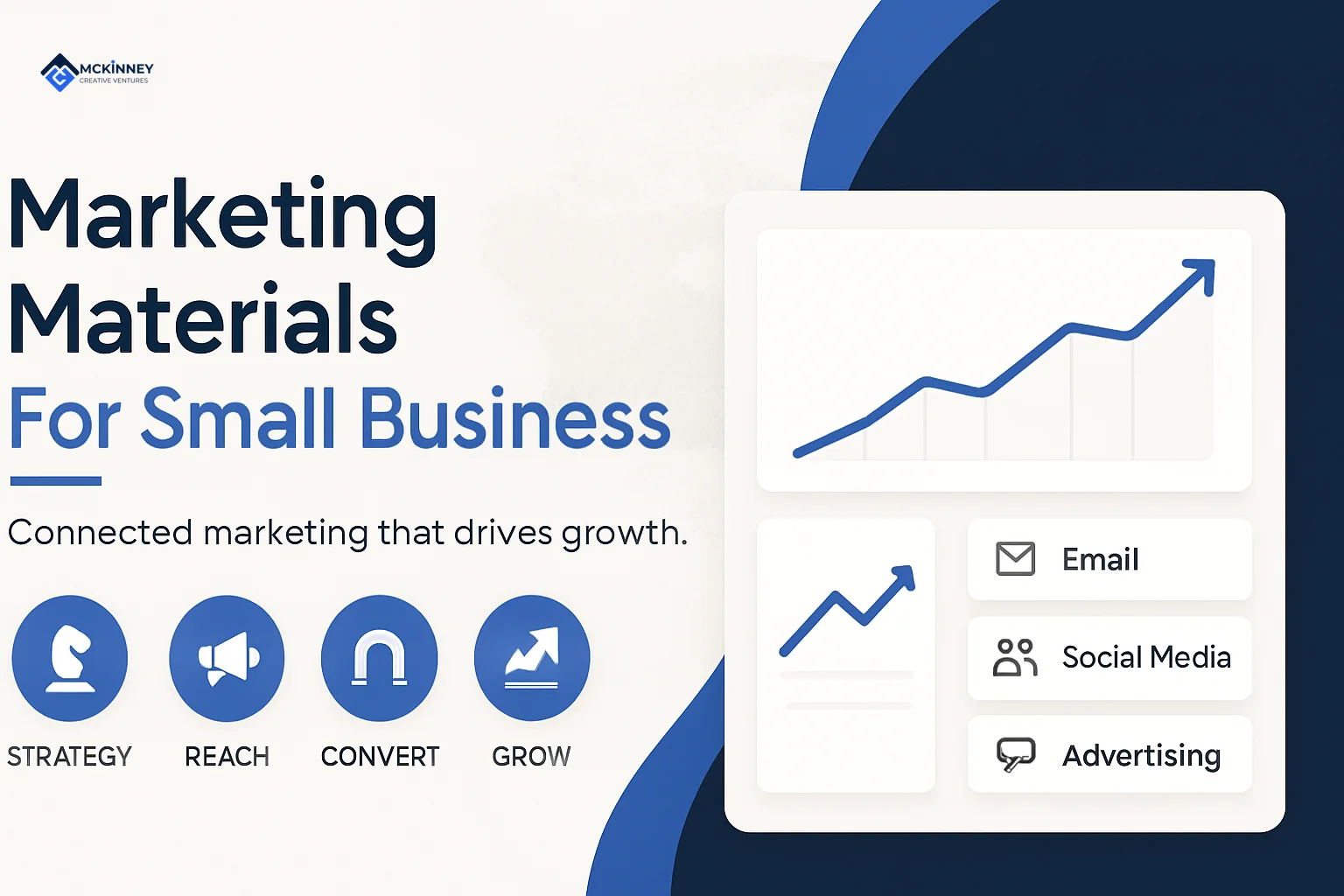
Marketing materials for small business are the tools you use to communicate who you are, what you offer, and why customers should choose you. They include everything from.
Marketing materials for small business are the tools you use to communicate who you are, what you offer, and why customers should choose you. They include everything from your business cards and brochures to your website, social media profiles, and promotional products.
Here's what you need to know:
- Digital materials include your website, email signatures, social media graphics, and blog content
- Print materials include business cards, flyers, brochures, postcards, banners, and signage
- Promotional products include branded apparel, custom swag, and giveaway items
- Purpose: Build brand awareness, generate leads, support your sales process, and encourage customer loyalty
- Key principle: Strategy comes before design. Know your goals and audience first.
Marketing materials remain one of the most effective marketing channels available. According to the Promotional Products Association International, business promotional items are the #1 most effective form of advertising across all generations. But effectiveness depends on having the right materials for your audience, not just more materials.
The real power comes from creating a cohesive system where each piece supports your overall business goals. Your logo, website, business cards, and promotional items should all work together to build recognition and trust. When someone sees your brochure in the mail and later visits your website, they should immediately recognize your brand.
Quality beats quantity every time. A small collection of well-designed materials will outperform a large stack of cheap ones. Professional marketing materials make your business look competent and trustworthy. Poor quality materials do the opposite, no matter how many you distribute.
Strategy matters more than tactics. Before you print anything or order custom swag, you need to understand your target audience, define your unique selling proposition, and clarify what you want each marketing piece to accomplish.
I'm Sam McKinney, and I've spent over 15 years helping service-based businesses build smarter marketing systems that actually drive growth. Through my work with marketing materials for small business owners, I've learned that the most successful companies focus on creating connected systems rather than isolated pieces.
Strategy First: Aligning Materials with Your Business Goals
Before we even think about designing a business card or choosing a promotional item, we need to talk strategy. For any small business, especially those in the East Metro Twin Cities and St. Croix Valley, setting clear goals is paramount. Why? Because it helps us, and any team members we have, stay focused. Without a clear destination, our marketing efforts can become scattered and ineffective. Our marketing materials are not just pretty pieces; they are strategic tools designed to help us achieve specific objectives. Whether it's building brand awareness, generating leads, or encouraging customer loyalty, every piece of collateral should have a purpose.
A marketing plan is a vital part of our overall business strategy. It serves as a roadmap to gain customer loyalty and improve the success of our organization. It guides us in identifying our target customers, how to reach them, and how to encourage repeat business. For example, if we aim to increase awareness for a new service in Woodbury, MN, our materials might focus on flyers and local social media campaigns. If our goal is to nurture leads for a consulting service in Stillwater, MN, a detailed brochure or an informative blog post would be more effective.
What are marketing materials and why are they crucial for small businesses?
Marketing materials for small business are any items or collateral we use to promote our business or brand. They are designed to present our marketing information to our target market. These can be physical items we hand out, or digital assets we share online. They are crucial because they form the tangible and visible representation of our brand.
Imagine meeting a potential client in Hudson, WI. Handing them a professionally designed business card with our logo and contact information makes a strong first impression. It builds trust and credibility, showing that we take our business seriously. These materials also support our sales process by providing information, reinforcing our message, and serving as a reminder of our services after an interaction. Custom marketing materials blend creativity with functionality, providing a powerful way to promote our brand and leave a lasting impression. They are a foundational element for meeting our marketing objectives.
How can marketing materials help a small business achieve its goals?
Marketing materials are not just about looking good; they are about driving results. They help us connect materials to real business outcomes, such as:
- Attracting new customers: A well-placed banner for our Maplewood, MN shop or a compelling social media ad can catch the eye of potential clients.
- Nurturing leads: Informative brochures or a series of blog posts can guide prospects through the decision-making process.
- Encouraging repeat business: Loyalty cards, personalized postcards, or useful promotional products can keep our brand top-of-mind.
- Establishing expertise: A well-designed website or an in-depth guide positions us as knowledgeable leaders in our field.
- Standing out in our local market: In competitive areas like St. Paul, MN, distinctive marketing materials help differentiate us from competitors.
Our marketing materials will improve our market’s awareness of our brand, and increased brand awareness means an expanded reach. Effective marketing materials also empower our sales team and improve their performance, giving them the tools they need to close deals. By using the right marketing materials for small business, we can build our company’s brand identity and drive growth.
Essential Marketing Materials for Small Business Growth
For any small business, whether we're just starting out in River Falls, WI, or looking to scale in Minneapolis, MN, having the right marketing tools is essential. We need to think about foundational materials that every business needs, as well as situational materials that serve specific purposes. It's about integrating print and digital to create a seamless brand experience, always focusing on quality over quantity.
Foundational Digital Materials
In today’s landscape, our digital presence is often the first interaction a potential customer has with us.
- Your website as your home base: Our website is our digital storefront, available 24/7. It's where customers can find detailed information about our services, our story, and how to contact us. A well-designed site communicates our mission, leaves a strong first impression, and boosts customer engagement, confidence, and brand loyalty. According to one source, a professional website should answer key questions like: Who are you? What do you do? Where can customers find you? When are you open? How can customers follow you?
5 Must-Have Elements for Your Business Website:
- Clear Branding: Our logo, color palette, and fonts should be consistent with our overall brand identity.
- Contact Information: Easily accessible phone numbers, email addresses, and physical locations (if applicable, for our clients in the East Metro or St. Croix Valley).
- About Us Section: Our story, our mission, and what makes our business unique.
- Products/Services Information: Detailed descriptions of what we offer, clearly outlining the benefits.
- Social Media Links: Easy ways for customers to connect with us on our preferred platforms.
- Professional email signature: This often-overlooked detail provides a professional touch to every email we send. It should include our name, title, company name, website, phone number, and perhaps a link to our latest offering or social media profiles.
- Social media profiles: Social media is where our customers are. For example, 40% of Gen Z have found new products on social media in the past three months, and 41% say it’s their preferred channel. We need to choose the platforms where our target audience spends their time and maintain consistent, engaging profiles. Our profiles should have a clear strategy, high-quality logo, complete bio, consistent username, and a content calendar.
- Content marketing such as blogs and guides: Providing valuable content like blog posts, infographics, presentations, and newsletters positions our brand as a source of valuable information. This helps us educate potential customers, establish authority, and improve our search engine optimization (SEO) efforts.
Tangible Print & Promotional Materials
Even in our digital world, physical marketing materials for small business still hold immense power. They offer a tactile experience that digital can't replicate.
- Business cards: Even today, business cards are versatile marketing tools. We should always have them on hand for networking events in Minneapolis or casual encounters in Cottage Grove, MN. They should include our logo, contact details, and website URL.
- Brochures and flyers: These are excellent for providing detailed information. Flyers are great for increasing awareness for new products or increasing foot traffic to our physical shop, while brochures are better for customers in the consideration or decision part of their buyer’s journey, offering more in-depth information about our offerings. We can distribute them door-to-door, at events, or in local businesses.
- Postcards for direct mail: Custom postcards can be used as reminders, promotional materials, or a friendly hello. They are effective for local marketing and for promoting special offers to specific neighborhoods in our service areas.
- Banners and signage for events or your location: Custom indoor and outdoor banners can bolster our brand presence for shop openings, events, or to direct foot traffic on high-traffic streets in St. Paul, MN. Yard signs are also effective for marketing our small business to passersby.
- Promotional products for giveaways: These are items our customers can use in daily life, like stickers, mugs, tumblers, or tote bags. Giving away useful items encourages regular use, turning our customers into "walking ambassadors" for our brand. Business promotional items are the #1 most effective form of advertising across all generations.
- Custom apparel for your team: Branded t-shirts, hoodies, or caps create a unified, professional look for our team. When our staff wears branded apparel, they become walking advertisements, boosting our brand identity and awareness both inside and outside our premises.
Designing for Impact: Creating a Cohesive Brand Experience
Designing our marketing materials for small business isn't just about making them look pretty; it's about making them effective. The value of professional design cannot be overstated. Our materials need to be clean, simple, and instantly recognizable. When a potential client in Lake Elmo, MN, sees our brand, we want them to immediately associate it with professionalism and quality.
What are the key elements to consider when designing effective marketing materials?
When we design marketing materials, we focus on several key elements to ensure they make the right impact:
- Your logo: This is the friendly face of our business. A strong, memorable logo is crucial for brand recognition and making a great first impression. We often advise clients that unless they moonlight as a designer, investing in a professional custom logo design is a smart move.
- Consistent color palette: Using a defined set of colors across all our materials creates visual harmony and reinforces brand recognition.
- Legible typography: The fonts we choose should be easy to read and reflect our brand's personality. Avoid overly decorative fonts for body text.
- High-quality imagery: Blurry or pixelated images scream unprofessional. We use crisp, high-resolution photos and graphics that improve our message.
- Clear and concise copy: Our message needs to be straightforward and easy to understand. We avoid large blocks of text and prioritize clarity over cleverness.
- A strong call to action: What do we want the customer to do next? Call us., make a purchase? We make it clear and easy for them to act.
How can small businesses ensure consistency in their branding?
Consistency is the backbone of a strong brand identity. It builds trust and familiarity with our audience in areas like Woodbury, MN, and New Richmond, WI.
- Creating a simple brand style guide: This document outlines our logo usage, color palette, typography, visual elements, and brand voice. It ensures everyone on our team, or any external partner, adheres to the same standards.
- Using templates for repeatable materials: For things like social media posts, email newsletters, or even invoices, templates ensure a consistent look and feel without reinventing the wheel every time.
- When to consider professional design help: While DIY tools like Canva are fantastic for many tasks, there are times when professional design help is invaluable. For our clients, we often help them navigate this. For instance, creating a truly unique and impactful logo or a complex brochure often benefits from an expert touch.
Here's a quick look at the pros and cons:
| Feature | DIY Design Tools (e.g., Canva) | Professional Designer |
|---|---|---|
| Pros | Cost-effective, quick turnaround, user-friendly, many templates | Unique and custom designs, expert advice, high-quality files, brand strategy integration |
| Cons | Limited customization, can look generic, less strategic insight, potential for inconsistent branding if not careful | Higher upfront cost, longer turnaround for initial projects, requires clear communication |
Putting Your Materials to Work: Smart Distribution & Use Cases
Creating beautiful marketing materials for small business is only half the battle. The other half is using them effectively. We need to move from merely creating materials to strategically distributing and leveraging them. This means integrating them into our daily operations and making sure they reach our target audience.
How can businesses leverage marketing materials for trade shows and events?
Trade shows and local events in places like Baldwin, WI, or Stillwater, MN, are prime opportunities to showcase our brand. Our marketing materials can make a significant difference in attracting and engaging potential customers.
- Creating an inviting booth: Our booth should be an extension of our brand. Custom table covers, backdrops, and signs immediately draw attention. We want to ensure our booth is professional and reflective of our brand's identity.
- Using banners and backdrops: Large, eye-catching banners communicate our core message quickly. Branded backdrops create a professional setting for conversations and photos.
- Providing informational handouts like flyers and brochures: These allow visitors to take information with them. Flyers can highlight special offers, while brochures can provide more detailed information about our services.
- Offering memorable giveaways with promotional products: Useful promotional items like branded pens, notepads, or small tech accessories can leave a lasting impression and serve as a reminder of our business long after the event.
- Coordinating pre-show and post-show communication: We can use postcards for pre-show invites and follow-up emails with links to our website or blog for post-show engagement.
What role do promotional products play in increasing brand awareness and customer traffic?
Promotional products are powerful tools for increasing brand awareness and driving customer traffic. They are tangible reminders of our brand that people can use and see regularly.
- Choosing useful items that people keep: The most effective promotional items are those that recipients will actually use. A branded mug, a high-quality pen, or a sturdy tote bag will be seen repeatedly, constantly reinforcing our brand.
- Low-minimum options for new businesses: For new companies in places like Roseville, MN, with a tighter budget, many suppliers offer low-minimum order quantities on popular items like pens, notepads, or keychains, making them accessible.
- Custom apparel for team unity: Beyond just our team, custom apparel can also be given to loyal customers. When they wear our branded t-shirts or hats, they become "walking billboards," spreading our brand message wherever they go.
- Building goodwill with thoughtful giveaways: Giving away a useful promotional product is a gesture of goodwill. It creates a positive association with our brand and can encourage word-of-mouth referrals.
Extended Recap & Conclusion
We've covered a lot about marketing materials for small business, emphasizing a strategy-first approach. These materials are more than just items; they are an investment in our brand’s growth, a reflection of our professionalism, and a powerful tool for connecting with our community in the East Metro and St. Croix Valley. The power of a consistent and professional image cannot be overstated.
For small businesses in the East Metro Twin Cities and St. Croix Valley, building a cohesive marketing system can feel overwhelming. We understand that wearing many hats can make it difficult to prioritize and execute an effective marketing strategy. That's where partners like McKinney Creative Ventures come in. We can provide the fractional support to make it manageable, helping you develop and implement the right marketing materials to get noticed and grow your brand effectively.
Let's build your marketing strategy
If you want a connected marketing system that brings this together for your business, we can help. Book a free strategy call and we will map out a plan built around your goals. No pitch, just a clear next step.
Frequently Asked Questions
What are the most effective marketing materials for small business on a budget?
For businesses looking to maximize their impact without breaking the bank, we recommend a smart combination of digital and print:
- Digital materials: Social media templates and a professional email signature are low-cost, high-impact tools that can be created with minimal investment. Our website, while requiring some initial investment, provides long-term value.
- High-impact, low-cost print: Business cards are incredibly affordable and essential for networking. Postcards can be used for targeted direct mail campaigns without the higher cost of larger brochures.
- Focus on quality over quantity: It's always better to invest in a small collection of well-designed, quality materials than a large quantity of cheap ones. A few professional pieces will leave a much better impression.
How do marketing materials contribute to building customer loyalty?
Marketing materials for small business are key to fostering customer loyalty by:
- Reinforcing your brand identity: Consistent branding across all touchpoints builds familiarity and trust. When customers see our logo on a thank you card, a promotional item, or our website, it reinforces who we are.
- Providing value: Useful promotional products or informative brochures that genuinely help customers create a positive association with our brand.
- Creating a professional and trustworthy impression: High-quality materials signal that we are a reliable and reputable business. This professionalism builds confidence and encourages customers to return.
- Using thank you cards and package inserts to show appreciation: A personalized thank you card or a small branded gift included with a purchase can make customers feel valued and appreciated, strengthening their loyalty.
How often should I update my marketing materials?
We advise our clients to review their marketing materials quarterly or whenever major changes occur. This includes a rebrand, a new product or service launch, or a change in our physical address in say, Afton, MN. Keeping our materials current maintains credibility and trust. Designs should also be refreshed regularly to avoid looking dated and to keep our brand vibrant and relevant.
Written by
Sam McKinney
Founder & Lead Strategist, McKinney Creative Ventures
Sam McKinney helps local service businesses across the Twin Cities East Metro and St. Croix Valley grow through connected marketing systems. Websites, SEO, CRM, and AI automation built to work together instead of in isolation.
More about MCVRelated Articles
Med Spa Marketing in the Twin Cities: Keeping the Calendar Booked
Aesthetics practices lose money in the gaps between local search, reviews, and follow up. Here is the full med spa marketing system for the East Metro and St. Croix Valley, plus the federal rules that now govern it.

Hudson, WI Service Businesses: Marketing Across the Border
A Hudson service business that works both sides of the St. Croix is running one brand across two states, two licensing regimes, and two separate local search markets. Here is how to set that up so neither side gets treated as an afterthought.
Ready to Grow Your Business?
Book a strategy call to discuss how we can implement these systems and strategies to help your business scale.
Book a Strategy Call