Why Web Marketing Small Business Growth Starts With the Right Foundation

Sam McKinney
Founder & Lead Strategist • January 25, 2026
Overview
Web marketing small business strategies are the digital tools and tactics local companies use to attract customers, build trust, and drive sales online. For small businesses,.
Web marketing small business strategies are the digital tools and tactics local companies use to attract customers, build trust, and drive sales online. For small businesses, this includes search engine optimization (SEO), social media marketing, email campaigns, paid advertising, and content creation. These channels work together to increase visibility, generate leads, and compete with larger competitors without requiring massive budgets.
Key components of effective web marketing for small businesses:
- SEO - Getting found when customers search for your services
- Social Media - Building relationships and community engagement
- Email Marketing - Nurturing leads and staying top of mind
- Content Marketing - Establishing expertise and answering customer questions
- Paid Advertising - Driving immediate, targeted traffic
- Reputation Management - Building trust through reviews and social proof
The digital landscape has changed everything for local businesses. In the past, competing with larger companies meant outspending them on billboards, radio spots, and print ads. Today, smart strategy and consistent execution matter more than budget size.
Three-quarters of businesses say their digital marketing campaigns directly influence overall revenue. For small businesses specifically, companies using digital marketing are 10% more likely to be expanding and 9% more likely to be profitable. The playing field has leveled, but only for those willing to learn the game.
The journey from being invisible online to becoming a trusted local brand follows a clear path. It starts with understanding who you serve and what they need. Then you build the systems to reach them, engage them, and earn their business. The businesses that succeed are the ones that commit to the process and measure what matters.
I'm Sam McKinney, founder of McKinney Creative Ventures, and I've spent over 15 years helping service-based businesses build smarter web marketing small business systems that drive consistent growth. My background in marketing strategy, automation, and international business development has taught me that sustainable results come from integrated systems, not random tactics.
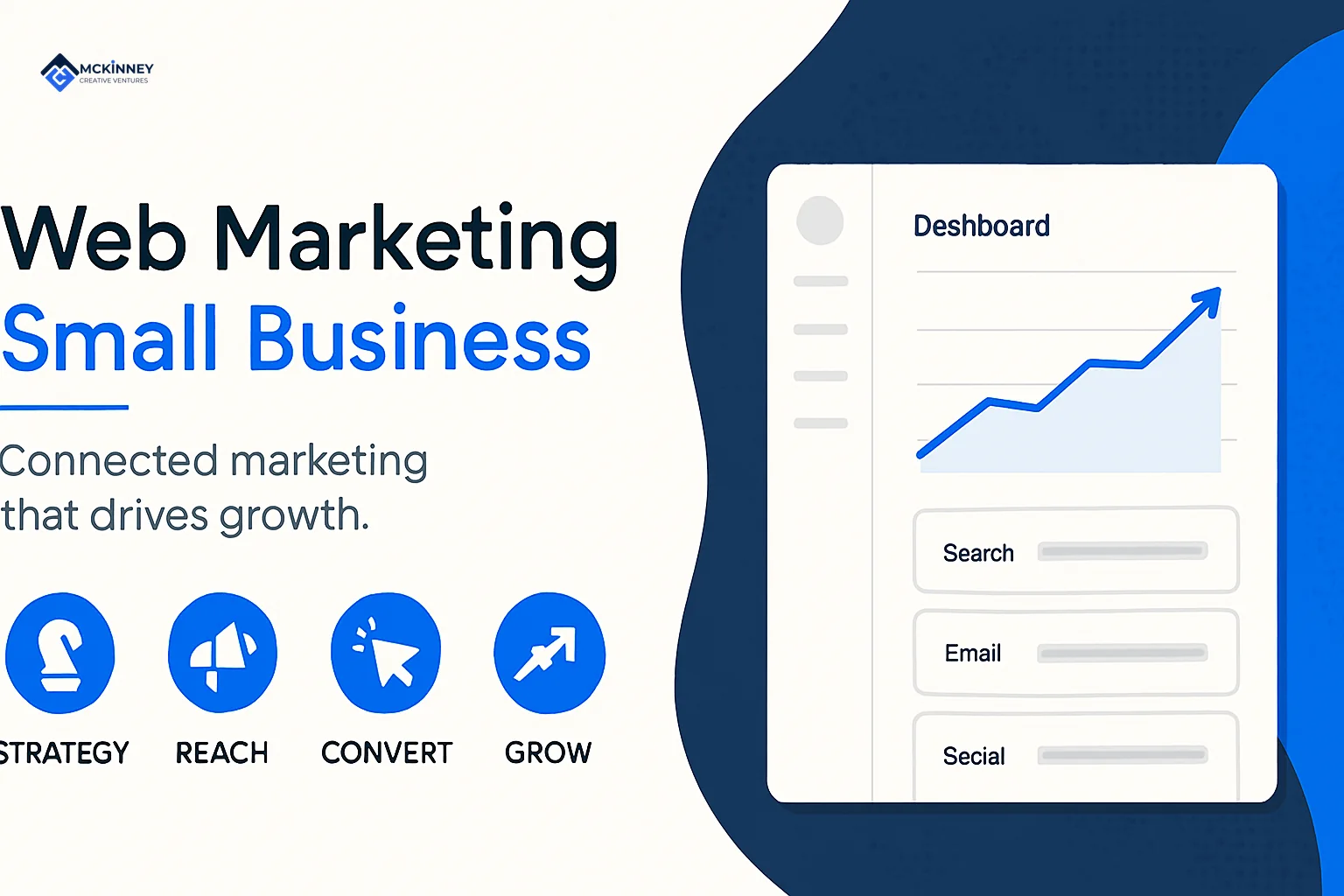
The five stages of a small business web marketing journey: Strategy (defining goals and audience), Channels (SEO, social, email), Investment (time and budget allocation), Measurement (tracking KPIs and ROI), and Growth (scaling what works).
First, a Plan: Building Your Digital Marketing Strategy
Before we dive into tactics, we always start with strategy. Think of it like building a house: you wouldn't just start nailing boards together. You need blueprints. For your web marketing small business efforts, those blueprints are your clear, realistic goals and a deep understanding of your audience. We use SMART goals (Specific, Measurable, Achievable, Relevant, Time-bound) to guide our efforts, ensuring every step we take is purposeful. Identifying your target audience and building buyer personas based on real customer needs helps us tailor our messages effectively. Content marketing then becomes the foundation, allowing us to answer customer questions and build trust, laying the groundwork for sustainable growth.
Building a strong foundation for your marketing takes commitment, but it’s the only way to ensure your efforts lead to real results. We know this from working with countless service-based businesses in the East Metro Twin Cities, MN, and St. Croix Valley, Wisconsin. Our goal is always to help you get found, get chosen, and build a business that lasts. For more on strategic growth, you can explore various business growth strategies.
Defining Your "Why" and "Who"
At its heart, digital marketing for small business growth is about connecting with the right people at the right time. For us, this means helping you reach a wider audience with limited resources, allowing you to compete effectively with larger companies. Our experience shows that most businesses see a direct impact on revenue from their digital marketing efforts.
But who exactly are you trying to reach? This is where buyer personas come in. These aren't just vague ideas; they're semi-fictional representations of your ideal customers, built on data and educated guesses. We consider their age, gender, interests, profession, daily routines, and most importantly, their pain points and motivations. For example, if you're a local HVAC professional in Woodbury, MN, your persona might be a busy homeowner in their 40s who values reliability and quick service because they can't afford a broken furnace in the Minnesota winter. Understanding these details allows us to craft marketing messages that truly resonate.
The Role of Content in Your Web Marketing Small Business
Content is how we share your expertise, build authority, and foster trust with your potential customers. It’s not just about selling; it’s about providing value. When we help service-based businesses in areas like Stillwater, MN, create content, we're aiming to answer the questions their customers are already asking.
Practical content ideas include blog posts that address common problems, short videos demonstrating your services, or how-to guides that showcase your knowledge. For instance, a local plumber in Cottage Grove, MN, could create a blog post on "5 Signs You Need a Water Heater Replacement" or a video demonstrating "How to Fix a Leaky Faucet." The beauty of content is that it can be repurposed: a blog post can become a social media series, which can then inform an email newsletter. We often help our clients create a simple content calendar to ensure consistency and keep their online presence fresh and engaging. This steady stream of valuable information positions you as the go-to expert in your field.
The Engine Room: Your Core Web Marketing Small Business Channels
Once we have a solid strategy and compelling content, we need to get it in front of your audience. This is where your core web marketing small business channels come into play. We see these channels (SEO, social media, and email marketing) as interconnected parts of an engine, each playing a crucial role in driving your business forward. The key is to make these channels work together seamlessly, maintaining a consistent brand voice and message across all platforms. This integrated approach ensures that your customers recognize and trust your brand, no matter where they encounter it online.
Search Engine Optimization (SEO): Getting Found on Google
SEO is the process of optimizing your website to attract organic, unpaid traffic through search engines. In simple terms, it's how we help your service-based business in Maplewood, MN, show up higher in Google search results when potential customers are looking for what you offer. We know that 75% of customers don’t bother clicking past Google’s first page of results, so getting there is vital.
Our SEO efforts focus on several key areas:
- On-page SEO basics: This involves optimizing your website's content, meta descriptions, and headers with relevant keywords that your customers are likely to use.
- Local SEO for service businesses: For our clients in the East Metro Twin Cities and St. Croix Valley, local SEO is paramount. We ensure your business appears in local search results for queries like "plumber near me" or "HVAC repair Hudson, WI."
- Google Business Profile optimization: We help you claim and fully optimize your Google Business Profile with accurate information, operating hours, and high-quality photos. This is often the first thing local customers see.
- Keyword research: We carefully research the terms your ideal customers would type into a search engine to find your products or services.
- Mobile-friendliness: With more than half of website traffic coming from mobile phones, we make sure your website is responsive and easy to use on any device.
By focusing on these elements, we help our clients improve their online visibility and attract more qualified leads. You can gain more insights into optimizing your presence with an SEO Checklist.
Social Media Marketing: Building Your Community
Social media is more than just posting pictures; it's about building genuine connections and fostering a community around your brand. For small businesses in areas like Oakdale, MN, choosing the right platforms is crucial. We help you focus on where your customers spend their time, whether that's Facebook for broad community engagement, LinkedIn for B2B services, or Instagram for visually-driven businesses. For example, a professional service provider in Lake Elmo, MN, would likely benefit more from a strong LinkedIn page than a TikTok account.
Our best practices for small business social media include:
- Consistency over frequency: It’s better to consistently post two to three times a week than to start strong and then disappear.
- Authentic engagement: Respond to comments, answer questions, and participate in conversations.
- Value-driven content: Share helpful tips, behind-the-scenes glimpses, and customer success stories.
- Humanize your brand: Show the faces behind your business. People connect with people.
We often discuss the differences between organic and paid social media strategies with our clients:
| Feature | Organic Social Media Strategies | Paid Social Media Strategies |
|---|---|---|
| Goal | Build community, foster relationships, establish brand presence, drive long-term engagement. | Reach specific audiences, drive immediate traffic, generate leads/sales, promote specific offers. |
| Cost | Free (requires time and effort). | Requires a budget for ad spend. |
| Reach | Limited to existing followers and their immediate networks; can be unpredictable due to algorithms. | Can reach a much wider, targeted audience beyond your current followers. |
| Targeting | Primarily relies on content quality and hashtag use to attract relevant followers. | Highly specific targeting options based on demographics, interests, behaviors, location (geofencing). |
| Speed of Results | Slower, long-term growth and relationship building. | Faster, more immediate results and traffic generation. |
| Content Type | Posts, stories, live videos, discussions, user-generated content. | Ads, promoted posts, sponsored content. |
| Measurement | Engagement rates, follower growth, shares, comments, website clicks from posts. | Clicks, impressions, conversions, Cost Per Click (CPC), Return on Ad Spend (ROAS). |
| Best For | Brand building, customer loyalty, thought leadership, community interaction. | Product launches, lead generation, sales campaigns, increasing website traffic quickly. |
Email Marketing: Nurturing Relationships Directly
Email marketing might seem old-fashioned to some, but we've found it to be one of the most powerful and cost-effective tools for small businesses, especially for nurturing customer relationships. Email marketing returns between $36 and $40 for every $1 spent, making it an absolute no-brainer for nearly every small business.
The key is building and maintaining a healthy email list and segmenting your audience. We encourage our clients in River Falls, WI, and New Richmond, WI, to collect email addresses through their website, in-store sign-ups, or events. Once you have a list, segmenting it allows you to send more relevant messages. For example, you wouldn't send a special offer for a new customer to a loyal, long-time client.
Email marketing is excellent for nurturing leads and driving sales because it's a direct line to your audience. We've seen great success with various email campaign types:
- Newsletters: Regular updates, industry insights, and valuable content.
- Promotional Emails: Special offers, discounts, and sales announcements.
- Welcome Emails: A warm greeting and introduction for new subscribers.
- Surveys: Gathering feedback to improve services.
- Announcements: New product/service launches, business updates.
- Re-engagement Campaigns: Reaching out to inactive subscribers.
- Seasonal Campaigns: Holiday greetings, seasonal offers.
- Event Invitations: Promoting workshops, webinars, or local events.
By consistently delivering value and relevant offers, email marketing helps your web marketing small business stay top of mind and converts leads into loyal customers.
Fueling Growth: Paid Advertising and Online Reputation
While organic strategies like SEO and social media build long-term presence, sometimes you need a boost. That's where paid advertising comes in. Think of it as a way to fuel immediate growth and get your message in front of the right people right now. Alongside paid ads, your online reputation acts as a powerful endorsement. Building social proof through positive reviews and proactively managing your reputation are crucial for long-term trust and continued growth for any web marketing small business.
Pay-Per-Click (PPC) Advertising Explained
Pay-Per-Click (PPC) advertising is a model where advertisers pay a fee each time one of their ads is clicked. Essentially, you're buying visits to your site, rather than attempting to "earn" those visits organically. For small businesses, PPC can be a fantastic way to drive immediate, targeted traffic, especially for time-sensitive promotions or when you need to quickly boost visibility for a new service in areas like Grant, MN, or Pine Springs, MN.
Here are the basic steps we follow to create a successful PPC campaign:
- Keyword Research: This is foundational. We identify keywords that your potential customers are likely to use when searching for products or services like yours. For a local auto repair shop, this might include "oil change St. Paul, MN" or "brake repair Minneapolis, MN."
- Compelling Ad Copy: We craft engaging ad copy that highlights your unique selling proposition and includes a clear call to action.
- Landing Page Optimization: The page your ad links to must be relevant, user-friendly, and designed to convert visitors into leads or customers.
- Budget Management: We set daily or monthly budgets and monitor spending closely to ensure we're getting the best return on investment.
- Tracking and Analysis: We continuously track performance metrics like clicks, impressions, and conversions to optimize campaigns for better results.
PPC can be a powerful accelerator for your web marketing small business efforts. To dig deeper into creating effective paid campaigns, you might find this guide on PPC campaign creation helpful.
Online Reviews and Reputation Management
Online reviews are your new word-of-mouth. For service-based businesses in the East Metro Twin Cities and St. Croix Valley, the impact of reviews on local businesses cannot be overstated. Up to 76% of local customers may look up a business and its reviews in advance to assess its reputation. Strong ratings boost click-through rates, ad quality, and conversions after the click.
We help our clients build trust through customer feedback by:
- Asking for reviews naturally: We guide you on how to politely and effectively ask satisfied customers for reviews, often right after a positive service experience.
- Responding to all feedback: Whether it's a glowing five-star review or constructive criticism, responding thoughtfully shows you value customer input.
- Using reviews in your marketing: We integrate positive testimonials into your website, social media, and other marketing materials to build social proof.
- Claiming and updating online business profiles: We ensure your profiles on platforms like Google Business Profile and Yelp are accurate and up-to-date, making it easy for customers to find and review you.
Proactive reputation management is an ongoing process, but it's essential for building and maintaining a stellar online presence.
The Dashboard: Measuring, Equipping, and Future-Proofing
Running a successful web marketing small business isn't just about launching campaigns; it's about understanding what's working, what's not, and continuously adapting. This is your marketing dashboard, where we identify the right Key Performance Indicators (KPIs), use analytics tools to track progress, ensure you have essential marketing software, and stay current with digital marketing trends. Without this feedback loop, you're driving blind.
Measuring What Matters: Analytics for Small Business
For us, measuring what matters means focusing on the KPIs that directly impact your business goals. This includes:
- Website Traffic: How many people are visiting your site, and where are they coming from?
- Conversion Rates: What percentage of visitors are taking a desired action, like filling out a contact form or making a purchase?
- Social Media Engagement: Are people interacting with your posts through likes, comments, and shares?
- Email Open Rates: Are your email campaigns reaching and resonating with your audience?
We rely heavily on tools like Google Analytics to provide comprehensive insights into website traffic, user behavior, and conversions. It helps us understand traffic sources, user demographics, and conversion rates for our clients in areas like Roseville, MN, and Shoreview, MN. By regularly reviewing this data, we can make informed decisions, adjust our strategies, and ensure your marketing budget is invested wisely, doing more of what generates leads and sales.
Essential Tools and a Reliable Connection
Just as a skilled tradesperson needs the right tools, a successful web marketing small business needs an effective tech stack. We help our clients choose tools that integrate and report in one place, reducing complexity.
Here are some essential tool categories we often recommend:
- CRM Systems: Customer Relationship Management systems help manage customer interactions and data, nurturing leads and improving customer service. Tools like HubSpot CRM or Zoho CRM are great starting points.
- Social Media Schedulers: Platforms like Hootsuite or Buffer allow you to plan and schedule posts across multiple social media channels, ensuring consistency.
- Email Marketing Platforms: Tools like Mailchimp or Brevo help you build lists, design campaigns, and automate emails.
- Content Creation & Design: Canva for graphic design and Grammarly for writing assistance can be invaluable.
- Analytics & Reporting: Beyond Google Analytics, tools like Hotjar can provide insights into user behavior on your website.
- SEO & Keyword Research: Google Keyword Planner, Ubersuggest, or Ahrefs help identify what your customers are searching for.
Equally important is a reliable business internet connection. For our service-based clients in the East Metro Twin Cities and St. Croix Valley, a fast and stable internet connection is the backbone of all digital marketing efforts. Whether it's Fiber Optics for high-speed data transfer, Wireless for flexibility, or Fixed Broadband for a reliable, cost-effective solution, choosing the right type of connection and provider is crucial to ensure your online operations run smoothly.
Staying Current and Compliant
The digital marketing landscape is constantly evolving, with new technologies, platforms, and consumer behaviors emerging all the time. For your web marketing small business to thrive, staying current is non-negotiable. We constantly monitor industry blogs, listen to podcasts, attend webinars, and engage in online communities to keep our strategies sharp.
We also stay updated on platform changes from major players like Google and social media networks. These changes can significantly impact visibility and performance. Furthermore, understanding and following regulations like the General Data Protection Regulation (GDPR) and the California Consumer Privacy Act (CCPA) is crucial. While these are often associated with larger businesses, understanding data privacy is important for any business handling customer information, helping you avoid potential legal issues and build customer trust. Continuous learning isn't just a suggestion; it's a requirement for sustained success.
Extended Recap & Conclusion
The journey from being unknown to becoming a trusted local brand through web marketing small business strategies is an achievable one, but it requires dedication, strategy, and consistent effort. We believe in building systems that lead to sustainable growth, not just quick fixes. By understanding your audience, crafting valuable content, leveraging the right digital channels, and continuously measuring your impact, your small business can thrive in today's competitive landscape.
At McKinney Creative Ventures, we are proud to be a fractional marketing team for service-based businesses in the East Metro Twin Cities, MN, and St. Croix Valley, Wisconsin. We provide flexible, outsourced marketing services like SEO, web management, and content creation, offering affordable, consistent support without the need for internal staff. We help businesses like yours navigate this journey with confidence, ensuring your marketing efforts are strategic, effective, and built for the long haul.
Let's build a marketing plan that lasts.
If you want a connected marketing system that brings this together for your business, we can help. Book a free strategy call and we will map out a plan built around your goals. No pitch, just a clear next step.
Frequently Asked Questions
How do I start digital marketing with a small budget?
Starting web marketing small business efforts with a limited budget is entirely possible. We always recommend focusing on the essentials first. Optimize your website for speed and mobile-friendliness, and ensure your Google Business Profile is fully completed and verified. Start posting consistently on just one or two social media platforms where your target audience is most active, rather than trying to be everywhere at once. Implement email capture on your website and begin building an email list. Prioritize organic efforts, like creating valuable content, before investing heavily in paid ads. Track your results weekly, and only scale the channels that are proving to be effective in generating leads or sales.
Which digital channels work best for local businesses?
For local businesses like those we work with in Cottage Grove, MN, and Stillwater, MN, local SEO is absolutely key. An optimized Google Business Profile is your digital storefront; it drives visibility in Google Search and Maps. We also emphasize geo-targeted social media posts and ads to reach customers within your service area. Email marketing to your local customer list allows for direct, personalized communication, and engaging with your community on local Facebook groups or online forums can build strong relationships and word-of-mouth referrals.
What are common digital marketing mistakes to avoid?
We've seen many small businesses make common mistakes that can hinder their growth. One of the biggest is not measuring results; if you don't know what's working, you can't improve. Another is lacking a clear strategy, leading to disconnected and ineffective campaigns. Inconsistent branding across different platforms can confuse customers. Sending traffic to a slow or poorly designed website will quickly drive potential customers away. Ignoring online reviews means missing out on valuable social proof and customer feedback. Finally, trying to be everywhere at once with limited resources often leads to burnout and diluted efforts. We always advocate for starting focused, tracking rigorously, and building systems that reinforce your web marketing small business goals.
Written by
Sam McKinney
Founder & Lead Strategist, McKinney Creative Ventures
Sam McKinney helps local service businesses across the Twin Cities East Metro and St. Croix Valley grow through connected marketing systems. Websites, SEO, CRM, and AI automation built to work together instead of in isolation.
More about MCVRelated Articles
Med Spa Marketing in the Twin Cities: Keeping the Calendar Booked
Aesthetics practices lose money in the gaps between local search, reviews, and follow up. Here is the full med spa marketing system for the East Metro and St. Croix Valley, plus the federal rules that now govern it.

Hudson, WI Service Businesses: Marketing Across the Border
A Hudson service business that works both sides of the St. Croix is running one brand across two states, two licensing regimes, and two separate local search markets. Here is how to set that up so neither side gets treated as an afterthought.
Ready to Grow Your Business?
Book a strategy call to discuss how we can implement these systems and strategies to help your business scale.
Book a Strategy Call