
Landscaping Marketing in Minnesota: Win the Short Season
Sam McKinney
Founder & Lead Strategist • September 22, 2026
Overview
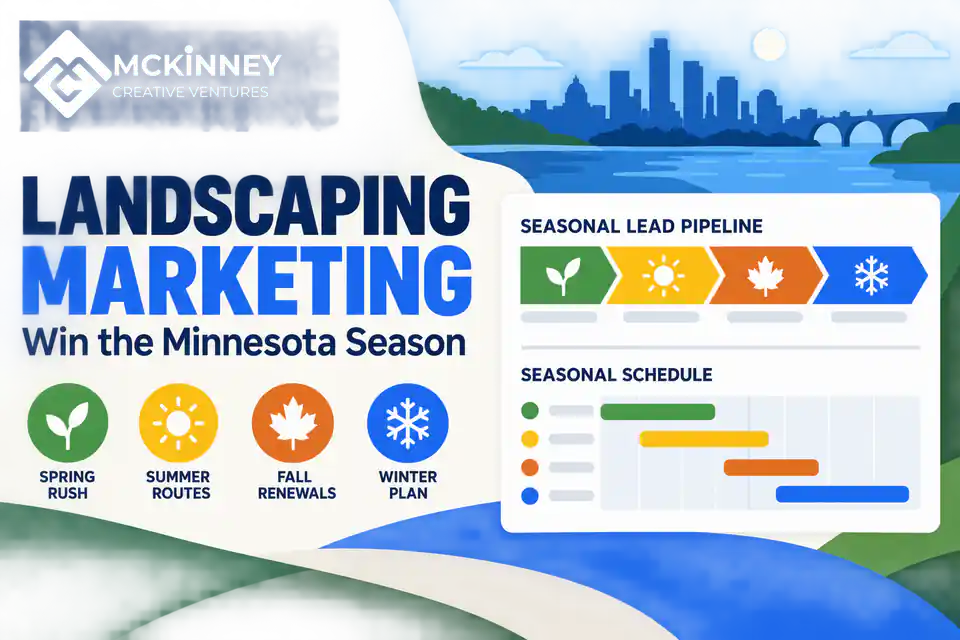
Landscaping marketing works best when spring demand, summer routes, fall renewals, and winter planning operate as one system. Build a Minnesota strategy that keeps crews productive without chasing every lead.
Landscaping marketing in Minnesota works when the campaign calendar follows the operating calendar. The goal is not to create the most leads during the spring rush. It is to fill the right routes, sell the right mix of recurring and project work, and keep future demand moving before the weather changes.
A practical system starts before the first warm week. Reactivate past customers, make local search coverage accurate, publish clear service and timing information, and route every inquiry into a follow-up process tied to capacity. Then use summer and fall work to build renewals, reviews, and next season's pipeline.
Landscaping marketing must follow the Minnesota service season
Minnesota demand is seasonal, but the work is not governed by one fixed date. Soil conditions, turf growth, rainfall, temperature, and the service itself determine when a crew should act. Marketing needs the same flexibility. Use calendar windows to prepare demand, then let field conditions determine the actual promise.
The University of Minnesota Extension lawn care calendar says cool-season turf grows rapidly in spring and fall and slows during summer heat and drought. Its current guidance places mowing from the last week of April into early November, with preferred windows for seeding, fertilizing, aerating, and weed control that vary across the season. That is not a sales script. It is evidence that one generic lawn campaign cannot stay equally relevant all year.
| Planning window | Customer need | Marketing job | Operational check |
|---|---|---|---|
| Winter planning | Compare providers, reserve recurring service, scope larger projects | Renew past accounts, publish service details, build spring waitlists | Confirm pricing, route limits, crew capacity, and response ownership |
| Spring rush | Cleanup, mowing, bed work, turf recovery, project estimates | Capture high-intent search and answer quickly | Sell only work the schedule can absorb |
| Summer routes | Recurring maintenance, irrigation, enhancements, problem solving | Improve route density, cross-sell current customers, collect proof | Track weather changes, cancellations, and crew utilization |
| Fall renewals | Cleanup, seeding, aeration, winter preparation, next-year planning | Secure renewals and prebook appropriate spring work | Separate confirmed work from tentative interest |
Build campaigns around these operating questions, not just the month on the calendar. A late thaw should change the message and schedule. It should not force the business to honor a date that no longer makes sense.
Own spring demand before the first rush
The least expensive spring opportunity is often already in the database. Past mowing customers, completed landscape projects, dormant estimate requests, and property managers with prior work all provide a reason to start a useful conversation before broad advertising peaks.
Segment by the work already completed and the next logical need. A mowing customer might need renewal and optional spring cleanup. A patio customer may need maintenance guidance or a new phase of work. An unclosed estimate may need a direct question about whether the project is still planned. Do not send the same offer to everyone.
Build a pre-season reactivation sequence
- Confirm the service fit. Remove contacts outside the current territory or service mix.
- Use the customer history. Reference the category of prior work without pretending to remember details the record does not contain.
- Offer one clear next step. Renewal, estimate review, property walk, or scheduling request is enough.
- Stop when the answer is clear. Respect opt-outs and do not keep pushing a customer who declined.
A connected CRM and automation system should record the service, property, last outcome, consent status, and next action. Automation can make the timing consistent. It should not manufacture a relationship that the business does not have.
Win local search with accurate territory and useful pages
Landscapers usually serve customers at the customer's property, which makes service-area accuracy central to local visibility and lead quality. Google's current Business Profile service-area guidance allows up to 20 areas entered as cities, postal codes, or similar places. It also says the overall area generally should not extend more than about two hours of driving time from the business base.
The maximum is not a target. A tight territory can produce better routes and more honest location pages than an inflated map of every city within driving distance. Choose areas the business regularly serves, then support them with accurate profile details and website pages that answer real local questions.
Our SEO, GEO, and AEO work treats the Business Profile, service pages, location pages, and structured data as one system. For a landscape company, that means separating recurring lawn care from design and installation, drainage, hardscaping, irrigation, or snow work when those services have different buyers and sales processes.
Show evidence that reduces uncertainty
- Real project photos: Name the service and general area only when that information is verified and approved.
- Clear process: Explain what happens after the request, who visits the property, and what the estimate includes.
- Service boundaries: State minimums, property types, and territory when they materially affect fit.
- Current availability: Use honest response and scheduling expectations. Do not advertise immediate service when the schedule is weeks out.
Use paid demand to fill capacity, not overwhelm it
Paid search can capture people looking for a landscaper now, but more leads are not automatically better during a compressed season. Campaigns should be divided by service line, geography, and economic value so the business can reduce low-priority demand without disappearing from the market entirely.
Match each ad group to a focused landing page and a real conversion action. A call click is an intent signal. A qualified estimate request is a stronger lead. A signed maintenance agreement or accepted project is the business outcome. Keep those stages separate so the cheapest form fills do not become the definition of success.
Review budgets and lead quality against the schedule at least weekly during demand swings. If one route is full, narrow that geography or service. If a crew has a gap, promote work that fits the gap. Our digital advertising management connects campaign decisions to qualified demand and operating capacity rather than optimizing for clicks alone.
Turn licensing and expertise into useful trust signals
Trust copy should be specific. The Minnesota Department of Agriculture states that a commercial pesticide applicator license is required for anyone applying a pesticide for hire, and fertilizer applications require a separate fertilizer license. Its licensing guidance identifies Turf and Ornamentals as the category covering lawns, parks, nurseries, and similar non-agricultural sites.
If those licenses apply to the services offered, publish the verified credential and keep it current. If they do not apply, do not borrow the language. The same rule holds for insurance, certifications, associations, warranties, and product claims. Precise proof builds confidence. A wall of vague badges does not.
Educational content can demonstrate expertise without giving a homeowner a recipe for work that should be assessed on site. Explain timing, tradeoffs, and warning signs. Make clear when conditions require inspection. This gives searchers a useful answer while reinforcing why professional judgment matters.
Use every completed job to build the next season
The end of a job is a marketing handoff. Record what was completed, invite feedback, request a review through a consistent process, and schedule the next appropriate reminder. The goal is not to push another service immediately. It is to preserve the context that makes future communication relevant.
Recurring customers should have a documented renewal path. Project customers should have maintenance guidance and a future follow-up date when another phase is plausible. Property managers may need budget timing, documentation, and multi-site planning. Each relationship should have an explicit next state instead of disappearing into a general contact list.
Measure the system by service line
- Qualified leads and estimates requested
- Estimate response time and appointments completed
- Accepted work, average job value, and gross margin when available
- Route density and recurring renewal rate
- Lead source, loss reason, and work declined because capacity was full
That last category matters. A full schedule can hide weak planning if valuable inquiries are repeatedly turned away. Record the service, location, and timing of declined demand so next winter's capacity and campaign decisions have evidence behind them.
Extended Recap & Conclusion
Effective landscaping marketing is a seasonal operating system. Prepare demand in winter, capture the spring rush with accurate availability, use summer to improve routes and collect proof, and turn fall work into renewals and next-year planning. Local search, advertising, CRM follow-up, and field capacity must share the same priorities.
The strongest plan does not promise endless leads. It makes the right work easier to find, responds while the opportunity is current, and preserves customer history so the company starts each season with more than an empty calendar.
Frequently Asked Questions
When should a Minnesota landscaping company start spring marketing?
Start renewal and planning outreach during winter, before field work begins. Increase high-intent promotion as conditions and crew capacity become clearer. Avoid promising a fixed start date when thaw, soil, and weather conditions still control the schedule.
What marketing channel works best for a landscaping business?
No single channel covers the whole customer journey. Local search captures active demand, reviews and project proof build trust, paid search can fill selected gaps, and CRM follow-up turns prior customers and estimates into future work. The best mix depends on service line and capacity.
Should lawn care and landscape projects use the same campaign?
Usually not. Recurring maintenance, seasonal treatments, and larger design or installation projects have different search terms, sales cycles, values, and qualification questions. Separate campaigns and landing pages make lead quality easier to manage.
How can a landscaper get more Google reviews?
Ask eligible customers through the same post-job process, make the request easy, and never screen customers based on the rating you expect. Connect the request to a completed-work stage so it happens consistently without pressuring the customer.
What should a landscaping company track from marketing?
Track source, service requested, location, qualification, estimate outcome, accepted value, and loss reason. Add response time, route density, renewal status, and work declined because of capacity. Those fields connect marketing activity to operational value.
If your spring campaigns, routes, and follow-up live in separate systems, book a free strategy call. We will map the handoffs and identify the first marketing fix worth making before the next rush.
Written by
Sam McKinney
Founder & Lead Strategist, McKinney Creative Ventures
Sam McKinney helps local service businesses across the Twin Cities East Metro and St. Croix Valley grow through connected marketing systems. Websites, SEO, CRM, and AI automation built to work together instead of in isolation.
More about MCVRelated Articles
Cottage Grove MN Marketing: How Local Service Businesses Get Found
Cottage Grove is growing, but growth does not automatically send the right customers to your door. Build a local marketing system that connects search visibility, useful city content, reviews, and fast follow-up.
Marketing for Electricians: How to Win More Panel, EV, and Service Work
Electricians lose money averaging emergency calls and panel upgrades into one marketing plan. Here is how to route each kind of demand to the channel that actually wins it.
Ready to Grow Your Business?
Book a strategy call to discuss how we can implement these systems and strategies to help your business scale.
Book a Strategy Call