
Missed-Call Text-Back: The Easiest Lead You Are Not Capturing
Sam McKinney
Founder & Lead Strategist • August 18, 2026
Overview
When a service business misses a call, the caller usually dials the next name on the list. Missed-call text-back closes that gap automatically. Here is how it works, the math of recovered jobs, and the 2026 rules that keep your texts landing.
Missed-call text-back is a simple automation that sends an instant text message to any caller you do not answer, so a missed call turns into a live conversation instead of a lost job. For a local service business, it is the highest-return automation you can turn on, because the lead already raised their hand by calling you. The only question is whether anyone gets back to them before your competitor does.
Most owners already know they miss calls. What they underestimate is what happens next. A homeowner with a leaking water heater or a dead furnace is not leaving a voicemail and waiting. They are working down a list of names, and the first business to respond usually books the job. A missed call is not a message to return later. It is a lead that is actively shopping your competitors in real time.
This post breaks down how missed-call text-back works, the honest math of what it recovers, how to set it up so the texts actually get delivered, and the compliance rules that changed in 2025 and 2026. No invented statistics, just the mechanics and the current rules.
What missed-call text-back actually does
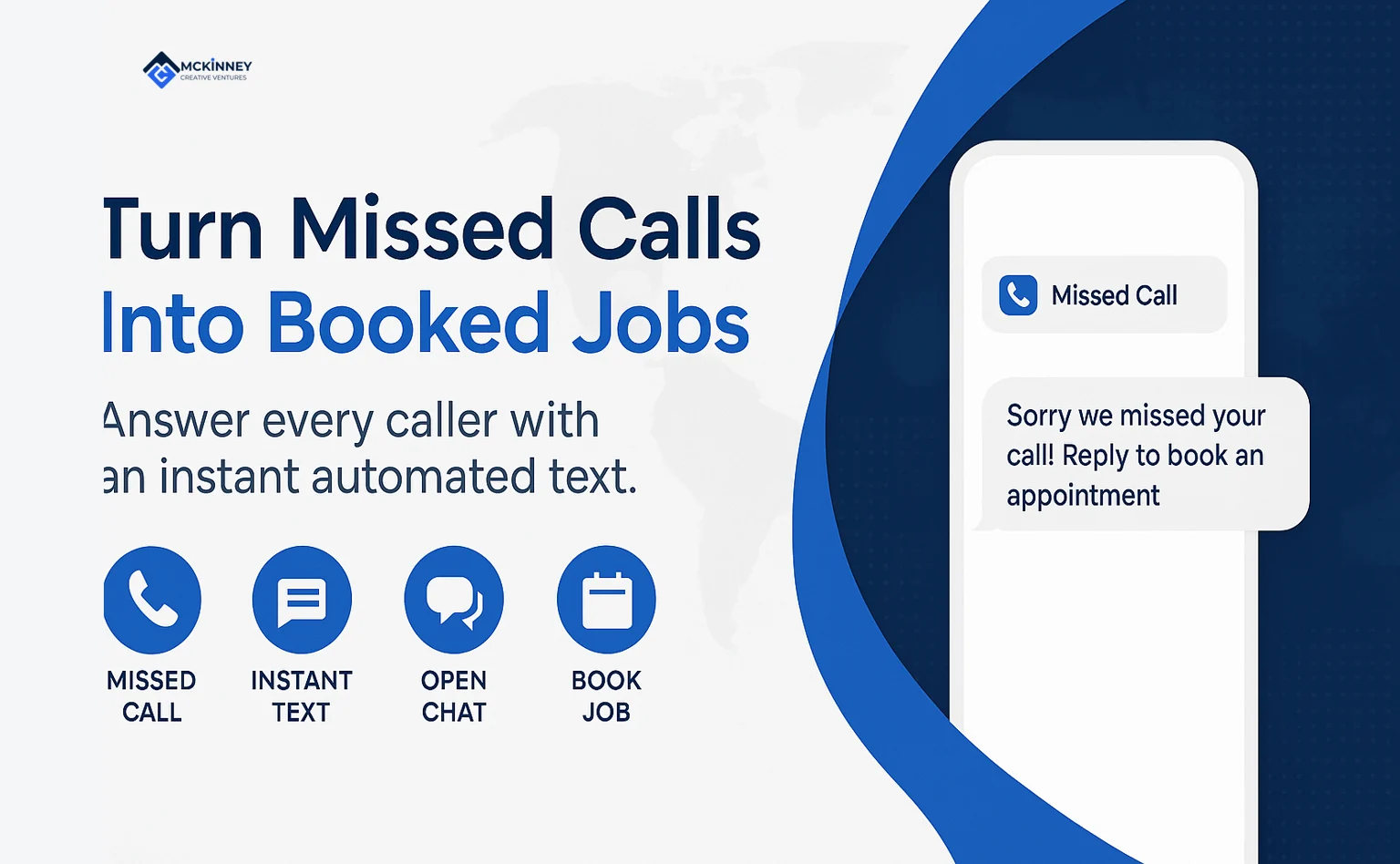
The workflow is short. A call comes in. You do not answer it, whether you are on a ladder, under a sink, driving, or it is 9 PM. Your phone system detects the missed call and, within seconds, fires an automated text back to that number. The message acknowledges the call and opens a conversation the caller can reply to right from their phone.
A good message does three things: it confirms you saw the call, it sets a clear expectation, and it asks one question that keeps the thread moving. Something like: "Hi, this is AJ at Northline Plumbing. Sorry we missed your call, we are with a customer. What can we help you with? We will get right back to you." That is it. The caller now has a thread open with you, and most people will answer a text far faster than they will sit on hold or leave a voicemail.
The reason this works is behavioral, not technical. Texts get read. A person who just called you is at peak intent, phone already in hand. Replying by text costs them almost nothing, and it keeps them from dialing the next company while they wait. You have converted a dead-end missed call into an open channel, and you did it without hiring an after-hours receptionist.
Where the missed calls are coming from
Before you automate the recovery, it helps to know why the calls go unanswered in the first place. For most service businesses it is some mix of these:
- You are on the job. The whole reason people call a plumber, electrician, or HVAC tech is that those people are working with their hands and cannot pick up.
- After hours. Emergencies do not respect business hours, and the caller with a flooded basement at 10 PM is the most motivated buyer you will get all week.
- Call overflow. Two calls come in at once, and the second one rings out.
- Paid clicks that ring out. If you run Google or Local Services Ads, every unanswered call is money you already spent on the click, wasted at the finish line. That is the most expensive kind of missed call, and it is why call handling and paid advertising have to be managed as one system, not two.
The math of a recovered job
You do not need a fabricated industry percentage to see the value. Run your own numbers. Take your average job value, whatever a typical service call or install is worth to you. Now estimate how many calls you miss in a week. Even a conservative guess, a handful of missed calls, adds up fast when a single recovered job can be worth hundreds or thousands of dollars.
The point is the asymmetry. Missed-call text-back is a low, flat monthly cost regardless of how many calls it recovers. One saved job in a month usually pays for the automation many times over, and after that every recovered lead is close to pure margin. Compare the two ways of handling a missed call:
| Factor | Manual callback (when you remember) | Automated missed-call text-back |
|---|---|---|
| Response time | Minutes to hours, if it happens at all | Seconds, every time |
| After-hours coverage | None until you are back at your phone | 24 hours a day, including weekends |
| Consistency | Depends on how busy the day was | Identical for every caller |
| Caller experience | Silence, so they call the next company | Immediate acknowledgment and an open thread |
| Record of contact | Easy to lose track of | Logged in your CRM automatically |
This is also why call channels matter more than they used to. Google retired the chat feature inside Google Business Profile on July 31, 2024, along with call history, and now points customers to text or phone instead, per Google Business Profile Help. One convenient inbound channel closed. The phone call, and how fast you answer it, carries even more of the load.
Setting up missed-call text-back so it works in 2026
Turning this on is easy. Turning it on so the texts actually reach people is where most DIY setups quietly fail. Two things changed that you have to get right, or your carefully written text never lands.
1. Register for A2P 10DLC, or your texts get blocked
Business text messages sent over a normal 10-digit phone number in the United States now run through a framework called A2P 10DLC (application-to-person, 10-digit long code). Since early 2025, the major carriers, AT&T, Verizon, and T-Mobile, block unregistered business texting traffic on these numbers outright, as documented in Twilio's A2P 10DLC compliance guide. Registration has two parts: a brand registration that identifies your business, usually requiring your EIN, and a campaign registration that describes the messages you send and how people opt in and opt out.
The practical takeaway: if you buy a texting tool, plug in your number, and start firing automated replies without completing registration, your messages get filtered or dropped and you never see the error. The caller just gets silence, which is the exact problem you were trying to solve. This is one of the main reasons it pays to run missed-call text-back inside a properly registered CRM and automation platform rather than a cobbled-together app.
2. Handle consent and opt-outs the way the rules require
A person calling your business is initiating contact, which is a strong basis for texting them back about the reason they called. Even so, the automated-messaging rules apply, and they tightened. The FCC's updated consent-revocation rules took effect on April 11, 2025. Under 47 CFR 64.1200, a customer can revoke consent to be texted using any reasonable method, and words like "stop," "quit," "end," "cancel," "revoke," "opt out," or "unsubscribe" count automatically. You must honor a revocation request within a reasonable time, not to exceed ten business days.
The same rule carves out a useful allowance: a single confirmation text that only acknowledges an opt-out request, with no marketing in it, is treated as within the customer's consent, and if you send it within five minutes it is presumed compliant. In plain terms, keep your automated replies focused on the reason they called, make opting out easy, and process a STOP immediately. A compliant setup does this for you and logs it. A sloppy one exposes you to statutory damages that run from 500 to 1,500 dollars per violation under the TCPA.
3. Route the reply to a real conversation
The text going out is only half the system. The reply coming back has to land somewhere a human sees it and can answer fast. If your missed-call text-back sends a friendly message and then nobody watches the inbox, you have automated the first response and abandoned the second. Replies should flow into a shared conversation view, ideally the same CRM that holds the customer record, so anyone on your team can pick up the thread and book the job. This is the difference between a gimmick and a system, and it is the same speed-to-lead discipline covered in our guide to why the first five minutes decide the job.
Common mistakes that kill the results
- Robotic or vague messages. "Your call is important to us" reads like a corporate autoresponder. Use your business name, a real person's name, and a plain question.
- No follow-up when the caller does not reply. Some people will not text back on the first message. One polite follow-up a bit later recovers a share of them. More than that starts to feel like nagging.
- Sending from an unregistered number. Covered above, and worth repeating because it is invisible when it fails.
- Treating it as set-and-forget. Read the actual conversations for the first few weeks. You will find wording that converts better and questions you should answer up front.
- Ignoring opt-outs. An unhonored STOP is both a bad customer experience and a compliance liability.
Extended Recap & Conclusion
Missed-call text-back is the easiest high-return automation a local service business can turn on, because it recovers leads who already called you at the exact moment they are shopping your competitors. The workflow is simple: a missed call triggers an instant, human-sounding text that opens a conversation, and that conversation flows into a CRM where someone can book the job. The math almost always works, because a single recovered job usually covers the cost of the automation for months.
The part that separates a working system from a broken one is delivery and compliance. In 2026 that means completing A2P 10DLC brand and campaign registration so carriers do not silently block your texts, honoring opt-outs the way the FCC rules that took effect in April 2025 require, and routing replies to a real inbox instead of a dead end. Get those right and you stop losing the leads you already paid to generate.
Frequently Asked Questions
What is missed-call text-back?
Missed-call text-back is an automation that sends an instant text message to anyone who calls your business when you do not answer. It acknowledges the missed call and opens a text conversation, so the caller replies to you instead of dialing the next company on their list.
Is missed-call text-back legal for business texting?
Texting back someone who just called you about the reason they called is on solid footing, because they initiated contact. You still have to follow the automated-messaging rules: register your number through A2P 10DLC, make opting out easy, and honor a STOP or similar request within a reasonable time, not to exceed ten business days, per 47 CFR 64.1200.
Why do my business texts sometimes not get delivered?
The most common reason in the United States is that the sending number is not registered for A2P 10DLC. Since early 2025 the major carriers block unregistered business texting traffic on 10-digit numbers, and the failure is usually silent. Completing brand and campaign registration fixes it.
How fast should the text go out after a missed call?
Within seconds. The entire advantage is speed. A caller who reaches out is at peak intent and will keep contacting other businesses until someone responds, so an instant acknowledgment is what keeps the lead from moving on.
What should the automated message say?
Keep it short and human. Name your business and a real person, apologize for missing the call, ask one clear question about what they need, and set an expectation that you will follow up. Avoid generic corporate phrasing, and include a simple way to opt out.
Does missed-call text-back replace answering the phone?
No. It is a safety net for the calls you cannot get to, not a substitute for picking up when you can. A live answer is still the strongest response. Missed-call text-back exists to catch the calls that would otherwise become lost jobs.
If you are a service business in the Twin Cities East Metro, St. Croix Valley, or western Wisconsin losing calls you never see, we can set up missed-call text-back inside a registered, compliant CRM that captures the lead and routes the reply to a real conversation. Book a free strategy call and we will map it to how your calls actually come in.
Written by
Sam McKinney
Founder & Lead Strategist, McKinney Creative Ventures
Sam McKinney helps local service businesses across the Twin Cities East Metro and St. Croix Valley grow through connected marketing systems. Websites, SEO, CRM, and AI automation built to work together instead of in isolation.
More about MCVRelated Articles
Speed to Lead: Why the First Five Minutes Decide the Job
The homeowner who contacts you is contacting your competitors too. Here is the research behind the five-minute rule, and the automation that lets a local service business answer first every time.
HVAC Marketing in Minnesota: How to Fill the Schedule Year-Round
HVAC demand in Minnesota swings hard with the seasons. This is the connected marketing system that captures the peaks, smooths the slow months, and keeps your calendar full all year.
Ready to Grow Your Business?
Book a strategy call to discuss how we can implement these systems and strategies to help your business scale.
Book a Strategy Call