
Speed to Lead: Why the First Five Minutes Decide the Job

Sam McKinney
Founder & Lead Strategist • July 21, 2026
Overview
The homeowner who contacts you is contacting your competitors too. Here is the research behind the five-minute rule, and the automation that lets a local service business answer first every time.
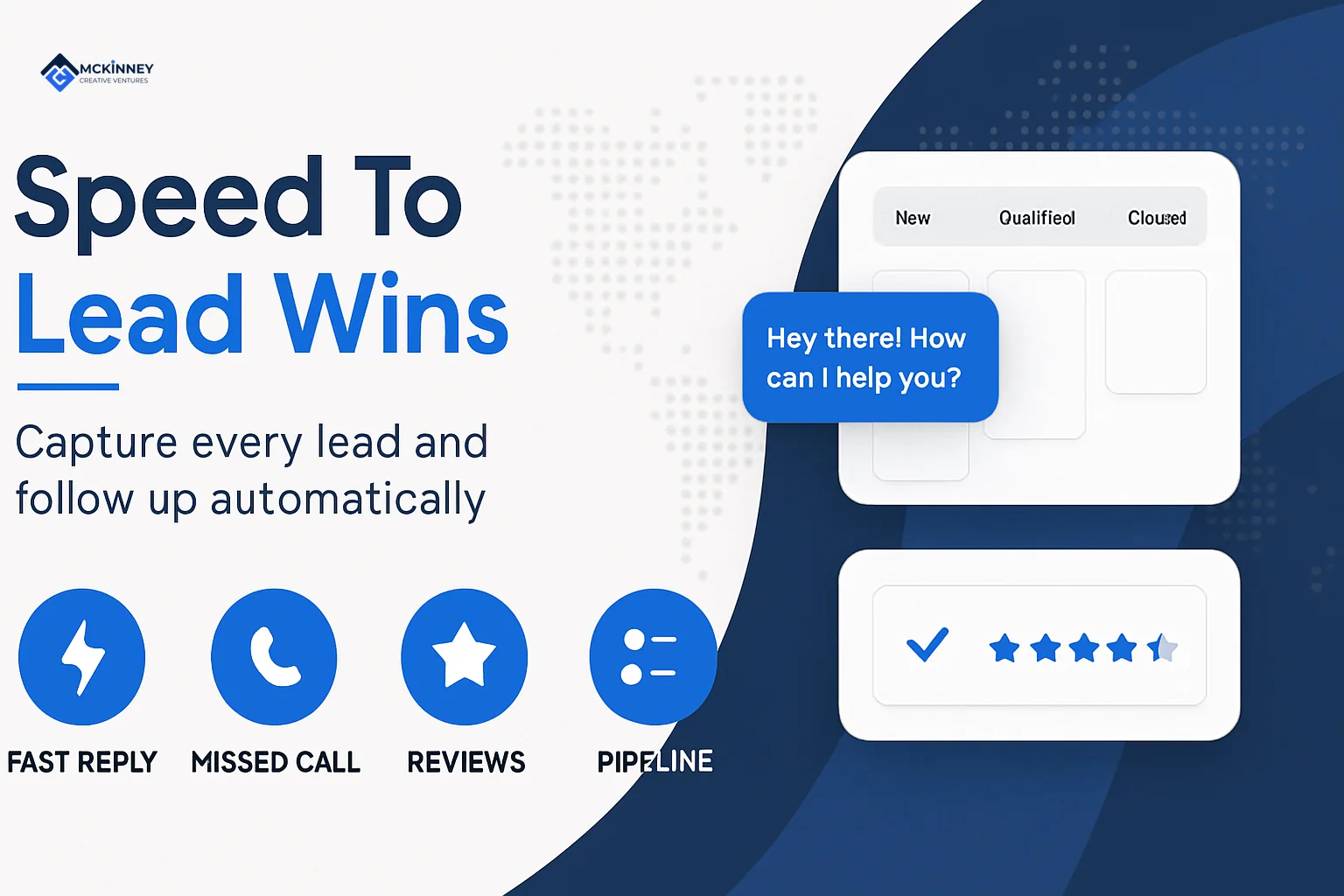
Speed to lead is the time between a customer reaching out and a real response reaching them back. For a local service business, it is the highest-leverage number in the entire sales process, because the homeowner filling out your form is almost never filling out only your form. Research on web-generated leads has found repeatedly that the odds of contacting and qualifying a lead collapse within the first half hour. The business that answers first usually books the job.
That is uncomfortable, because it means you can do everything else right and still lose. You can rank in the map pack, run clean Local Services Ads, and build a website that converts, and then hand the job to a competitor because your tech was under a sink and nobody called back until 4pm. Every dollar you spend on visibility is wasted at the exact moment a lead sits unanswered.
The good news is that response time is not a discipline problem or a hiring problem. It is a systems problem, and systems problems have fixes that hold up on the busiest day of your year. This is the case for treating speed to lead as an operating metric, and the specific automation that makes a five-minute standard realistic for a business with no dedicated office staff.
Speed to lead is the number that decides who gets the job
The foundational research here is the Lead Response Management study led by Dr. James Oldroyd, then at MIT's Sloan School of Management. The team analyzed three years of data from six companies that generate and respond to web leads, covering more than fifteen thousand leads and over a hundred thousand call attempts. Two findings stand out. The odds of contacting a lead drop by 100 times when the callback stretches from 5 minutes to 30 minutes, and the odds of qualifying that lead drop by 21 times over the same delay (Lead Response Management Study).
Read that again with a service business in mind. The difference between answering at 9:02 and answering at 9:30 is not a slightly worse outcome. It is a different business.
A separate Harvard Business Review audit measured how long 2,241 US companies took to respond to a web-generated test lead. Firms that made contact within an hour were roughly seven times more likely to qualify the lead than those that tried an hour later, and more than sixty times more likely than those that waited a full day. The uncomfortable part is what the audit found about actual behavior: among companies that responded at all within thirty days, the average first response took 42 hours, and 23 percent never responded (Harvard Business Review, "The Short Life of Online Sales Leads").
Both studies point the same direction, and the gap between what the research says and what most businesses actually do is the opportunity. In a market like the Twin Cities East Metro or the St. Croix Valley, where a homeowner with a leaking water heater will contact three or four companies in the same ten minutes, being the one that responds instantly is a durable competitive advantage that costs almost nothing to hold.
Why fast response is a systems problem, not a hustle problem
Every owner who hears this research responds the same way: we will just get better about calling people back. That never survives contact with a real week. The reason is structural. In a service business, the people best equipped to answer a lead are the people least available to answer it. Your technicians are in crawl spaces and attics. You are quoting a job or driving between calls. The lead arrives during the exact hours you are least able to look at your phone.
So the response cannot depend on a human being free. It has to be triggered by the event itself. That is the whole design principle: when a form is submitted, a call is missed, or a chat comes in, something acknowledges that customer within seconds without anyone deciding to act. The human follow-up still matters, and it still closes the job. But automation buys you the window in which that human follow-up is still worth making.
This is also why bolting a chatbot onto your website does not solve it. The problem is not the first message. The problem is the handoff, the routing, and the record of what happened. That is CRM work, which is why we treat this as part of CRM and automation rather than a website feature.
The four automations that make a five-minute standard realistic
You do not need a large stack to hold a fast response standard. You need four things wired to fire on their own.
1. Missed-call text back
When a call comes in and nobody picks up, an automatic text goes out within seconds: a short acknowledgment from your business name, naming the missed call and asking what they need. This is the single highest-return automation for a service business, because the phone is still where urgent local work starts. A missed call with no follow-up is a lead that goes to the next name in the search results. A missed call followed by a text in fifteen seconds is a conversation.
2. Instant form and chat acknowledgment
Any web form, chat widget, or Google Business Profile message triggers an immediate text and email confirming you received it and telling the customer exactly what happens next and when. Do not write it like a receipt. Write it like a person, and include a real question so the customer can reply and start a thread you can pick up.
3. Instant internal routing
The same trigger notifies whoever owns follow-up, by text and by app notification, with the customer's name, number, service need, and source. If nobody claims it inside a set window, it escalates. The point is to remove the step where a lead sits in an inbox somebody has not opened.
4. Self-service booking for after hours
A meaningful share of inquiries arrive when you are closed. Your automated response should carry a booking link so a customer who wants to solve their problem at 9pm can put themselves on your schedule instead of continuing to shop. This is the difference between capturing after-hours demand and merely logging it.
Layer those four together and the outcome is that every inbound lead gets a response measured in seconds, regardless of what your crew is doing. The deeper nurture sequence for people who are not ready yet is a separate build, covered in our post on lead follow-up automation.
Set a written response standard, by channel
What gets defined gets managed. Rather than a vague goal to respond fast, set an explicit target for each inbound channel and then build the automation that guarantees it. The table below is the standard we recommend for local service businesses, separating the automatic acknowledgment from the human follow-up that actually closes work.
| Inbound channel | Automatic first response | Human follow-up target | Automation that delivers it |
|---|---|---|---|
| Missed phone call | Under 30 seconds | Within 5 minutes | Missed-call text back plus instant staff alert |
| Website contact form | Under 1 minute | Within 5 minutes | Form trigger sends text and email, routes to owner |
| Google Business Profile message | Under 1 minute | Within 15 minutes | Message routed into the CRM inbox with auto-reply |
| Local Services Ads lead | Immediate | Within 5 minutes | Lead notification plus call-now workflow |
| After-hours inquiry | Under 1 minute | First business hour | Auto-reply with booking link and expectation set |
Publish the standard internally, then hold the system to it rather than holding people to it. If a channel misses the target consistently, the automation is wrong, not the crew.
Slow response also raises what you pay for leads
There is a second cost to slow response that most owners never see on a report: it makes paid channels more expensive. Google is explicit that responsiveness feeds Local Services Ads ranking. Google's documentation states that your responsiveness to customer inquiries factors into how likely your ad is to result in a lead, that missed calls can negatively affect your responsiveness, and that a consistently fast response time could improve your ad ranking and your ability to receive leads (Google Local Services Help, About ad rankings).
So the same behavior that loses individual jobs also quietly reduces how many leads Google sends you in the first place, in a channel where you pay per lead. Fixing response time is one of the few moves that improves conversion and distribution at the same time. If you are running or considering that channel, it is worth pairing this work with your digital advertising setup rather than treating them as separate projects.
Measure it, or it will drift
Speed to lead degrades silently. The month you get busy is the month it slips, and that is exactly the month you cannot feel it happening. Track three things and review them monthly.
- Median time to first response, by channel. Use the median rather than the average so one very late reply does not hide a good week, or one instant reply hide a bad one.
- Percentage of leads with no response inside your standard. This is the leak. Every entry on this list is money you already spent to generate.
- Missed calls, and what happened after each one. Every missed call should show a text sent and a resolution, booked, quoted, or dead.
All three require that every lead lands in one system in the first place. If your calls live in your phone, your forms email you, and your Google messages sit in a separate app, you cannot measure any of this, which is usually the real starting problem.
Extended Recap & Conclusion
Speed to lead is the cheapest competitive advantage available to a local service business, and the research is unusually clear about why. The MIT-led Lead Response Management study found the odds of qualifying a lead drop 21 times between a 5-minute and a 30-minute response, and Harvard Business Review's audit found most companies take a day or more, if they respond at all. That gap between what works and what most businesses actually do is the opening, and it is wide.
Closing it does not require hiring or heroics. It requires four automations firing on the event itself, missed-call text back, instant form acknowledgment, instant internal routing, and after-hours self-service booking, plus a written response standard by channel and a monthly look at whether the system is holding. Do that and you stop losing jobs you already paid to generate, and you improve your standing in the paid channels that reward responsiveness.
Frequently Asked Questions
What is speed to lead?
Speed to lead is the elapsed time between a prospective customer contacting your business and your business responding to them. It is usually measured to the first meaningful response, whether that is an automated text acknowledging the inquiry or a live callback, and it is tracked separately for each inbound channel.
Why is five minutes the benchmark?
It comes from the Lead Response Management study led by Dr. James Oldroyd at MIT, which analyzed more than fifteen thousand leads and over a hundred thousand call attempts and found the odds of contacting a lead drop 100 times, and the odds of qualifying one drop 21 times, when the response moves from 5 minutes to 30 minutes. Five minutes is where the decay curve is still shallow.
Does an automated text really count as responding?
It counts for holding the customer's attention, which is what the five-minute window is actually about. An instant text keeps you in the conversation while a competitor's voicemail does not. It does not replace the human follow-up that qualifies and books the job, so treat the automation as the thing that buys you time, not the thing that closes.
Does slow response affect my Google ads?
For Local Services Ads, yes. Google states that responsiveness to customer inquiries factors into ad ranking, that missed calls can hurt it, and that a consistently fast response time could improve your ranking and your ability to receive leads. Slow response therefore reduces both your conversion rate and your lead volume in that channel.
What if I already have a CRM and still respond slowly?
Then the workflows are not wired to the triggers. Having a CRM does not create speed on its own. The fix is to connect each inbound channel, calls, forms, chat, and Google messages, to an automation that fires the moment the event happens, and to route the internal notification to a specific person with an escalation if nobody claims it.
How long does it take to set this up?
The core automations, missed-call text back, form acknowledgment, and internal routing, are straightforward to build once every channel is pointed at one system. The longer part is usually consolidating phone numbers, forms, and message inboxes so the triggers have something to listen to.
If leads are reaching your business and going cold before anyone answers, that is a fixable systems problem, not a sales problem. Book a strategy call with McKinney Creative Ventures and we will map exactly where your response time is leaking and what it takes to close it.
Written by
Sam McKinney
Founder & Lead Strategist, McKinney Creative Ventures
Sam McKinney helps local service businesses across the Twin Cities East Metro and St. Croix Valley grow through connected marketing systems. Websites, SEO, CRM, and AI automation built to work together instead of in isolation.
More about MCVRelated Articles
Missed-Call Text-Back: The Easiest Lead You Are Not Capturing
When a service business misses a call, the caller usually dials the next name on the list. Missed-call text-back closes that gap automatically. Here is how it works, the math of recovered jobs, and the 2026 rules that keep your texts landing.
HVAC Marketing in Minnesota: How to Fill the Schedule Year-Round
HVAC demand in Minnesota swings hard with the seasons. This is the connected marketing system that captures the peaks, smooths the slow months, and keeps your calendar full all year.
Ready to Grow Your Business?
Book a strategy call to discuss how we can implement these systems and strategies to help your business scale.
Book a Strategy Call