
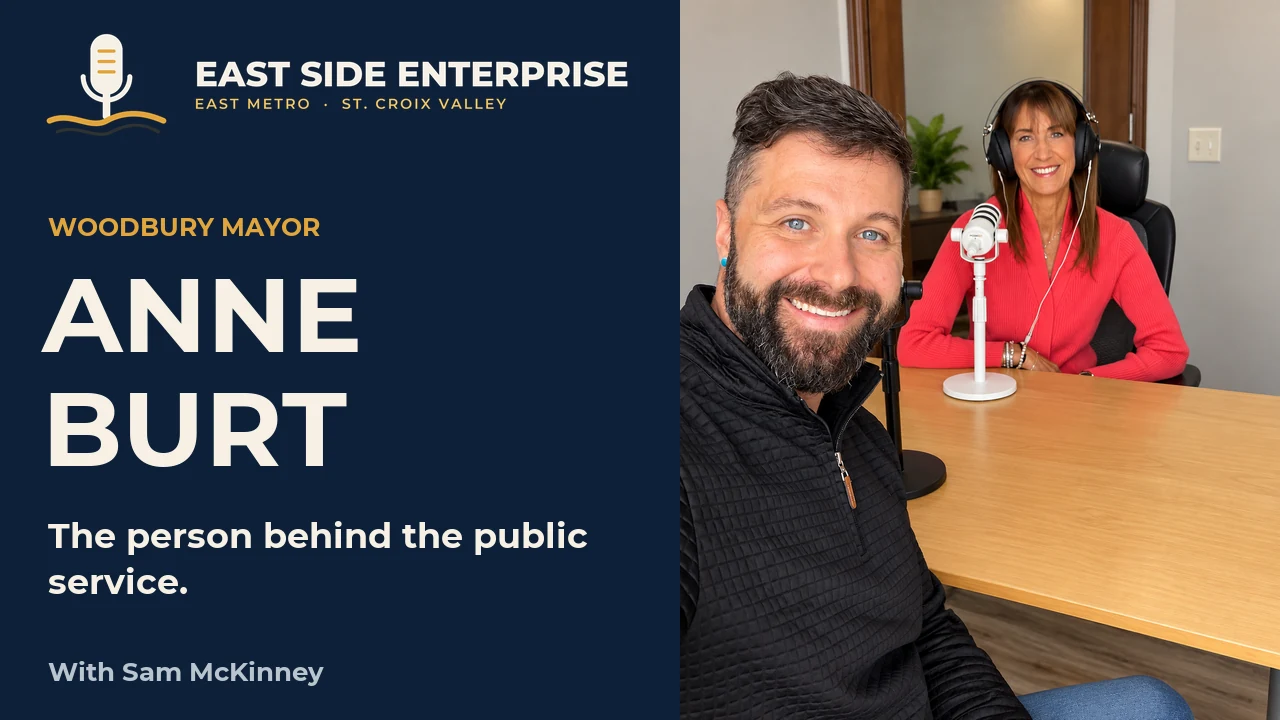
Woodbury Mayor Anne Burt loved the career she had built in the water industry. Leaving full-time corporate work to be more present for her three young children was a difficult decision. In our conversation on East Side Enterprise, she describes that turning point, the part-time consulting she continued, and the school and neighborhood involvement that became part of her family’s life.
Her interest in contributing to Woodbury also grew into public service. Anne talks about parks and planning commissions, the decisions behind long-term infrastructure, and the work of leading a city through difficult circumstances. Her gratitude for residents’ trust connects those responsibilities to the community where she raised her family. The conversation gives room to both the personal choice and the public work that followed.
Scroll to see all columns
| Phase | What it involved |
|---|---|
| Career | Water treatment and water quality work |
| Parenting and consulting | More family time, with part-time professional projects |
| Community involvement | Schools, youth activities, parks, and planning |
| Public service | City leadership and shared community work |
A career she loved, and a family decision
Before the move, Anne had built a professional life that drew on both technical and business skills. She earned a B.S. in chemistry from the University of Dayton and an MBA from Johns Hopkins University. Her account of working in water quality also included the experience of being a woman in a male-dominated professional setting. She said that advancing in a large company and pushing against a glass ceiling mattered to her. The campaign site’s experience list describes more than 30 years in industrial, commercial, and drinking water quality.
Anne said, “I loved my work. I loved everything I did.” Her work used her creative, management, and marketing skills alongside her technical background. That made her decision difficult. When her husband, Jeff, accepted a job in St. Paul, their children were young, and Anne said she and her husband saw a need to parent them more closely. She spoke appreciatively about the help their family had received, while explaining that as the children grew, the parents wanted to be more present themselves.
Anne described giving up the full-time career fulfillment and advancement she had worked toward, then taking a couple of years to adjust. She maintained her professional life through part-time consulting when the children were in school. She also became active in school activities, youth sports, and community groups. As she put it, “My biggest success in life is raising those kids along with my husband.”
Anne speaks with affection about the work she had done and gratitude for the different paths she and her husband, Jeff, were able to take. His continued career helped support the family while she changed the rhythm of her work. The satisfaction of raising their children and contributing locally developed alongside an adjustment that she describes as difficult.
Keeping a professional identity while changing priorities
The change was larger than a different work schedule. Anne had valued the creativity, management, marketing, and technical skills her role required. She had also cared about advancement in a field where few women shared her role. Choosing a different rhythm meant finding satisfaction in work that looked different from the career she had known.
Consulting remained part of that life. She describes taking projects through professional contacts and doing the work while her children were in school. At home and in the community, her energy found other outlets: joining an HOA board, organizing around school boundaries, helping with school activities, coaching sports, and serving on an athletic association board. These were specific commitments to people and places she knew.
Sam shares a turning point of his own. Work travel had left him feeling disconnected from his family and community. He describes telling his wife that he needed to change, then wanting to help build the place where they were raising their children. Their experiences are different, but both give the conversation a personal question: how do you want your work and your daily life to fit together?
Anne’s answer also returns to relationships. Later in the episode, she talks about wanting to spend time with people she cares about. Family, professional fulfillment, and connection continue to matter in her account of what makes a life meaningful.
From neighborhood involvement to city planning
Community participation gave Anne a way to use her energy and leadership close to home. She mentioned neighborhood involvement, school and youth activities, homeowners association work, and athletic association boards. She also paid attention to local government, reading about what the city was doing and wondering how she could contribute to a place where her family was putting down roots.
Her first city appointment was to the Parks and Recreation Commission, where her interest in parks and trails connected with how her family spent time in Woodbury. Later she applied to the Planning Commission. She described its work in practical terms: considering how the city grows and develops, where different uses belong, and what kinds of retail or industry fit. She also served on the 2040 Comprehensive Plan Task Force, a longer process that considered land use, housing, water, and transportation. The work gave her a practical role in shaping the future of the place her family called home.
Anne connects that work to her earlier experience with strategic planning in companies and athletic associations. She says that background helped prepare her for decisions about how a city grows. Choices about treatment facilities, pipes, parks, and roads have consequences far beyond a single meeting. Her account gives the public-service chapter substance: experience and involvement become responsibilities for the place where people live.
Explaining infrastructure through disruption
That long view becomes especially visible when a project disrupts daily routines. Anne discussed Woodbury’s permanent water treatment plant, pipelines, and road closures. She acknowledged residents’ frustration and described communicating why the work was happening and how it connected to the city’s water system.
The City of Woodbury says the permanent plant is under construction, with operation expected in 2028. Its water treatment project page describes the project and its system improvements. Those details provide context for the scale of the work, while Anne’s interview conveys the public-facing challenge: residents encounter closures and construction now, while infrastructure planning considers needs over many years. She emphasized communicating that short-term disruption was tied to a long-term public project. For residents dealing with closures, her acknowledgment of the frustration sits alongside the explanation of what the work is intended to accomplish.
Anne also reflected on leading during COVID and other emergencies. She credited city staff and the community for adapting together. Public safety, emergency medical services, fire, and public works still had to function under extraordinary constraints. She described the response as shared work by colleagues, staff, and residents.
That emphasis on shared work also appears in her comments about maintaining city assets. Anne described staff analyzing the useful life and replacement needs of trails, baseball backstops, and other facilities. Planning for those costs is part of caring for what residents already depend on.
Later, Anne speaks about the gratitude she feels for people trusting her with the work of leading Woodbury. In her words, “People trust me to do this work and to lead this community.” Sam responds by recognizing that communities rely on people willing to take on public service, even when others do not have the time, ability, or desire to do it themselves. The exchange gives each perspective its own place: Anne’s sense of responsibility and Sam’s appreciation for the people who step forward.
Collective service beyond City Hall
Anne’s community work also extends beyond formal city roles. She described involvement with the Woodbury Community Foundation and the Lions Club, as well as a local Power of 100 Women effort. The Woodbury Community Foundation’s program page identifies Anne Burt, Gab Yacovella, and Kelly Lindstrom as founders. The initiative is designed to combine individual donations into support for a local nonprofit while helping participants learn about community needs.