
Dental Practice Marketing: Help More Patients Find You
Sam McKinney
Founder & Lead Strategist • October 6, 2026
Overview
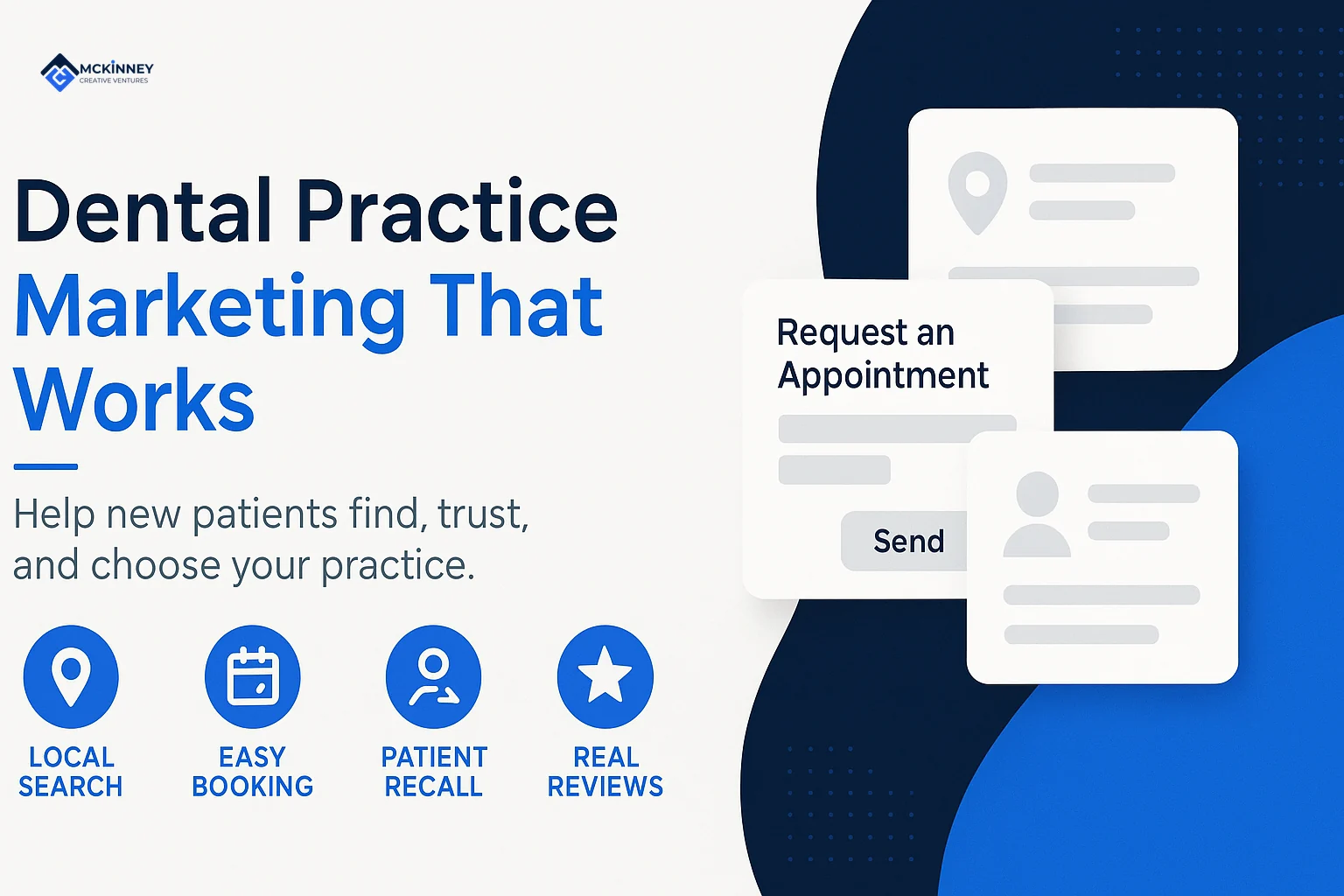
Dental practice marketing works best as one connected system for local search, trust, booking, and patient recall. Learn what to build, what to measure, and where privacy rules belong.
Dental practice marketing is the system that helps the right local patients find your practice, understand whether you provide the care they need, trust what they see, and take a clear next step. It is not one ad campaign, a weekly social post, or a collection of disconnected tactics.
For an independent dental office in the Twin Cities East Metro, St. Croix Valley, or western Wisconsin, the strongest plan connects local search, a useful website, patient reviews, appointment handling, and recall. Each part should make the next decision easier without making medical claims, exposing patient information, or promising results the practice cannot guarantee.
Dental practice marketing starts with the patient decision
A prospective patient is rarely evaluating marketing as marketing. They are trying to answer practical questions. Is the office close enough? Does it offer the service I need? Is it accepting appointment requests? Does the experience look organized? Can I understand the next step without sharing sensitive information in a public form?
Your marketing system should answer those questions in the order they appear. Search earns visibility. The business profile and website establish relevance. Reviews and clear practice information build confidence. A phone call or appointment request creates the handoff. Follow-up and recall help the practice maintain the relationship after the first visit.
When those steps are managed separately, the patient feels the gaps. An accurate profile can lead to an outdated service page. A polished site can send a request into an inbox nobody owns. A review campaign can create public responses that reveal more than the practice should say. The goal is not more activity. It is a clear path from discovery to care.
Build local visibility on accurate practice information
Most local dental searches contain a location decision even when the city is not typed. Google explains that local results are mainly based on relevance, distance, and prominence in its local ranking guidance. Google also says complete and accurate profile information helps it match a business to relevant searches.
That makes accuracy the first job. The practice name, address, phone number, hours, primary category, appointment link, and services should agree across the Google Business Profile and the website. If the office has holiday hours, a temporary closure, or a changed phone workflow, update the source patients actually see. Do not create extra locations, practitioner profiles, or service claims simply to cover more keywords.
Build service content around what the practice genuinely provides. A page for emergency dental care, implants, pediatric care, or cosmetic dentistry is useful only when that service is available and the page explains the real patient process. Thin pages that swap city names do not help someone decide whether to call. A focused local SEO and AI search strategy should make verified practice information easier for both people and search systems to understand.
Turn the website into a patient decision tool
A dental website does not need to answer every clinical question. It needs to help a visitor decide whether the practice is a reasonable fit and what to do next. The home page should identify the practice, location, core services, and appointment path quickly. Service pages should explain who the service is for, what the first step involves, and when the patient should call instead of relying on a form.
Use plain language before technical language. A patient may search for a symptom, a procedure, an insurance question, or a nearby dentist. Organize the site around those real decisions, while keeping diagnosis and treatment decisions with the clinical team.
| Patient decision | What the practice should make clear |
|---|---|
| Can this office help? | Services actually offered, patient types served, and when to call for guidance. |
| Is it practical for me? | Location, hours, phone number, accessibility details, and the real appointment process. |
| Can I trust the experience? | Provider information, current photos, genuine reviews, and clear expectations for the first visit. |
| What happens next? | One visible call or appointment request path, a confirmation step, and an owner for follow-up. |
| How do I return? | A documented recall, rescheduling, and ongoing communication process handled through approved systems. |
On mobile, the phone number and primary appointment action should be easy to find without hunting through a menu. Forms should ask only for information the practice has decided it needs and is prepared to protect. A conversion-focused dental practice website should reduce uncertainty, not turn a public marketing page into an intake record.
Build a review process that protects trust
Reviews help prospective patients understand the experience of working with a practice, but the process needs neutral rules. Google's review guidance says reviews should reflect genuine experiences and prohibits incentives in exchange for reviews. Do not offer a discount for a five-star review, filter requests so only happy patients receive them, or ask staff and vendors to pose as patients.
A sound process asks eligible patients for honest feedback at a consistent point in the relationship. The request should be simple, optional, and easy to stop. The practice should also decide who monitors new reviews and how quickly a concern moves into a private service-recovery process.
Public replies deserve extra care. A reviewer can disclose their own experience, but that does not mean the practice should confirm treatment, appointment status, or a patient relationship in its response. Keep the public reply general, thank the reviewer for the feedback, and invite an appropriate private conversation. The clinical and privacy team should approve the response policy before automation is added.
Connect appointment requests to accountable follow-up
A website form or ad does not create a new patient. It creates a request that someone must handle. Decide where calls, form submissions, chat requests, and profile appointment clicks go. Assign ownership, define what counts as a completed follow-up, and make the status visible.
The handoff can be supported by a CRM and automation system, but the dental practice management system and approved clinical tools still matter. The marketing system should not become an uncontrolled copy of patient records. Use the minimum information needed to route the inquiry, and establish which system is authoritative for appointment and patient data.
Automated confirmation can acknowledge that a request arrived and explain when the office will respond. It should not claim that an appointment is confirmed when the schedule has not accepted it. If the office offers online scheduling, test the complete path on a phone and verify what happens when the requested time is no longer available.
Use recall and reactivation with a privacy review
Some recall communications support an existing care relationship, but that does not make every recall or reactivation campaign a treatment communication. This is an area where marketing, treatment communication, consent, and protected health information can overlap. Those classifications should not be guessed by a marketing automation.
The federal HIPAA regulation says a covered entity generally must obtain authorization for uses or disclosures of protected health information for marketing, subject to stated exceptions. The current rule appears in 45 CFR 164.508. This article is not legal advice, and the exact treatment of a reminder depends on its purpose, content, data, channel, and applicable law.
Before launching recall or reactivation, have the practice's privacy and compliance owner approve the audience rules, message templates, systems, vendors, and opt-out handling. Keep the message discreet. Avoid putting treatment detail in a subject line, preview text, voicemail, or text notification. Record preferences and suppression centrally so one campaign cannot override them later.
Start with one documented workflow, such as an approved reminder or an incomplete appointment request. Test it with authorized internal records, confirm every error path, and verify that replies reach a person. The goal is a dependable patient communication process, not the largest possible send.
Measure the path to a kept new-patient appointment
Marketing reports should separate attention from operational outcomes. Search visibility, profile actions, ad clicks, calls, and form submissions describe different stages. None of them alone proves that a new patient arrived.
Define the stages the practice can verify without moving protected details into unnecessary systems. A practical sequence may include qualified inquiry, appointment request, booked appointment, kept appointment, and approved attribution category. Report unknown attribution as unknown. Do not force every appointment into a marketing source when the evidence is missing.
Review the system monthly by asking where people stop. If local visibility is weak, improve accurate profile and service information. If traffic arrives but requests do not, inspect page clarity and friction. If requests arrive but appointments are not booked, inspect the handoff. If patients book but do not return, the problem may be recall operations rather than advertising.
Build the system in the right order
- Verify the practice record. Confirm location, hours, categories, services, phone routing, and appointment options.
- Fix the decision pages. Make core services, provider information, trust signals, and next steps clear on mobile.
- Own the inquiry handoff. Route every call and request, acknowledge receipt accurately, and assign follow-up.
- Standardize reviews. Ask neutrally, monitor consistently, and use a privacy-safe response policy.
- Approve recall workflows. Review purpose, data, vendors, consent, message content, and suppression before launch.
- Add paid demand last. Advertise only after the website, phone process, scheduling path, and measurement can handle it.
This order protects the budget. Buying more clicks before the practice can convert and follow up with existing demand usually makes the leak larger. Fix the path first, then add traffic where capacity and service fit are clear.
Extended Recap & Conclusion
Dental practice marketing works when local visibility, website clarity, patient trust, appointment handling, and recall operate as one accountable system. Accurate information helps patients find the office. Useful pages help them decide. Genuine reviews strengthen confidence. Clear follow-up turns a request into a real scheduling conversation.
The practice should build that system around verified services, real capacity, privacy controls, and measurable stages. Start with the patient path, repair the weakest handoff, and add promotion only when the operation can support it.
Frequently Asked Questions
What is the best marketing strategy for a dental practice?
The best strategy connects accurate local search information, clear service pages, genuine patient reviews, an easy appointment path, accountable follow-up, and approved recall. The right channel mix depends on the practice's services, location, capacity, and current patient process.
How can a dentist improve local search visibility?
Keep the Google Business Profile complete and accurate, align it with the website, publish useful pages for services actually offered, maintain consistent contact information, and earn genuine reviews. Distance cannot be optimized away, so focus on relevance, accuracy, and prominence.
Should a dental office ask patients for Google reviews?
A dental office can ask eligible patients for honest reviews through a consistent process. Do not offer incentives for a particular rating, pressure patients, or publicly confirm treatment details when replying. Have the practice approve a privacy-safe request and response policy.
Can a dental practice automate recall messages?
Automation may support approved reminders and recall, but the practice should review the purpose, protected information, consent, vendor access, channel, message content, and opt-out process first. Marketing automation should not decide HIPAA classification on its own.
What should a dental marketing report measure?
Separate visibility, clicks, calls, appointment requests, booked appointments, and kept new-patient appointments. Use only attribution the practice can verify, protect patient information, and label unknown sources honestly.
If your dental practice needs a connected plan for search, website conversion, follow-up, and measurement, book a free strategy call with McKinney Creative Ventures.
Written by
Sam McKinney
Founder & Lead Strategist, McKinney Creative Ventures
Sam McKinney helps local service businesses across the Twin Cities East Metro and St. Croix Valley grow through connected marketing systems. Websites, SEO, CRM, and AI automation built to work together instead of in isolation.
More about MCVRelated Articles
Customer Reactivation Campaign: Revenue in Your Database
A customer reactivation campaign turns accurate service history into relevant outreach. Learn how to segment past customers, choose the right timing, respect opt-outs, and measure actual booked work.

Landscaping Marketing in Minnesota: Win the Short Season
Landscaping marketing works best when spring demand, summer routes, fall renewals, and winter planning operate as one system. Build a Minnesota strategy that keeps crews productive without chasing every lead.
Ready to Grow Your Business?
Book a strategy call to discuss how we can implement these systems and strategies to help your business scale.
Book a Strategy Call