
Customer Reactivation Campaign: Revenue in Your Database
Sam McKinney
Founder & Lead Strategist • September 29, 2026
Overview
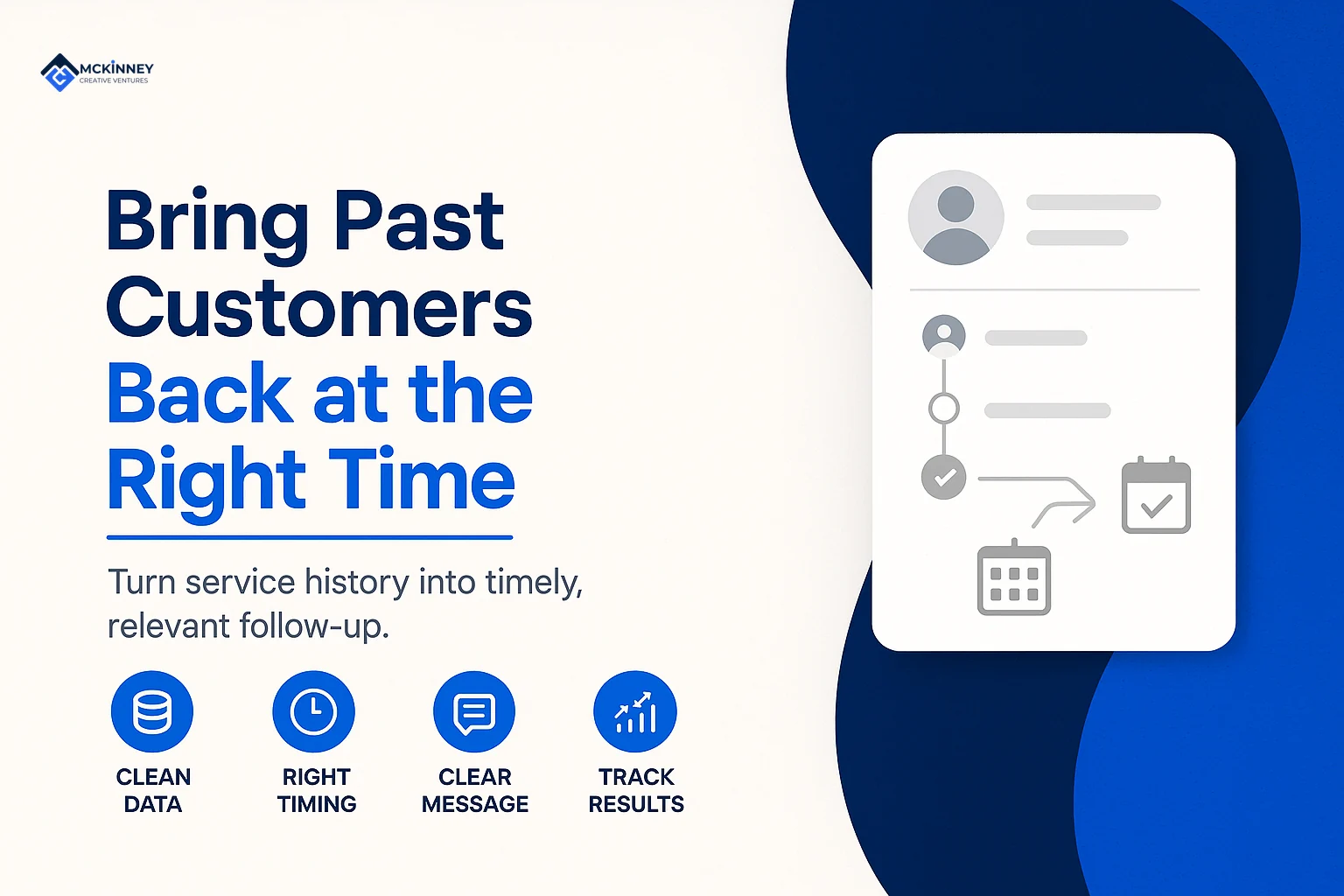
A customer reactivation campaign turns accurate service history into relevant outreach. Learn how to segment past customers, choose the right timing, respect opt-outs, and measure actual booked work.
A customer reactivation campaign is a focused effort to reconnect with past customers who have a relevant reason to return. It starts with accurate records, a meaningful service interval or customer event, and one clear next step. It is not a mass message sent to every old contact.
For a local service business, the database may contain completed jobs, seasonal services, unbooked recommendations, old estimates, and customers whose next need is predictable. Those records can support useful outreach, but only when the business knows what happened, why the message is relevant, and whether the contact is eligible for that channel.
A customer reactivation campaign starts with timing, not a blast
The central question is not, "How old is this contact?" It is, "What should reasonably happen next in this customer relationship?" A furnace tune-up, exterior cleaning, annual inspection, recurring treatment, and one-time remodel all operate on different timelines. A single rule such as "contact everyone after six months" ignores the work that was actually completed.
A 2023 peer-reviewed paper on timing customer reactivation initiatives modeled both a customer's typical time between purchases and the variation in that pattern. The study was not about local service businesses, so it should not be treated as a promise of results here. The useful principle is broader: a customer becomes meaningfully overdue relative to their own pattern and service context, not because every record crossed the same calendar date.
For a small business, that does not require a complex prediction model. Start with service categories and documented dates. Define the normal next event for each category, then create a review queue for customers approaching that window. The campaign becomes a timely reminder instead of a generic attempt to wake up an old list.
Clean the customer records before writing the message
Reactivation quality depends on record quality. If the CRM cannot distinguish a customer from a lead, a completed job from a canceled one, or an active service plan from a lapsed relationship, automation will scale the confusion.
Review the systems that already hold customer history: the CRM, scheduling platform, estimating tool, invoices, and service notes. Decide which system is authoritative for contact details, completed work, consent, and suppression. Then identify the minimum fields the campaign actually needs.
- Customer identity: One usable record for the person or business, with duplicates resolved.
- Completed service: The category and completion date, recorded without inventing missing detail.
- Next relevant event: A renewal, maintenance window, related service, or documented follow-up.
- Channel eligibility: The consent and opt-out state for email, text, or calls.
- Outcome: Reply, appointment, estimate, completed work, decline, or no response.
A connected CRM and automation system can keep those fields together and create the review queue. It should not fill gaps with assumptions. When a service record is unclear or a contact has opted out, the correct automated action may be no outreach at all.
Build segments from real service events
The useful segment is usually smaller than the marketing list. Group customers by the work they received and the next need that can be supported by the record. A seasonal service may justify a preparation reminder. A completed installation may support a maintenance check-in. A customer who asked about a related service may receive information about that service if the interest was actually documented.
Keep the first segmentation model simple enough to maintain. Service category, last completed date, territory, open recommendation, and communication status are often enough. Add complexity only when it changes the message or decision.
Do not confuse a lead-nurture sequence with reactivation. An unclosed estimate may need a direct question about whether the project is still planned. A past customer needs recognition of the existing relationship and a reason tied to prior work. Our guide to lead follow-up automation covers the earlier stage, when an inquiry has not yet become a customer.
Use a planning matrix before building automation
| Customer group | Review and record |
|---|---|
| Prior seasonal customer | Review when a new planning window opens. Record the reply, appointment, decline, or no response. |
| Customer with recurring maintenance | Review as the expected service interval approaches. Record a booked visit, later date, or not needed. |
| Customer with a documented recommendation | Review the open next step in the service record. Record an estimate, question, decline, or completion. |
| Contact with uncertain history | Hold marketing until the record is resolved. Correct, merge, or suppress the record. |
This table is a decision tool, not a promise that every segment should receive a campaign. Before launch, confirm that the reason still fits the business, the service is available, and the customer is eligible for the chosen channel.
Write one relevant message with one clear next step
A reactivation message should answer three questions quickly: who is contacting me, why is this relevant now, and what can I do next? The customer should not have to decode a broad newsletter or click through several pages to understand the request.
Reference the service category only when the record supports it. "We completed your annual inspection last fall" is useful if that date and service are accurate. "It is time to replace your system" is not appropriate when the business has not assessed the equipment. The message can invite a conversation without pretending the conclusion is already known.
Choose one next step that matches the campaign. That may be replying with a question, requesting an estimate, choosing an appointment window, or reviewing current service information. If the business cannot respond promptly or the schedule is already full, delay the campaign or narrow the segment. Reactivation that creates a new backlog without an owner is not a working system.
Offers are optional. A useful reminder, timely availability, or easier scheduling can be enough. If a discount is used, document the terms and make sure the team can honor it. Do not manufacture urgency or claim that a customer asked for something the record does not show.
Treat consent and opt-outs as operating data
Past-customer status is not a blanket permission to send any message through any channel. Email, text, and calls have different requirements, and state rules may add obligations. This article is operational guidance, not legal advice. Before activating a campaign, confirm the current rules and the evidence your business keeps.
For promotional email, the Federal Trade Commission's CAN-SPAM compliance guide specifically says commercial email can include a message to former customers. It requires accurate sender information and subject lines, identification of the commercial nature of the message, a valid physical postal address, a clear opt-out method, and honoring an opt-out within 10 business days. The guide also warns that calling a message relational does not automatically make it exempt.
For automated texts and calls, do not infer consent from a completed job alone. The Federal Communications Commission's 2024 consent-revocation order explains that a consumer may revoke consent by a reasonable method that clearly communicates a desire to stop. It also limits any final confirmation text to a single message without marketing content. Because requirements vary by message type, technology, consent record, and jurisdiction, review the live campaign with qualified counsel when the classification is uncertain.
Operationally, the safest workflow is immediate suppression. Record the opt-out on the main contact, stop the active sequence, and make that status available to every future campaign. A suppression field hidden inside one automation is not enough if another list can ignore it next month.
Run a small campaign and measure business outcomes
Start with one service segment and one message. A small launch makes wrong numbers, duplicate contacts, confusing copy, broken links, and handoff problems visible before they affect the full database.
- Record the audience. Save the inclusion rules and the number of eligible contacts without exporting more customer data than necessary.
- Test the workflow. Confirm sender identity, links, replies, appointment routing, opt-out handling, and ownership of every response.
- Launch in a controlled batch. Watch for incorrect records, complaints, and unexpected replies before expanding.
- Reconcile the outcome. Connect the campaign to inquiries, appointments, estimates, completed work, declines, and suppressions when the business can do so reliably.
Delivery, opens, clicks, and replies are signals. They are not booked revenue. A reply may be a request to stop. A click may not become an inquiry. Report each stage separately, then use completed work or collected revenue only when the records genuinely connect. Our guide to marketing ROI tracking explains how to keep platform activity separate from qualified leads and business outcomes.
Make reactivation a maintained process
The long-term value comes from the process created after each job. When work is completed, record the service, outcome, relevant future interval, communication status, and next owner. That gives the business a reliable next action instead of another name in an undifferentiated list.
Review the process on a schedule that matches the business. Seasonal companies may prepare before each demand window. Maintenance businesses may review upcoming service intervals every week. Project businesses may use a documented recommendation or anniversary as the trigger. The calendar can start the review, but the customer record decides whether outreach is appropriate.
Automation should handle repeatable movement: selecting eligible records, scheduling approved messages, stopping on replies or opt-outs, creating tasks, and preserving campaign attribution. A person still owns service fit, capacity, exceptions, and the response. That balance keeps the system consistent without pretending every customer relationship is identical.
Extended Recap & Conclusion
A customer reactivation campaign works when it reconnects accurate history to a relevant next need. Clean the records, define service-based timing, choose one useful segment, write one clear message, verify channel eligibility, and measure what happened after the send. The database is not valuable because it is large. It is valuable when the business can trust and act on it.
Start smaller than feels necessary. One well-defined segment will teach you more than a generic blast, and it creates a process the business can improve without sacrificing customer trust.
Frequently Asked Questions
What is a customer reactivation campaign?
It is targeted outreach to prior customers who have a relevant reason to consider another service, renewal, maintenance visit, or conversation. The campaign should use documented history, an appropriate channel, and a clear next step.
How long should a business wait before contacting a past customer?
There is no universal interval. Base the timing on the service cycle, the customer's documented history, current capacity, and the reason for the message. A seasonal service and a one-time project should not share the same trigger.
Can a business text past customers?
Do not assume past-customer status alone creates permission. The answer depends on the message, technology, consent record, and applicable federal and state rules. Confirm eligibility before sending, preserve evidence of consent, and stop promptly when a recipient opts out.
Does promotional email to former customers need an unsubscribe option?
Commercial email generally must follow CAN-SPAM requirements, including a clear opt-out method and timely handling of opt-out requests. The FTC guide specifically includes promotional email to former customers within its discussion of covered commercial messages.
How should a small business measure customer reactivation?
Track replies, qualified inquiries, appointments, estimates, completed work, declines, and opt-outs when those outcomes can be reliably connected to the campaign. Keep delivery, opens, and clicks separate from revenue or completed jobs.
If your customer history is scattered across tools or follow-up happens only when someone remembers, book a free strategy call. We will map the records, triggers, and handoffs needed for a practical reactivation system.
Written by
Sam McKinney
Founder & Lead Strategist, McKinney Creative Ventures
Sam McKinney helps local service businesses across the Twin Cities East Metro and St. Croix Valley grow through connected marketing systems. Websites, SEO, CRM, and AI automation built to work together instead of in isolation.
More about MCVRelated Articles
Marketing ROI Tracking for Local Service Businesses
Marketing ROI tracking works when every lead source connects to qualified opportunities and closed revenue. Build a practical measurement system for calls, forms, CRM stages, and smarter budget decisions.
Missed-Call Text-Back: The Easiest Lead You Are Not Capturing
When a service business misses a call, the caller usually dials the next name on the list. Missed-call text-back closes that gap automatically. Here is how it works, the math of recovered jobs, and the 2026 rules that keep your texts landing.
Ready to Grow Your Business?
Book a strategy call to discuss how we can implement these systems and strategies to help your business scale.
Book a Strategy Call