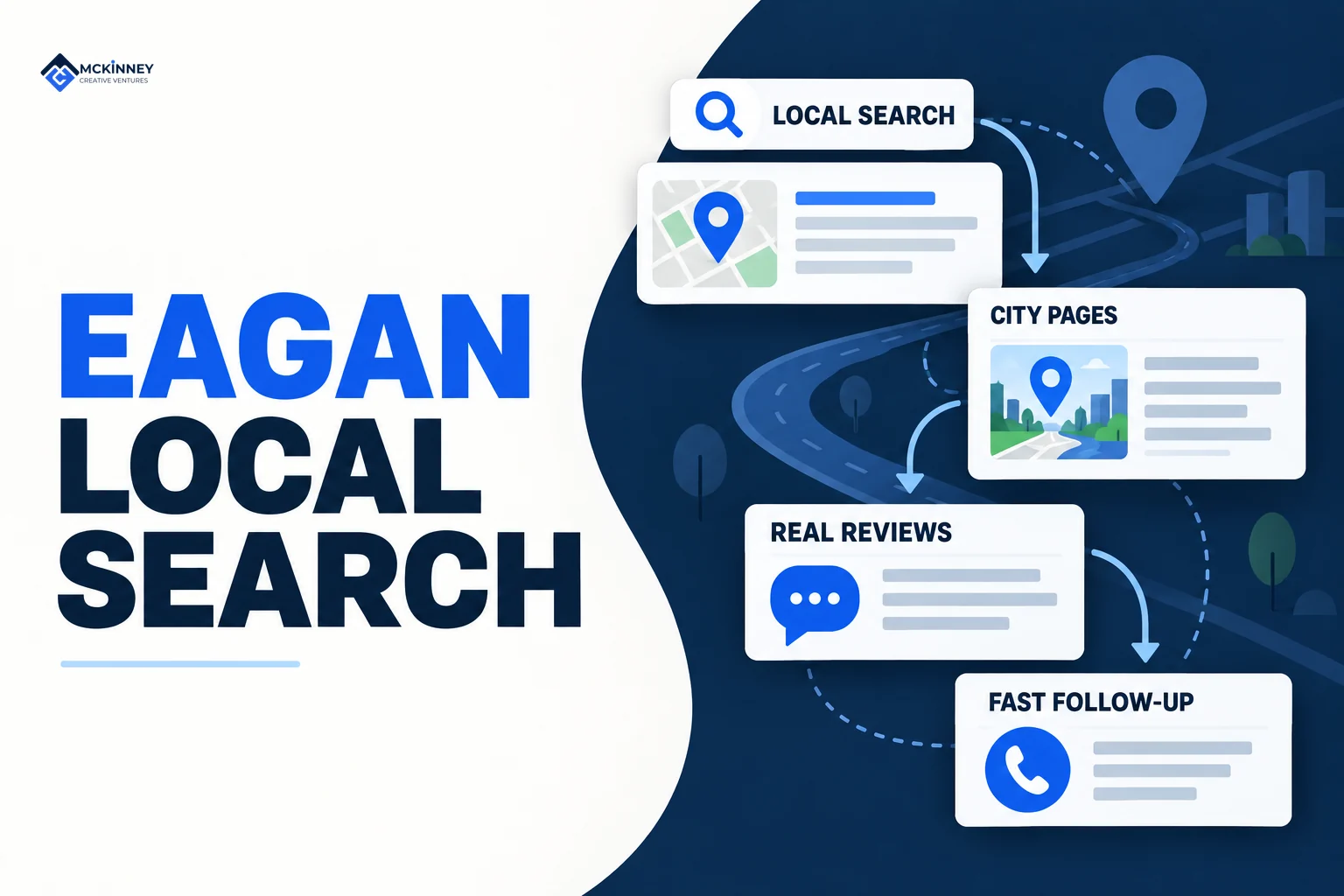
Eagan MN business marketing should help a nearby customer answer four questions quickly: Do you offer what I need? Do you genuinely serve Eagan? Can I trust the business? What happens when I call or submit a request?
The strongest local strategy connects accurate business information, useful city and service content, real customer proof, a clear website path, and accountable follow-up. A city name in a page title is not a strategy. The business must prove local relevance and make the next step easy.
Eagan MN business marketing starts with local intent
Eagan is part of a connected south-metro market. A customer may live in Eagan, work nearby, compare providers across city lines, and search without typing a city at all. The search could be a service, a problem, or a phrase such as "near me." Your marketing has to match that intent without pretending every searcher sees the same results.
Google explains in its local ranking guidance that local results are mainly based on relevance, distance, and prominence. Relevance is how well the business matches the search. Distance reflects where the searcher is relative to the business. Prominence reflects how well known the business is, including signals such as links and reviews.
That framework matters because only part of local visibility is directly controllable. You can improve how clearly your services are described, keep business information accurate, earn genuine reviews, build useful pages, and strengthen the business's reputation. You cannot optimize away the physical distance between a searcher and your real location.
A practical local SEO and AI search strategy therefore starts with the searches the business can credibly satisfy. Define the services you want, the Eagan customers who need them, and the actual area your team can serve well. That keeps the plan grounded in operations instead of a list of city keywords.
Build the Google Business Profile around accuracy
Your Google Business Profile is often the first complete view of the business. The name, category, address or service area, hours, phone number, website, services, photos, and reviews should describe the same company a customer encounters after clicking.
Start with the real-world business name. Choose the most specific primary category that describes the core business. Add only relevant secondary categories. Keep regular and holiday hours current. Route the listed phone number to a person or process that can handle the inquiry. Link to the page that best continues the customer's task.
Service-area businesses need extra discipline. Google's service-area guidance says businesses that do not serve customers at their address should remove that address from the public profile. It also says service areas are entered as cities, postal codes, or other defined areas, not as a radius, with up to 20 areas available.
Adding Eagan as a service area does not guarantee Eagan rankings. It tells customers where the business operates. The profile still needs accurate categories, strong relevance, genuine reputation, and a real connection between the business, its website, and the work it performs.
- Keep one authoritative record. Decide who owns profile changes and where approved business information is documented.
- Use real categories and services. Do not add a service simply because it has attractive search volume.
- Show current work. Add useful photos that reflect the business, team, equipment, location, or completed work when customer permission allows.
- Handle reviews consistently. Ask for honest feedback, monitor new reviews, and respond without inventing context.
- Test every contact path. Confirm that calls, website clicks, and appointment links reach the intended destination.
Create Eagan content that earns its place
A useful Eagan page is not the Woodbury page with a different city name. It should answer what changes for an Eagan customer. That may include the services available there, how scheduling works, what types of properties or businesses the company serves, where the team travels from, and which nearby areas are part of the same route.
Only publish claims you can verify. If the business does not have an Eagan office, do not imply that it does. If a featured project happened elsewhere in the metro, label it as regional proof instead of presenting it as an Eagan customer. If there is no local testimonial, leave it out rather than manufacturing one.
City-specific content should also help someone make a decision. A homeowner needs to know whether the company handles the relevant service, how to request help, and what information to prepare. A commercial buyer may need service coverage, scheduling expectations, documentation, and a clear contact. The page should reduce uncertainty, not merely repeat the keyword.
Scroll to see all columns
| Local signal | What it should prove |
|---|---|
| Business Profile | The business is accurately represented, reachable, and eligible to serve the stated area. |
| Eagan page | The service is genuinely available in Eagan and the page answers city-specific customer questions. |
| Service pages | The company performs the work and explains the process, fit, and next step clearly. |
| Reviews and proof | Real customers describe credible experiences without incentives or invented outcomes. |
| Follow-up system | Calls and forms reach an owner, receive a response, and move through a visible process. |
Use internal links to connect the Eagan page with the relevant service pages, helpful resources, and contact path. This creates a coherent journey for customers and gives search systems more context about how the pages relate.
Make the website prove local fit quickly
A search result earns attention, but the website has to carry the decision. On a phone, the first screen should identify what the business does, where it works, and the next action. The customer should not have to decode a slogan, close multiple popups, or search the footer for a phone number.
Strong local service pages usually include a direct description of the work, the customer or property types served, the real process, trust evidence, common questions, and one primary call to action. A conversion-focused small business website should make the business easier to evaluate, not simply look polished.
Proof belongs near the claim it supports. If the page says the company understands commercial properties, show a verified commercial example. If it emphasizes responsiveness, explain the actual inquiry process without promising a response time the team cannot consistently meet. If licensing, insurance, or certification matters to the service, display only current credentials and identify what they cover.
Mobile usability is part of local marketing. Test the page at a narrow width, tap every button, open the menu, submit the form with authorized test data, and check that the phone link calls the correct number. A page can rank and still fail if its next step is hard to use.
Use Eagan's business climate as context, not decoration
The City of Eagan reported results from its 2024 business survey showing that nine in ten respondents rated Eagan positively as a place to do business and nine in ten would recommend operating a business there. The city's published survey summary also says businesses value quality of life, city services, and ease of travel.
Those findings describe the community, not the performance of any individual marketing campaign. The useful takeaway is that Eagan has an active business environment where a service company must be clear about its fit. Generic metro-wide copy makes that harder. Specific service, area, and process information makes comparison easier for the customer.
Local context can improve a page when it affects the service. Travel routes, seasonal scheduling, property types, commercial districts, or municipal requirements may matter for some businesses. Include them only when they are relevant and verified. A list of landmarks added for keywords does not demonstrate expertise.
Connect visibility to a reliable response system
Local search does not end at the click. A call, form, chat, or booking request enters an operational system. If nobody owns that handoff, more visibility creates more missed opportunities.
Map every inquiry source to one destination and one accountable owner. Decide what information is required, how receipt is acknowledged, when a human reviews it, and how the status is recorded. A CRM and follow-up system can help, but the workflow should match the team's real capacity.
Automation should confirm what actually happened. A form acknowledgement can say the request was received. It should not say an appointment is booked unless the schedule accepted it. A missed-call text can offer a helpful next step. It should not create parallel conversations that nobody monitors.
Track the full path in separate stages: search visibility, website visit, qualified inquiry, booked appointment or estimate, completed work, and known source. Do not call all form submissions leads if many are spam or poor fits. Do not call every phone click a customer. Accurate stage definitions make weak handoffs visible.
Build the Eagan marketing system in order
- Verify the foundation. Confirm the business name, categories, location or service area, hours, phone, services, and website destinations.
- Choose the priority services. Focus on work the business wants, can deliver, and can describe with real expertise.
- Improve the decision pages. Build useful service and Eagan content with honest coverage, proof, common questions, and a clear next step.
- Standardize reputation work. Create a neutral review request, monitoring process, and response policy.
- Own the handoff. Route calls and forms into a visible process with clear responsibility and error handling.
- Measure by stage. Separate visibility, inquiries, bookings, and completed work so the report shows where improvement is needed.
- Add paid promotion deliberately. Use advertising after the profile, pages, response process, and measurement can support more demand.
This order protects the budget and the customer experience. It also makes diagnosis easier. If visibility is weak, inspect relevance and prominence. If visits do not become inquiries, inspect clarity and friction. If inquiries do not become booked work, inspect response and qualification.