
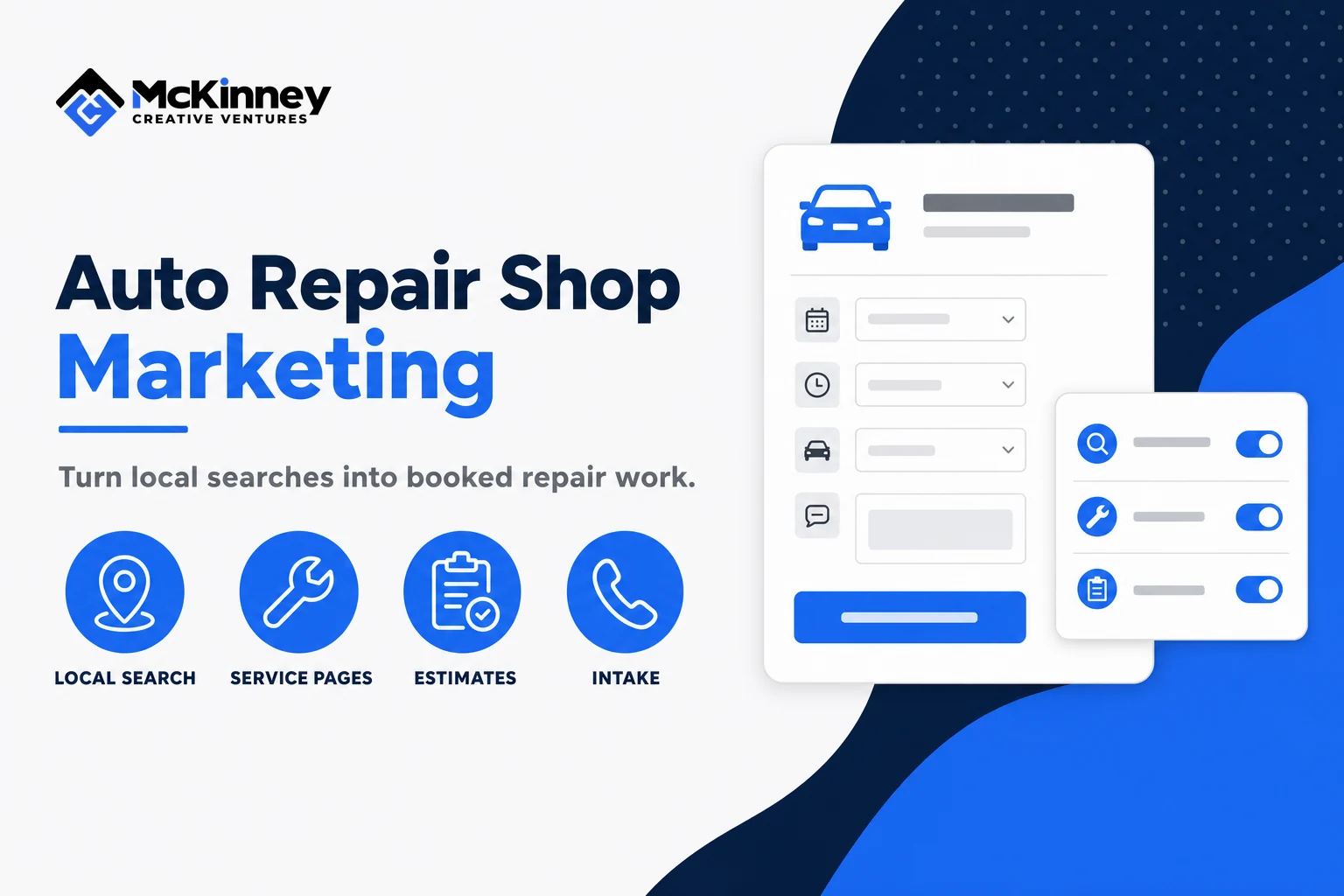
Effective auto repair shop marketing connects five parts of the customer journey: local discovery, service-specific proof, a clear estimate process, measurable call and form intake, and timely follow-up. When those parts share the same message and data, the shop can see which marketing creates real repair opportunities instead of counting every click or phone call as a win.
This guide is for independent mechanical and collision shops in the Twin Cities East Metro, St. Croix Valley, and western Wisconsin. It is a practical marketing framework, not legal advice or a promise that one channel will fill every bay. Demand changes by service, season, location, vehicle mix, insurer involvement, and shop capacity. The goal is to build a system that makes those differences visible.
Scroll to see all columns
| Customer moment | Marketing asset | Evidence to track | What it does not prove |
|---|---|---|---|
| Needs a nearby shop | Google Business Profile and local service page | Search query, profile action, landing page | That the person contacted the shop |
| Compares repair options | Service detail, process, credentials, and real photos | Page engagement and contact action | That the inquiry is qualified |
| Requests an estimate | Call, form, or appointment intake | Connected call, completed form, estimate request | That work was authorized |
| Approves service | CRM or shop-management disposition | Scheduled repair, authorized repair order | That marketing caused every part of the sale |
| Returns later | Service reminder and useful follow-up | Repeat appointment and customer history | That every reminder created the return |
Auto repair shop marketing starts with local discovery
Most repair searches begin with a problem and a place: brake repair near me, collision repair in Woodbury, transmission diagnosis in Stillwater, or a mechanic open now. Your Google Business Profile, website, and major directory listings should describe the same shop, location, hours, phone number, and services. Contradictory information creates friction for customers and weakens the evidence available to search platforms.
Google says local results are mainly based on relevance, distance, and prominence. Complete business information helps relevance, while links and reviews contribute to prominence. There is no way to request or pay Google for a better local ranking. That makes accurate categories, detailed services, current hours, real shop photos, and useful pages the starting point, not a shortcut or guaranteed formula. See Google's current local ranking guidance.
Make the profile and website agree
If the profile lists collision repair but the website only says full-service automotive, the customer has to guess whether the shop handles the actual need. Build clear pages for the services the shop truly performs and wants more of. A useful page explains the problem, the vehicles or situations the shop can handle, the inspection or estimate process, the service area, and the next step. Our local SEO and AI search work treats those pages as connected evidence, not isolated keyword targets.
Do not create dozens of thin city pages with the same paragraph and a swapped place name. Start with one strong service page for each distinct intent, then add location detail only when the shop truly serves that area and can provide useful local information. A mechanical repair page and a collision repair page should not be interchangeable. The questions, urgency, decision process, and proof are different.
Build service-page proof around the repair decision
A repair shopper is rarely looking for a clever slogan. The shopper wants to know whether the shop understands the problem, can explain the process, and offers a credible next step. Put the strongest relevant proof near that decision: actual facility and equipment photos, verified credentials, accepted repair categories, documented warranty terms if the shop publishes them, and genuine customer feedback the shop is authorized to use.
Separate mechanical and collision journeys when the shop offers both. Routine maintenance, warning-light diagnosis, and brake service often begin with a direct appointment or phone call. Collision work may begin with damage photos, an estimate question, insurer coordination, or towing logistics. The website should route each visitor into the appropriate intake rather than pushing every problem through one generic contact form.
Use plain language to explain what happens after the request. For example: the shop reviews the vehicle information, confirms whether the service fits, schedules inspection or diagnosis, and explains the next authorization step. That sequence is more useful than claiming world-class service. A focused website and conversion path should reduce uncertainty without promising a diagnosis before the vehicle is inspected.
Make estimate and authorization clarity part of the experience
Estimate language is not just an operations detail. It shapes whether a customer trusts the intake process. The website should explain how a request becomes an estimate, what information the shop needs, whether diagnosis may carry a charge, and when the customer will be asked to authorize work. The exact policy must match the shop's real process and current law.
Minnesota's Attorney General explains that the state's Truth in Repairs Act applies to covered repair work costing more than $100 and less than $7,500. Its consumer guidance says a customer may request a written estimate before repair work begins and generally limits charges above that estimate unless the shop provides an updated estimate and receives authorization. Review the full Minnesota Truth in Repairs guidance before publishing a shop policy.
Wisconsin's Department of Agriculture, Trade and Consumer Protection says repair shops must get authorization for repairs and offer an estimate or firm price quote when repairs will cost $50 or more. Its guidance also says the shop needs permission for an increase after providing an estimate or quote. Shops serving Wisconsin customers should confirm their process against the current Wisconsin motor vehicle repair guidance.
These state rules are different, and a marketing page should not collapse them into one regional promise. Use state-appropriate language, have the shop review it, and send legal questions to qualified counsel. Marketing can clarify the customer experience. It should not invent a compliance policy.
Measure calls and forms as intake, not completed repairs
Automotive lead generation is call-heavy, which makes call measurement useful and easy to overstate. Google Ads call reporting can use a forwarding number to record details such as call start time, duration, connection status, and whether a call meets a duration threshold selected by the advertiser. Google's call reporting documentation also makes clear that the forwarding number belongs to Google and should not be used outside its reporting system.
A long call is still not automatically a repair order. It might be an existing customer, a parts question, a vendor, an out-of-area request, a service the shop does not perform, or a price shopper who never schedules. Keep at least four stages separate: contact attempt, connected conversation, qualified estimate or appointment, and authorized work. If paid campaigns optimize toward the first stage while the business cares about the fourth, the platform can learn from the wrong signal.
Connect intake to a real disposition
Every new inquiry needs an owner and a next step. Record the requested service, vehicle basics, location, urgency, source, and final disposition in the shop's CRM or management system. Use a small set of consistent outcomes such as scheduled, estimate pending, not a fit, no response, and authorized. The labels should match how the shop actually works.
Then compare marketing sources using the same definitions. A campaign that creates fewer calls but more authorized work may be more valuable than one that produces a large volume of weak inquiries. Our CRM and automation work focuses on preserving that handoff, including missed-call recovery and follow-up that does not pretend an unqualified inquiry is revenue.
Use paid search to capture specific repair intent
Paid search is most useful when the campaign, keyword theme, ad, landing page, and shop capacity point to the same service. Separate campaigns for collision estimates, brake repair, diagnostics, maintenance, or other real priorities make budgeting and measurement clearer. Sending every click to the homepage hides which message and service created the request.
Before increasing spend, confirm that the destination page works on a phone, the call button reaches the correct line, the form succeeds, and the shop can handle the promised response. Add geographic limits that reflect where customers will realistically travel and where the shop wants work. Review actual search terms and negative keywords so the campaign is not paying for jobs, training, parts, do-it-yourself research, or services the shop does not offer.
Most importantly, send qualified outcomes back into the reporting process when the platform and privacy rules allow it. Our digital advertising approach distinguishes platform conversions from confirmed business results. That distinction protects the budget from looking successful merely because the phone rang.
Build a retention loop after the first repair
The first completed job creates information that can make future communication more relevant. With appropriate consent and accurate records, a shop can segment follow-up by vehicle, service history, recommended next step, or seasonal need. A reminder should help the customer act on a real maintenance or inspection need, not broadcast the same promotion to everyone.
Ask for honest feedback at a consistent point after service, then respond to reviews with care and without exposing private repair details. Use recurring questions from calls and reviews to improve service pages and FAQs. When the same uncertainty appears repeatedly, the marketing system should answer it before the next customer has to ask.
Retention reporting should stay grounded. A reminder sent is not a booked appointment. A booked appointment is not completed work. Track the return visit and the repair order separately, then compare repeat business by customer group and service type. The useful system closes the loop without assigning credit the evidence cannot support.
A practical implementation sequence for an independent shop
Start with one service line that matters to the business and can be measured. Confirm the profile, website page, phone number, hours, estimate language, intake owner, and final disposition. Test the full path on desktop and mobile. If any step breaks, fix it before adding traffic.
Next, document a baseline for the selected service: relevant profile actions, landing-page visits, connected calls or completed forms, qualified estimates or appointments, and authorized work. The numbers do not need to be impressive. They need to use stable definitions. Then improve the page and intake process, add or refine the campaign, and compare the same stages after enough real demand has accumulated.
Only after that first loop is reliable should the shop expand to another service or location. This keeps the work diagnostic. If every page, campaign, intake rule, and follow-up sequence changes at once, no one can tell which correction helped or what made performance worse.
If you want a connected marketing system that links local visibility to real shop outcomes, book a free strategy call. We will start with one service path and the evidence your shop already has.